




Sapp ready for Umno's 'gerrymandering' of seats
Sabah Peoples Progressive Party (SAPP) fully expects Umno to indulge in 'gerrymandering' of electoral seats in the state and has vowed to beat the ruling party at its own game.
Sabah Peoples Progressive Party (SAPP) fully expects Umno to indulge in 'gerrymandering' of electoral seats in the state and has vowed to beat the ruling party at its own game.
The party's backroom boys are hard at work figuring out the movements in the marginal seats and studying the electoral rolls for new trends.
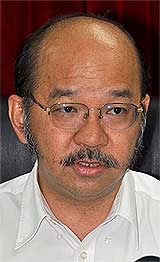 "Umno will try to improve their chances at the next polls by dividing its seats further into more seats. At the same time, it will lump together non-Umno seats to reduce the number of such seats," said Sapp president Yong Teck Lee tracing a scenario of the existing number of seats being 'rigged' in favour of Umno.
He was commenting on Sabah Chief Minister Musa Aman's statement in recent days that Umno was conducting a review of the state's electoral boundaries. Musa did not disclose what kind of review was being conducted and why the Election Commission should consider any such review.
Yong rules out an increase in the number of seats in the state for a number of reasons. He sees the prohibitive costs involved in such an increase as a major reason.
Elsewhere, he attributes the non-increase to the ruling coalition not having the necessary two-thirds majority in Parliament to amend the Federal Constitution to allow for any planned increase. Besides, the opposition alliance can be counted upon not to support any move in Parliament to increase the number of seats.
"Since they can't increase the number of seats, they can only re-draw the boundaries of existing seats," pointed out Yong. "Even here, they will be taking a big gamble which can backfire."
Of an estimated 150,000 illegal immigrants allegedly given MyKads and placed on the electoral rolls between 1970 and 1985 alone, it is said that quite a few may have returned to the Philippines and Indonesia or passed away.
Yong says his party will also be proceeding on the basis that Umno will re-draw the boundaries to take into account the near losses in the previous outing early in 2008.
Sapp plans to contest in 40 seats
Apparently, only the lack of a one-to-one pact among opposition parties in the state saved the BN from falling like ten-pins in at least 15 state seats and six parliamentary seats.
Next time, the opposition will be bolstered by the presence of Sapp which pulled out from the BN on Sept 17 last year. The party then cited loss of confidence in the federal leadership’s ability to give Sabah a fair deal.
Sapp plans to contest in 40 state seats but has not decided on the number of parliamentary seats.
The party is not put off by claims made by Umno and the Election Commission that 35 of the existing 60 state seats in Sabah have a Muslim majority. This includes Muslim KadazanDusunMurut (KDM). Of the others, 17 are considered non-Muslim KDM and eight Chinese.
The opposition in Sabah is against the Election Commission dividing the electoral rolls on the basis of Muslim Bumiputera, non-Muslim Bumiputera, Chinese and others. This, according to them, "masks the real picture and is a cover to include phantom voters in the Muslim Bumiputera category."
Sapp sees hope in that the Muslim-majority seats in Sabah are not a monolithic block. Besides the Muslim KDM, the other Muslim seats are divided among the Bajau, Suluk, Bugis and Barunai, "all of whom don't necessarily subscribe to the same kind of politics."
There are also differences, according to the party, between local Muslims and "other Muslims who parachuted in from outside the state."
"When we say 40, it's not based on our position of strength but on the principle of forming an autonomous state government," said Yong in disclosing that this stand has been officially conveyed to the Pakatan Rakyat. "We cannot have a party that wins less than the majority to form an autonomous state government."
Autonomy, according to Sapp, is an ideal subscribed to by all genuine Sabahans and the party sees this as its electoral trump card.
Yong pointed out that if Sapp and Pakatan win less than the majority, "Kuala Lumpur (assuming BN is still in power) will still decide who will be the chief minister in Sabah."
Prepared to work with Pakatan
Yong reiterated that Sapp won’t seek membership in Pakatan but is prepared to work together with the opposition alliance in defeating Umno in Sabah.
"They have not officially come back to us and we are also not pushing them for an answer," said Yong. "We are just saying that we are going for 40 seats, not the entire 60 seats as they feared, but it could be slightly more or even slightly less than our present target. 40 seats is just a rough guideline."
Winning 40 seats won't be easy, Yong concedes, and he sees a lot of training, preparing and hard work ahead for not just the party leaders but others at every level in time for the next general election. The focus here would be to ensure a high voter turnout among Sabahans to defeat "the phantom voters on the electoral rolls."
One key strategy adopted by the party is to get young Sabahans who are eligible to register as voters. An estimated 260,000 are said to be in this category. It is not known how many others are yet to register as voters.
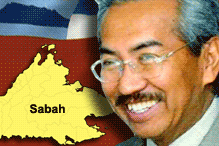 "We are not underestimating the BN machinery since they know that elections are not a forgone conclusion as in the past," said Yong. "They will not be complacent like before and will come out using every trick in the book to continue to stay in power."
Sapp, however, will institute mechanisms to ensure that the ruling coalition does not get away with fraudulent electoral practices including abuse of government machinery and bribing voters with money and government projects.
They are also counting on the NGOs to help monitor polling in Sabah "to ensure free and fair elections".
The last electoral boundary re-delineation exercise in Sabah was carried out by the Election Commission before the 2004 General Election. Then, the existing 48 state seats were increased to 60 and five new parliamentary areas created to make a total of 25 new seats.
It was the re-drawing of the electoral boundaries that brought the Parti Bersatu Sabah (PBS) to near defeat in 1994 and subsequently helped topple the state government under Joseph Pairin Kitingan.
Sapp, a PBS breakaway on the eve of the 1994 state elections, played a crucial role in bringing Umno to power in Sabah over Yong's dissatisfaction with Pairin.
Umno is said to have capitalised on the disunity among Sabahans in 1994 to bring it to power and entrench itself further.


Are you sure you want to delete this comment?
This action cannot be undone.