




Petronas not granting large subsidies to IPPs
It's a misconception that Petronas is granting large subsidies to Independent Power Producers (IPPs), Parliament was informed.
It's a misconception that Petronas is granting large subsidies to Independent Power Producers (IPPs), Parliament was informed today.
Energy, Green Technology and Water Minister Peter Chin Fah Kui said the government had stipulated that Petronas cannot sell gas beyond the market price to IPPs and Tenaga Nasional Berhad (TNB) in order to ensure electricity tariffs in the country remained low.
"The government, through Petronas, has decided that gas prices cannot reflect market prices as it is a valuable source of fuel for power generation.
 "As such, the tariffs applied by TNB is very reasonable and stable although gas prices have risen...and the subsidy is enjoyed by all of us as consumers", he said in his ministry's committee-level winding up debate on the Supplies Bill 2010.
Chin said the government would not allow TNB to pass the entire cost of spiralling fuel prices to consumers as practised by neighbouring Singapore and Thailand.
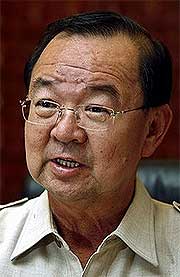
Chin ( right ) was also queried by several Members of Parliament as to whether the power purchase agreements would be reviewed to ensure TNB was not pressured by a lopsided agreement which favoured IPPs.
"We are aware that power purchase agreements favour IPPs but what we have to review is whether the profits are excessive. If it is not lucrative, who would want to do this business," he asked.
He said negotiations were on-going to formulate a supplementary agreement for existing power purchase agreements, led by the Private-Public Cooperation Unit
under the Economic Planning Unit.
No plans to increase IPPs
Chin also dislcosed that TNB paid RM4.19 bilion to five IPPs namely YTL Power Generation Sdn Bhd (RM1.50 billion), PowerTek Bhd (RM188 million), Port Dickson Power Bhd (RM184 million), Genting Sanyen Power Bhd (RM969 million) and Segari Energy Ventures Sdn Bhd (RM1.36 billion).
The minister also said IPPs collectively generated 67 per cent of the country's electricity demand while TNB generated the remaining 33 per cent.
Chin also commented on the country's energy reserves of 53.2 per cent, which far exceeded international requirements of 25 per cent.
"We are aware 53 per cent is very high...we understand and we want others to understand that IPPs were formed when the economy was robust, hence the higher demand.
"And, this does not mean we are generating excessive power which is being wasted. We are just providing the capacity should the need arise for higher output," he added.
Chin also said there were no plans to increase the number of IPPs and by 2015, the energy reserves would reduce to 25 per cent.
- Bernama


Are you sure you want to delete this comment?
This action cannot be undone.