




Civil society must take charge of its own destiny
University Malaya (UM) associate law professor Azmi Sharom spoke of unlikely heroes, who he calls the "geekiest" segment of society: Birdwatchers.
They were the source of the Ramsar Treaty, a textbook example of grassroots action which resulted in the protection of wetlands and waterfowl the world over.
University Malaya (UM) associate law professor Azmi Sharom spoke of unlikely heroes, who he calls the "geekiest" segment of society: Birdwatchers.
They were the source of the Ramsar Treaty, a textbook example of grassroots action which resulted in the protection of wetlands and waterfowl the world over.
Azmi said: "They were common and decent ordinary citizens and, thanks to thecbirdwatchers, the treaty is now observed worldwide."
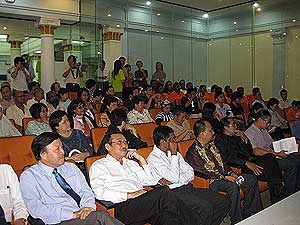
Azmi told this to guests at the Kuala Lumpur and Selangor Chinese Assembly Hall's Civil Society Award ceremony last week.
However, Azmi said that Malaysians seem to suffer from what he termed the 'Hang Tuah' complex.
"They are always waiting for a hero to come to their rescue. Forget Hang Tuah!" he exclaimed.
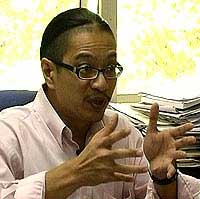 "We control our own destiny. Working together at the grassroots level is the best kind of civil action," added Azmi (
left
).
"We control our own destiny. Working together at the grassroots level is the best kind of civil action," added Azmi (
left
).
Quoting Thomas Jefferson, he said: "The price of freedom is eternal vigilance."
In that regard, Azmi believes that it is civil society's role to keep that vigilance.
He said that it is the job of civil society to keep an eye on the government, not just once every four years but constantly.
Azmi stressed that civil society must engage in politics or at least monitor it to protect itself.
He said: "We must voice out complaints and express our opinions. It is our right to do so. Our opinions must be heard and they do matter."
This, according to him, is especially important since the enemies of freedom work methodically, slowly chipping away at civil liberties in the guise of protecting us.
Azmi urged civil society to rise up to protect our democracy, which he defined as the right to choose our leaders ‘meaningfully'.
That choice, he said, is only meaningful when coupled with the right to criticise and have free access to necessary information.
Yet, Azmi said, in Malaysia, the right to freedom of expression and access to important information is still being curtailed.
Two divergent paths
Azmi said that we are at a strange and interesting time in our country, where activism has forked out into two divergent paths.
One, he explained, were those who wanted to work within the system by introducing the two-party system. Then, there were those who want a total change in our system of governance.
The latter believes that a two-party system would make no difference to civil society's plight, stating that it is akin to choosing between Coke and Pepsi.
While they deserved respect for their idealism, they worked under the assumption that we need to change the entire system in order to affect positive change.
However, Azmi counselled pragmatism and believed that values like justice and good governance can still exist in the current framework if civil society fights for it.
 He submitted as evidence, the fact that the mere threat of a two-party system has forced the government to listen to citizens.
As proof he cited the 1Malaysia concept, the proposed revamp of BTN courses and the declassification of the Bukit Antarabangsa landslide report.
"They (the government) are frightened, they have to bow to pressure from civil society, they are afraid to lose power."
But Azmi cautioned that the work must continue, likening it to a journey with no end.
Progress, he added, is not a goal but a process as we build on the foundations of those that came before us.
Yet, Azmi cautioned, civil society needed to be careful to not let anger and bitterness get in the way of the fight for a better naition


Are you sure you want to delete this comment?
This action cannot be undone.