




Cooperatives' fate hang in balance
High Court judge Lau Bee Lan is set to deliver her judgment on another court dispute involving two cooperative legislations seen as lopsided and unhealthy for the growth of these voluntary bodies.
High Court judge Lau Bee Lan is set to deliver her judgment on another court dispute involving two cooperative legislations seen as lopsided and unhealthy for the growth of these voluntary bodies.
An originating summons was filed two years ago by railway cooperative, Koperasi Keretapi Berhad (KKB), at the Appellate and Special Powers Division - the same day the Malaysia Cooperative Societies Commission Act 2007 and Cooperative Societies (Amendment) Act 2007 came into force.
KKB is challenging the constitutional validity of four provisions in these two new Acts of Parliament.
The Malaysia Cooperative Commission (MCC), government of Malaysia, (then) finance minister and (then) development, entrepreneur and cooperatives ministers have been named respondents.
Last year, two apex cooperative bodies also filed separate lawsuits, challenging these provisions.
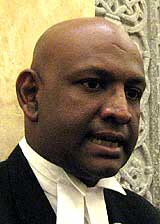 Lawyer K Shanmuga (
left
), representing KKB, told
Malaysiakini
last month that the judge will deliver her decision on the originating summons on Feb 25 in chambers.
Lawyer K Shanmuga (
left
), representing KKB, told
Malaysiakini
last month that the judge will deliver her decision on the originating summons on Feb 25 in chambers.
KKB is contending that Section 43 of the Malaysia Cooperative Societies Commission Act 2007 is unconstitutional for being inconsistent with Article 13(2) of the Federal Constitution.
This section compels all cooperatives to deposit their funds not immediately needed for operations or investments into the Cooperative Deposit Account.
In addition, cooperative commission may, with the minister’s prior written approval, make regulations on the scope, operation and management of the Cooperative Deposit Account.
However, Article 13(2) of the Federal Constitution states that "no law shall provide for the compulsory acquisition or use of property without adequate compensation.”
An insidious form of taxation
Shanmuga, in his submissions, argued: "If land is taken, there must be adequate compensation in money. In this case, money is taken. This provision is tantamount to simply ‘taking’ money from cooperatives without giving them anything in return."
For example, he said: "If a cooperative society kept RM1,000,000 in fixed deposit, which was not immediately needed for ‘operations' or 'investments', all this money may be required to be paid to the MCC (Malaysia Cooperative Societies Commission)".
KKB is also challenging Section 42 of the Malaysia Cooperative Societies Commission Act 2007 which provides as follows:
(1) MCC may require any cooperative society or any class, category or description of cooperative society by order in writing to contribute to the Central Liquidity Fund;
(2) Any cooperative society can be required by MCC to contribute to the Central Liquidity Fund under subsection (1) shall pay to MCC or to its agent as specified in the order such amount of contribution or such rate of contribution as a percentage of its share capital, subscription capital, assets or liabilities or a combination thereof as may be determined by MCC from time to time not later than such date as may be specified in the order.
Shanmuga charged that this is contrary to Article 97(1) of the Federal Constitution which states: "All revenues and moneys however raised or received by the Federation shall, subject to the provisions of this Constitution and of federal law, be paid into and form one fund, to be known as the Federal Consolidated Fund."
He noted that none of the monies collected by MCC is to be paid to the Consolidated Fund but would instead benefit the Central Liquidity Fund managed by MCC.
He added that since the rate and percentage is to be determined by MCC, without guidelines set by Parliament, it is against Article 96 of the Federal Constitution which reads: “No tax or rate shall be levied by or for the purposes of the Federation except by or under the authority of federal law.”
"It does not appear to be a form of taxation authorised by parliament," he said in his submissions.
Draconian measures
KKB is also contending that Section 43(2) of the Cooperative Societies (Amendment) Act 2007 is contrary to citizens’ fundamental right of freedom of association guaranteed by Article 10(1) of the Federal Constitution.
This section restricts the appointment or re-appointment of any person as a member of the board of a cooperative society until "such person satisfies the fit and proper criteria set by MCC".
Shanmuga argued that it is "impossible" for MCC to do that as there are over 6.3 million members of cooperatives in the country, and each one is eligible to be a member of the board.
"Members of cooperatives are by and large ordinary citizens. They may be clerks, policemen, soldiers, nurses, hospital attendants, persons from the industrial and manual group, fishermen, farmers, workers and such other people from the low and lower middle-income group.
"By and large they manage their cooperatives well. Through this process of self-help they improve their income and well-being.
“For example, an IMG worker can buy a bicycle for his son with a loan from his cooperative society with a long-term easy repayment facility at low interest rate instead of taking a hire-purchase finance loan at a much higher interest rate and harsher terms. The IMG worker may himself be a board member," he explained in his submissions.
He pointed out that most cooperatives are managed by volunteers and the bodies may be "hard put to find volunteers to serve when there is such a bureaucratic restriction on the freedom of association".
KKB is also contesting Section 54 of the Malaysia Cooperative Societies Commission Act 2007 which states: "Every offence punishable under the said Act, the Cooperative Societies Act 1993 or any other written law enforced by the MCC shall be a seizable offence and that a police officer not below the rank of inspector or an investigating officer may arrest on reasonable suspicion."
Shanmuga stressed that this section does not require the reason for the arrest to be stated out.
Describing it as "oppressive", Shanmuga reasoned that "this statute ought to be remitted to the parliamentary draftsman to incorporate appropriate constitutional provisions”.
"They should also ensure that ordinary people are not subject to being arrested under this law for minor offences," he said.
"Even the Criminal Procedure Code which gives powers of arrest for specified criminal offences requires the person arrested to be brought before a magistrate within 24 hours. There is no such requirement here."


Are you sure you want to delete this comment?
This action cannot be undone.