




Dr M blamed me instead of himself: Soros
exclusive Controversial currency speculator cum philanthropist George Soros said the reason he got bad press in some Asian countries was due to attacks hurled against him by former Malaysian premier Dr Mahathir Mohamad.
"It really started with Mahathir blaming me instead of accepting responsibility (for the Asian financial crisis)," Soros told Malaysiakini in an interview in Hong Kong.
"He blamed me instead of accepting blame for his excesses, which led to the crisis."
exclusive Controversial currency speculator cum philanthropist George Soros said the reason he got bad press in some Asian countries was due to attacks hurled against him by former Malaysian premier Dr Mahathir Mohamad.
"It really started with Mahathir blaming me instead of accepting responsibility (for the Asian financial crisis)," Soros told Malaysiakini in an interview in Hong Kong.
"He blamed me instead of accepting blame for his excesses, which led to the crisis."
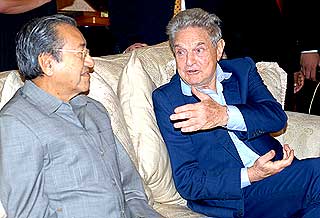 Soros (
right in photo
) was however quick to credit Mahathir (
left in photo
) for his response to the financial crisis.
Soros (
right in photo
) was however quick to credit Mahathir (
left in photo
) for his response to the financial crisis.
"It so happened that the way he handled the financial crisis of 1997-98 was against the advice of the IMF (International Monetary Fund), and it was very successful. And that was what I told him when I met him. Since then, the IMF itself has changed its approach."
Soros, who will turn 80 this year, was in Hong Kong early this month to speak at the Hong Kong University and to attend a meeting of his foundation, the Open Society Institute.
The Hungarian-born financier is ranked 29th in the world's richest persons list by Forbes magazine, with a net worth estimated at US$13 billion.
According to the billionaire, he had heard rumours that Mahathir and his sons lost a lot of money on currency speculation in 1992.
On Sept 16, 1992 - dubbed as Black Wednesday - the British government was forced to defend the pound sterling after currency dealers mounted an attack on the pound, plummeting its value.
Soros, one of the high-profile currency speculators, made over US$1 billion profit by short-selling sterling and was given the moniker ‘the man who broke the Bank of England'.
I
 t is believed that Malaysia's Bank Negara, which was controversially
involved in currency speculation
at the time, was betting against Soros and lost billions of ringgit.
t is believed that Malaysia's Bank Negara, which was controversially
involved in currency speculation
at the time, was betting against Soros and lost billions of ringgit.
However, Soros said that the reason for his enmity with Mahathir was perhaps more due to the philanthropist's advocacy against the military junta in Burma.
Nevertheless, the billionaire conceded that the controversy surrounding him was because of his "dual personality".
"In the financial markets, I'm there to make profits, and in my private capacity, I stand for certain principles. Sometimes those principles are at odds with the profit motive," he said, referring to his generous funding of human rights movements around the world.
In the 20-minute interview held at a Hong Kong hotel, Soros also said he believed newspapers in United States would adopt the subscription model "within a year".
The following is an excerpt of the interview. Part 1 appeared yesterday.
During the Asian financial crisis, you had a tiff with Mahathir. He called you a "moron". What was your reaction when you first heard about it?
I gave him as good as I received when I called Mahathir a "menace" to his own country. But we actually made up some years later when he was no longer in power. I didn't take it personally.
You met him two years ago in Kuala Lumpur. Has there been any meeting after that?
No.
You're going to Indonesia next. Like it or not, you're a controversial figure in both Indonesia and Malaysia. Why do you think that's the case, and how can you overcome it?
It really started with
 Mahathir blaming me instead of accepting responsibility.
Although it so happened that the way he handled the financial crisis of 1997-98 was against the advice of the IMF (International Monetary Fund), and it was very successful. And that was what I told him when I met him. Since then, the IMF itself has changed its approach.
I think that was the reason - he blamed me instead of accepting blame for his excesses, which led to the crisis.
Could the dispute between both of you be traced back to 1992 - Black Wednesday? At that time Malaysia's central bank was also heavily into currency speculation.
There were rumours that he and his sons lost a lot of money and he was angry. But actually, I think that he, at that time, linked my activities in financial markets with my advocacy for Burma. He thought that I wanted to punish Malaysia for its position on Burma. That was a false accusation.
I carry on my policy-orientated philanthropy with my own money, but in managing the fund (Soros Fund Management) I don't let those considerations come into it because I have a responsibility to other investors. It was a false accusation, but it stuck.
It looks like the situation (regarding your image) has improved somewhat.
The fact that he (Mahathir) had acknowledged it was helpful.
It is really difficult for people to understand because I have a dual personality - in the financial markets, I'm there to make profits, and in my private capacity, I stand for certain principles. Sometimes those principles are at odds with the profit motive.
When it comes to making money, it's one thing, but when it comes to recommending legislation or recommending how the financial system should be organised, I put the interest of the system ahead of my personal interest.
For instance, I've always been advocating some degree of supervision over the hedge funds because I believe they need to be supervised. So it is difficult for people to understand because that's unusual.
In fact, Malaysiakini was somehow drawn into this Mahathir versus Soros debate. Soon after we launched, Mahathir called us "traitors" because he said we were linked to you. And you didn't even know about us until it became news.
Yes. It is not a problem for you anymore?
No, not really.
Very good. Do you think your model is replicable in other countries?
In some ways, Malaysia is unique - the fact there is a push factor because the mainstream media is not doing a good job in reporting news. And people are willing to pay for our content.
Do they pay for the content?
They do. We are a subscription-based website. Our subscribers pay about US$6 per month to access Malaysiakini.
I think that within a year United States will move to adopt the same model.
I agree. New York Times has just announced that it will go subscription-based beginning next year.
You know, I was thinking of investing in New York Times because I think it will be a very valuable franchise once you pay (for online content). They will be global, and people can buy it even from Malaysia.
Part 1: Obama fails to impress Soros


Are you sure you want to delete this comment?
This action cannot be undone.