




Two foes bury the hatchet
Ten years ago, many would have considered this next to impossible. But it appears that time has healed all wounds.
Ten years ago, many would have considered this next to impossible. But it appears that time has healed all wounds.
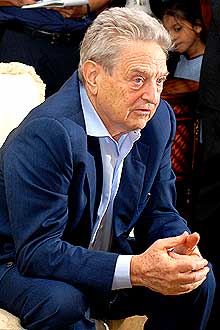
And this was evident at a prominent hotel in Kuala Lumpur this morning where former premier Dr Mahathir Mohamad met his one-time nemesis, Jewish billionaire philanthropist George Soros.
During the height of the 1997 Asian financial crisis, Mahathir had blamed Soros, a former currency speculator, for the devaluation of the ringgit.
The former premier had even called him a 'moron' on one occasion, to which Soros retaliated by describing Mahathir as 'a menace to his country'.
Following their hour-long private meeting today, the duo gave a joint press conference for a barrage of local and international journalists.
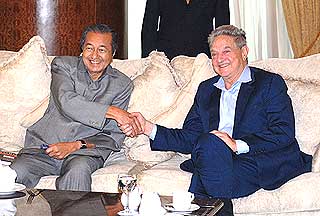 Mahathir:
We had a very good discussion. The discussion centred on the situation in the world today, on wars as a solution to problems. I did bring up our (Perdana Peace Foundation) effort to criminalise war.
Mahathir:
We had a very good discussion. The discussion centred on the situation in the world today, on wars as a solution to problems. I did bring up our (Perdana Peace Foundation) effort to criminalise war.
But we did agree that in some instances, war may be inevitable. Defensive wars would still happen. But we also discussed the need to attend to the problems in the Middle East. Somehow or rather, I have been labelled as anti-Semitic.
I would like to explain that whenever I made criticisms, I don't make criticisms against the Jews. I also make criticisms against the Muslims and in my OIC (Organisation of Islamic Conference) speech I did say that Muslims need to learn from the Jews. But I did conclude that the Jews have a lot of influence in the US and that US is a very powerful nation.
But I would like to say that I have Jewish friends and many of my Jewish friends won't think that I am anti-Semitic. But the press only picks on what I say against Israel and make it sound as if I am against all Jews.
I believe that if anybody does anything wrong, everybody has the right to criticise, whether they are Muslims or Jews or whatever. That is my belief, but unfortunately the press has only picked on that part, that I have criticised the Jews and I have been labelled as anti-Semitic.
I would like to say that I am not anti-Semitic, that I am not anti-Jew. But I am certainly very much against what is happening in Palestine where the Israelis have tried to out-terrorise the Palestinians. And I think that is a wrong way to resolve the problem there. And we both agreed that the root causes of the problem in Israel must be tackled.
Soros: We did agree that our view of the world is really very similar. We have to clear this misunderstanding about anti-Semitism. Our views on the errors of the Bush administration and their response to the (9/11) terrorist attacks, are similar.
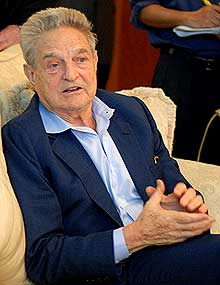 That we have a war with terrorists because they kill innocent people for political ends. And in fighting terrorism we must not go out of our way to do the same thing.
And the Bush administration has actually gone out of its way to humiliate and torture the people of Iraq. And as a result, the rest of the world looks at the United States in the same light as we look at terrorists.
That is very difficult for the American public to understand, because Americans are usually very decent and well-meaning people. So how can they be regarded as some kind of criminals. We did the wrong things, and it's also counter productive, because instead of reducing the terrorist threat, there is a greater terrorist threat today.
But fortunately the American public has begun to realise this. The mid-term elections were strong repudiations of the policies pursued by the Bush administration. I think we both are hopeful that America is now in the process of recognising these mistakes and taking a different course.
And addressing the root causes of the opposition, particularly in the case of Palestine where there is no military solution. There has to be a political solution. The nature of the solution is well-known to everyone. It's only a question of finding a way to restart the political process. That is going to be very difficult given the tremendous damage that has been done. But hopefully that is not too late.
Journalist: We are interested to know what are the views you agree with Mahathir and the views that you don't. What's the actual reason for meeting Mahathir?
Soros: I'm sorry, what is the reason...
Journalist: What is the reason for the meeting?
Mahathir to Soros: What is the reason for you meeting me? (laughs)
Soros: I think we have heard about the exchange of correspondence. Mahathir is interested in promoting peace in the world. I felt that the idea of just getting people to renounce war is not enough. We agreed on that. I think we are both really concerned about the future of our civilisation. (To Mahathir) Am I right in saying that?
Mahathir: Yes
Journalist to Soros: In retrospect, what do you think of Mahathir's economic policies post the financial crisis?
Soros: Actually, I believe that the financial authorities made a mistake in maintaining the exchange (peg) [to the green]back too long, which created a lot financial distress. But I think Mahathir was travelling at that time. So maybe he was not personally responsible for that.
Actually, I said that after the crisis, imposing exchange controls after the exchange rates were adjusted - imposing capital controls - reduced the damage that Malaysia suffered.
Also we happen to be quite close in what the actual right financial policies were at the time.
Journalist to Mahathir: (in Malay) Do you still hold on to your perception regarding Soros after the financial crisis?
Mahathir: Soros said he was not involved in the depreciation of the ringgit value. It was others who were involved. That has been accepted.
Journalist: So you have forgiven him?
Mahathir: It is not a question of forgiveness. (laughs)
Foreign journalist: Can you translate the question (to English) please.
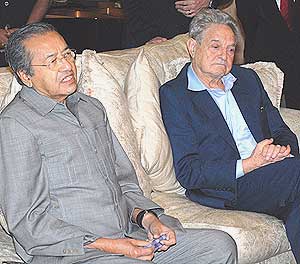 Mahathir to Soros:
He is asking whether I have changed my opinion about you. Because I said things about you, accusing you of being responsible for devaluing our currency.
Mahathir to Soros:
He is asking whether I have changed my opinion about you. Because I said things about you, accusing you of being responsible for devaluing our currency.
What I pointed out was that you were not personally involved and that the devaluation was done by other traders and I accept that.
And it is not a question of forgiveness or anything like that. It's just that you didn't do it and I accept that you didn't do it.
Journalist to Mahathir: (in Malay) So your perception about him regarding the devaluation has changed?
Mahathir: Yes it has changed, that's why I am talking to him (laughs).
Journalist: So can we consider the two of you friends now?
Mahathir: We have certain things that we believe together. The problem of Palestine. The problem of US taking unilateral actions. The mistakes of Bush. On this issues we agree. I have proposed that Soros support our peace movement about criminalising war. But he has a slightly different opinion.
But there is really no great difference between his views and mine.
Soros: The main difference is that I favour, and I think you (Mahathir) do too, the doctrine of the responsibility to protect. This is a doctrine which is now adopted by the United Nations which says sovereignty belongs to the people, but sometimes the rulers betray the trust that they have in exercising that sovereignty and are oppressing their people, committing atrocities and even genocide.
And in those cases, the international community has an obligation to defend the people against their rulers. That is an excellent doctrine that needs to be strengthened. And unfortunately, the way the US acted by invading Iraq arbitrarily and unilaterally, has made it more difficult to get the international community to agree on this valuable doctrine, because people are now suspicious of the US because they have acted arbitrarily.
And hopefully, US will change its policy and this doctrine can be used to preserve peace and to prevent atrocities in individual countries. The action must be taken by the international community and not by any single country. In this case, US acted on its own and that was wrong.
But Saddam Hussein was a tyrant. And what to do with tyrants is one of the unsolved problems with the prevailing world order. This doctrine, with the responsibility to protect, would cure the way we have been dealing with that problem. And that is the direction we need to go. And I think we (Mahathir and him) agree on that.
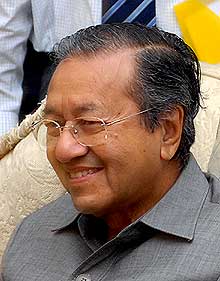 Journalist to Mahathir:
It took you awhile to come up saying that George Soros is not responsible for the devaluation. Is that because you were not fed the right information or you did not seek the right information?
Journalist to Mahathir:
It took you awhile to come up saying that George Soros is not responsible for the devaluation. Is that because you were not fed the right information or you did not seek the right information?
Mahathir: Well I read about him in the press and I had a more personal meeting with him, now that I have met him. I think his statement is true about his involvement. My concern is that currency speculation can destroy the economies of a lot of countries. So that's why I'm still against it. I don't think we need such actions in order to make corrections in the economy of countries.
Soros: We did not actually discuss this issue. This issue is not the subject of our discussion. And ... you see ... might I just give my view. This is not necessarily the same as yours (Mahathir) because we did not talk about it.
The responsibility does not belong to the speculators, but to the authorities. Because the authorities have to decide how the market should function. Whether there should be capital controls or under what conditions and so on.
So I as a speculator, act, or used to act, according to the prevailing rules. But knowing the markets, I believe that sometimes it's appropriate to impose some restrictions on capital movement.
Journalist: So you took advantage of the loopholes? I mean, people like you, speculators, did you take advantage of the loopholes?
Soros: There are negatives about capital controls. That is why at the moment there is such wide freedom of movement of capital. The way things are right now, the markets find ways of adjusting themselves.
There is the danger of excessive capital movements. Financial markets are inherently unstable. And it is the role of the financial authorities to maintain stability. That has to be there and at the moment they are actually doing quite a good job. So you don't have any great imbalances.
 Journalist to Soros:
What do you think of the country's management of its currency?
Journalist to Soros:
What do you think of the country's management of its currency?
Soros: Of what?
Journalist: Malaysia ...
Soros: What do I think of Malaysia now?
Journalist: In terms of currency management. What do you think of Malaysia now?
Soros: You know, I am no longer active in the financial markets. So I can't answer your question.
Journalist: What is your outlook on the current global currency situation?
Soros: In the US, there is a current account deficit, which hopefully will now be corrected because of the deflation of the housing zones in the US. Very good growth in the developing world, not only China, but India and other countries. Right now, we are in the process of reducing that imbalance. But it remains the most troubling imbalance in the world economy.


Report this comment
Are you sure you want to delete this comment?
This action cannot be undone.