




Sabah employers want levy on foreign workers eased
Employers in Sabah and political leaders want the high levy imposed on foreign workers in the state to be eased and their entry regularised.
Employers in Sabah and political leaders want the high levy imposed on foreign workers in the state to be eased and their entry regularised. This follows the failure of many employers to take advantage of the 50 percent levy discount that expired last year after several extensions.
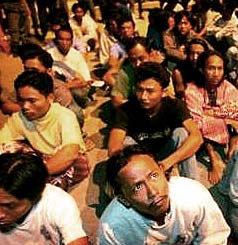 A crackdown on illegal foreign workers (
left
) and their errant employers is rumoured to be imminent after a ‘truce’ for the Chinese New Year period ends on
Chap Goh Mei
, this Sunday.
A crackdown on illegal foreign workers (
left
) and their errant employers is rumoured to be imminent after a ‘truce’ for the Chinese New Year period ends on
Chap Goh Mei
, this Sunday.
The government, it was noted, was determined to erase the negative public perception that illegal immigrants are being protected by enforcement agencies as they continue to enter the country.
Yet Tawau MP Chua Soon Bui insists that no major policy changes pertaining to foreign workers have been made despite proposals from various quarters.
Her concerns are echoed elsewhere in the state. Consumer Movement for Sabah & Labuan (Cash) chief Patrick Sindu ( below ) thinks that stingy employers who can afford to pay foreign worker levies refuse to do so, wanting ‘free’ or ‘cheap’ labour.
 Sindu is in favour of doing away with the current system of foreign workers going through agencies in their home countries and Malaysia before they can be employed.
“The agency approach is where all the abuses and corruption begins. The documentation process costs some RM4,000 and this is something the workers cannot afford,” said Sindu.
“We need to look at our neighbour Brunei and Singapore who have no problems in managing the entry of foreign workers.”
Singapore has 1.8 million foreign workers for a population of 4.9 million in a developed economy, noted Sindu, while only 30 percent of the workers in booming Brunei are foreigners.
“The unregulated presence of a large number of foreign workers would have an adverse impact on society,” said Jeffrey Ong from the Federation of Hin Ann Associations Malaysia. “There are 1.7 million foreigners in Sabah, almost as much as in Singapore but without the economic benefits.”
“The high levy noose around employers must be loosened,” said Yee. “Otherwise, Indonesia would emerge as the powerful player in the oil palm industry.”
Job-hopping rampant
The high levies aside, Tawau parliamentarian Chua says that processing procedures at present were too long and tedious and job-hopping rampant among even regularised foreign workers.
Lax enforcement and loopholes are the main reasons for this state of affairs, she added. “By right, the job-hoppers and their new employers should be penalised.”
 Employers who lose their legal workers, says Chua
(left
), also lose the levies paid on their behalf. This means that they have to employ new workers and fork out their levies again. The system is akin to penalising the law-abiding employers while not acting against the errant ones who recruit job-hoppers, continued Chua.
Employers who lose their legal workers, says Chua
(left
), also lose the levies paid on their behalf. This means that they have to employ new workers and fork out their levies again. The system is akin to penalising the law-abiding employers while not acting against the errant ones who recruit job-hoppers, continued Chua.
She claimed that several industries are in difficulties over the unpaid levies despite their willingness to co-operate to regularise their workers. The main sectors affected, according to her, are plantations, wood processing and construction.
For starters, Chua wants the levy to be made transferrable and employers who take in foreign job-hoppers be penalised to deter the apparently rampant practice. This would be a better approach than mounting costly operations against illegal workers, said Chua.
“Only 47,310 illegal immigrants were netted last year throughout the nation after 7,099 operations against them.”
“The operations burden the government financially and drains human resources and this cannot be kept up for long,” warned Chua. “Skilled legal foreign workers are getting fed-up of the raids which target them too.”
Increasing shortage
As a result, many Indonesian workers are returning home to join their local palm oil plantations where the wages can generally match those in Sabah or even higher in South Kalimantan. The increasing shortage of workers in Sabah in this sector has meant millions lost in non-harvested oil palm fruits.
It is not known when the next crackdown against illegal workers in Sabah would begin. Already, the East Malaysian Planter’s Association (EMPA) has warned the state government in Kota Kinabalu that the east coast is swarming with workers, legal and illegal, who have abandoned their employers.
Employers who hire illegal foreign workers can be charged under Section 55B of the Immigration Act 1959/63 (amendment 2002) which carries a jail term of up to five years and whipping. The courts have been reluctant to impose the sentence as prescribed, citing the social fall-out on workers if their employers are jailed.
Those harbouring illegal workers can be charged under Section 55E of the same Act. They could be subject to a fine of up to RM 30,000, a year in jail, or both.


Are you sure you want to delete this comment?
This action cannot be undone.