




Media giant scotches rumours of Nanyang takeover
Media giant Media Prima has categorically denied plans of taking over Nanyang Siang Pau to move into the Chinese newspaper market - an area in which the Umno-linked company does not have much presence.
Media giant Media Prima has categorically denied plans of taking over Nanyang Siang Pau to move into the Chinese newspaper market - an area in which the Umno-linked company does not have much presence.
Rumours were rife within the political and media circles that Media Prima was about to stitch a deal with Nanyang owner, the Media Chinese International Limited, to buy the ailing newspaper.
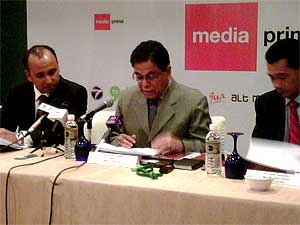 However, Media Prima managing director Amrin Awaluddin clarified that the media conglomerate had no intention of taking over any Chinese newspaper at a Wednesday press conference called to announce the company's 2009 financial report.
"As for print, we will concentrate on developing New Straits Times , Berita Harian and Harian Metro . We do not have any plan to publish other products, including Chinese, English and Malay newspaper," he stressed.
Amrin ,however, conceded that there were rumours on the Internet of a Nanyang takeover. But he said this was not true.
He added that the speculation might be due to the earlier move by Media Prima to privatise its subsidiary, the New Straits Times Press Group.
"People love to speculate, but we really don't have any plan to buy other newspapers," he said.
Amrin also revealed that the group does own a permit to publish a Chinese newspaper, which belongs to former daily Sin Min Jit Poh . However, he said Media Prima did not have any intention to use it.
Media Prima chairperson Johan Jaafar, a former top editor seen as Prime Minister Najib Abdul Razak's media czar, was also at the press conference. He however kept silent and instead let his subordinate answer questions on the matter.
Political move
It has been widely speculated that Media Prima's plan to take over Nanyang was due to political considerations.
 The group owns all four free-to-air television stations, three radio stations, two Malay dailies and one English newspaper.
Although two of its television stations - NTV 7 and 8TV - have substantial Chinese news programmes, and another radio station, One FM, is in Chinese language, the group does not have much presence in the Chinese newspaper market.
By acquiring Nanyang , Media Prima will not only shore up its foothold in the Chinese media but also help serve the strategy adopted by Najib in directly wooing the Chinese community without having to go through the MCA and the Gerakan, which are besieged by internal problems.
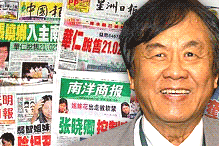 Nanyang Siang Pau
is currently owned by Media Chinese International, which in turn is controlled by timber tycoon-cum-media baron Tiong Hiew King (
right
).
Nanyang Siang Pau
is currently owned by Media Chinese International, which in turn is controlled by timber tycoon-cum-media baron Tiong Hiew King (
right
).
The Chinese newspaper, which was considered the most popular broadsheet in the 1980s, has seen its circulation falling from its high of 140,000 in 2001 just before the controversial takeover by MCA.
The plunge in circulation continued unabated after Tiong took over in 2006. It is believed that the latest figure stands around 60,000.
Although Media Chinese International tried to rebrand the newspaper, Nanyang appeared unable to stem its slide.
From a financial viewpoint, the Media Prima-Nanyang deal will help relieve the group of the huge losses accumulated by Nanyang.
However, some quarters believed that Media Chinese International has the ability to absorb the loss since the group controls 93% of Chinese newspaper market in Malaysia and enjoyed a profit of RM59 million in 2009.
Can Sin Chew be trusted?
But in the eye of some former Nanyang employees and anti-takeover campaigners who are still smarting from the loss of the newspaper to a political party and which later came under the control of a media tycoon, Tiong's role in assisting MCA to acquire the newspaper cannot be exonerated.
However, it cannot be ruled out that Tiong might decide to sell Nanyang from political pressure, much like the newspaper former owner Quek Leng Chan was said to have bee nudged to sell it to MCA about 10 years ago.
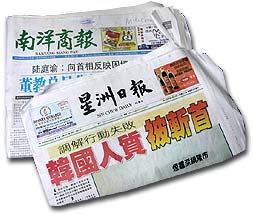 There has been some bickering between
Sin Chew Daily
, another Chinese newspaper owned by the Media Chinese International, with Umno-owned
Utusan Malaysia
over recent racial and religious issues which created some doubt among Umno leaders over the loyalty of the Chinese media group.
There has been some bickering between
Sin Chew Daily
, another Chinese newspaper owned by the Media Chinese International, with Umno-owned
Utusan Malaysia
over recent racial and religious issues which created some doubt among Umno leaders over the loyalty of the Chinese media group.
It is also reported that Media Prima's Chinese advisor Goh Hin San was the prime mover behind the deal.
However, when asked by Malaysiakini previously, Goh denied any such deal was in the works.
The fate of Nanyang, once a premier Chinese newspaper, remains uncertain as media tycoons and ruling politicians ponder their next move in the Malaysian media chessboard.


Are you sure you want to delete this comment?
This action cannot be undone.