




Fight not over for Malaysian women
comment March 8 is the day when women throughout the world celebrate and are celebrated for their achievements. Countries like China and Madagascar have gone as far to declare that day a public holiday.
But in Malaysia, women are struggling to work in a non-discriminatory environment and still pleading with the federal government to extend the current 60-day maternity leave to prevent denying babies their right to mother's milk.
March 8 is the day when women throughout the world celebrate and are celebrated for their achievements. Countries like China and Madagascar have gone as far to declare that day a public holiday.
But in Malaysia, women are struggling to work in a non-discriminatory environment and still pleading with the federal government to extend the current 60-day maternity leave to prevent denying babies their right to mother's milk.
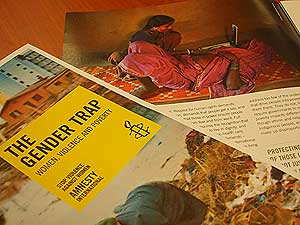 The eight-week paid maternity leave is in fact six weeks short of the recommended 14 weeks by the International Labour Organisation's Maternity Protection Convention 2000. Malaysia regrettably is not a signatory to the convention.
A Health Ministry analysis in 2008 on national breastfeeding data showed that exclusive breastfeeding rates in the country were high in the first two months but dropped sharply after two or three months, about the time when the maternity leave ends and working mothers return to paid employment.
In 2008 a memorandum on ‘Maternity Protection Supporting Working Women' was presented to National, Family and Population Development Board (LPPKN) urging the government to provide working women with maternity leave of four months to facilitate exclusive breastfeeding.
This is the bitter truth affecting women in Malaysia - they are hardly recognised for their contributions to the workforce and relegated to tasks deemed less threatening to their male counterparts.
And for those women whose work is appreciated and are rewarded justly, their hard work paradoxically has put Cuepacs, an NGO that represents civil service, in a very insecure position going by the gender-biased statement made by its secretary-general Ahmad Shah Mohd Zin that the upward trend of female employees in the civil service is a cause for concern and would implicate on the progress and growth of the nation in the long run.
Rights of women in Malaysia not respected
When the Labour Department director-general Ismail Abdul Rahim ridiculed the need for a sexual harassment bill saying such a bill "could lead to a dull and rigid environment in the workplace", not a single member of the Cabinet rebuked him.
As al
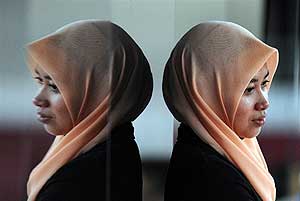 ways, the Barisan Nasional government which under Prime Minister Najib Abdul Razak keeps hooting that ‘rakyat didahulukan pencapaian diutamakan (people first, performance a priority)' fared just as miserably, with no politician troubled enough to reprimand Ismail. This is just the tip of the iceberg of the many examples of women's rights in Malaysia not respected by the ‘powers that be'.
It is because of this ‘can't be bothered' attitude that a lecherous politician like Jamaluddin Jarjis in 2008 got away scot-free after a waitress charged him with sexual harassment. A statutory declaration was made by the woman but with the help of a hot-shot lawyer this former cabinet minister escaped being punished.
 With a blemished record, Jamaluddin (
right
) who once made a racist remark about a Malaysian student in America could still smile on after he was appointed ambassador to the United States of America. Looks like having a godfather in politics is all one needs to be protected. As for the waitress who suffered the sickening gestures of Jamaluddin, she thereafter became no one's concern.
With a blemished record, Jamaluddin (
right
) who once made a racist remark about a Malaysian student in America could still smile on after he was appointed ambassador to the United States of America. Looks like having a godfather in politics is all one needs to be protected. As for the waitress who suffered the sickening gestures of Jamaluddin, she thereafter became no one's concern.
The women's groups have been pleading for a long time for a law on sexual harassment in place of the 1999 Code of Practice on the Prevention and Eradication of Sexual Harassment in the Workplace. It has been 11 years and painfully slow efforts are being made to legislate a law in the interest of women and protecting their welfare at work.
For men like Ismail and Jamaluddin Jarjis, they obviously never will respect women and enforcing a law on sexual harassment at the workplace is the only way to teach such goatish males a lesson.
Women must fight their battles alone
Where it concerns women, the laws in Malaysia are far from favourable to them. Take the rape law and the amendments demanded by the women's groups. In 1987, nine-year-old girl Ang May Hong was found dead with a piece of wood embedded with nails pushed into her vagina and a piece of wire around her neck.
In 2007 eight-year-old Nurin Jazlin Jazimin was sexually assaulted and her rectum ruptured as a result of cucumber and brinjal forced into her anus. She died due to bacterial infection that had set in.
The above two cases are examples of rape not just being about penile penetration into the vagina as is currently stated in the Criminal Procedure Code and Penal Code.
Amending the existing laws on rape to widen the definition of this act of violence against women is in no way appeasing the women's groups, as accused by the Bar Council's criminal law sub-committee chairperson V Sithambaram in 2006.
If objects are thrusted into the anus or vagina of a girl or a woman, is that not an act of rape - sexually assaulting the girl or women? But until today, there has been no news on when the government will open its eyes to the raw truth that rape is not just about penile penetration into the vagina.
The call to widen the definition of rape has fallen on deaf ears since 2003 when the Joint Action Group Against Violence Against Women (JAG) proposed in a memorandum that amendments be made to rape-related laws as once too often the system failed to put the perpetrators behind bars.
And the government in its typically ‘couldn't care less' fashion made no attempt to respond to the memorandum. The recipients of the memorandum, namely the Women and Family Affairs Ministry (today knows as Women, Family and Community Development Ministry), the Attorney-General's office and the Prime Minister's Department (under then de-facto minister Rais Yatim) all did not respond to the memorandum.
Maybe now with Najib's one too many promises to make Malaysians his priority there might be some hope that the amendment gets his attention and precedence. Only time will tell!
Whatever it is, the request from the women's groups' s were fair, keeping in mind the heinous crime of rape. The groups under the JAG coalition asked that weak aspects of rape-related laws be reviewed, with punishment for violent forms of rape also known as aggravated rape be increased.
Likewise, gang rape, rape of pregnant women, custodial rape (committed by police officers, army personnel or others in position of power) and rape by HIV-positive individuals seeing higher minimum and maximum sentences has yet to materialise.
The coalition also hoped to see an increase in rape convictions. The conviction rate in the Federal Territory in 2004 stood at a miserable 20 percent. What abut the disabled women who suffer rape? Who can they turn to for help?
Women's Day not for fun and fr olic
While the International Women's Day celebrates the achievements of women the world over, the situation in Malaysia makes it little reason for women to rejoice.
Take the case of the Penan women who cried rape for many years only to find their cries ignored by the government, the police and Malaysia's human rights commission Suhakam.
The insidious attempts to cover up these rapes forced a group of women to brave themselves and recently approach Prime Minister Najib Abdul Razak's wife Rosmah Mansor to intervene and seek justice for the Penan rape survivors.
It remains to be seen whether Rosmah finds the issue of rape serious enough to help.
The double standards shown by the government in the caning of Muslim women has further eroded the trust of womenfolk in the country's leadership.
When Najib received a memorandum from JAG entitled ‘Justice for Kartika, Stop Whipping, End Corporal Punishment for All Offences' on Aug 25, 2009, he declared such punishment was ‘not right' for Kartika and that she make an appeal to the courts.
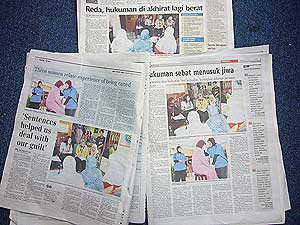 But when it came to the caning of three Muslim women who were charged with committing illicit sex, the government via the Home Ministry found whipping these women to be ‘right'.
Why this hypocrisy? Can Najib explain? The fact that these three women were caned a week earlier before the announcement of their whipping was disclosed tells a lot about the government's insensitivity and disregard for the human rights of women.
Since 1995 Malaysia became party to the United Nations Convention on the Elimination of All Forms of Discrimination Against Women (CEDAW) which means the country's leaders are committed in upholding respect and equality for women. Did Najib and his people conveniently forget that international human rights norms censure whipping and want it abolished or are they plain ignorant?
There are so many inconsistencies in safeguarding the welfare of women in Malaysia. Take for example Article 8 of the federal constitution which guarantees equality for women in Malaysia.
But yet for the Muslim women they are subjected to whipping whereas women of other faiths are not. Again, under the federal law a woman cannot be whipped but under the Syariah law she can.
Until and unless the rights of women in Malaysia are respected and upheld, the International Women's Day will remain far from the grasp of women in Malaysia.


Are you sure you want to delete this comment?
This action cannot be undone.