




The lie of the GST
There’s an old saying: a lie is a lie is a lie, whichever way you care to spin it. There’s another saying: there are only two certainties in life — death and taxes. And so when you put the two adages together, what do you say about the on-again off-again good-and-services (GST) proposal by the Najib Razak regime? Very simply: a tax is a tax is a tax, whichever way you care to spin it.
There’s an old saying: a lie is a lie is a lie, whichever way you care to spin it. There’s another saying: there are only two certainties in life — death and taxes. And so when you put the two adages together, what do you say about the on-again off-again good-and-services (GST) proposal by the Najib Abdul Razak regime? Very simply: a tax is a tax is a tax, whichever way you care to spin it.
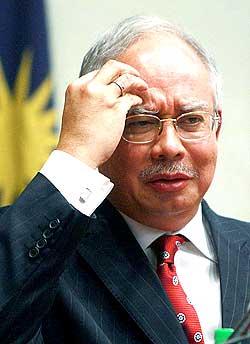 Much has been said why the Najib regime suddenly backed off bringing in the GST. It’s clear, from all accounts, that no comprehensive consultations were undertaken by the regime that would include and not preclude nor exclude some or more constituents. And to that end the proposed GST, it seems to me, was wholly politically shortsighted but also politically engineered or motivated.
The underlying motivation is what to do about the Malaysian economy that is bleeding from a few gashes to its wrists. With the world economy spinning into a global recession, and Malaysia’s key export markets collapsing around the knees, Kuala Lumpur (or Putrajaya) dithered even as the possibility of a real recession loomed larger by the week.
Its response to the crisis was to pump prime the economy. In late 2008 Najib, who also doubles as finance minister, threw RM7 billion at the economy, hoping that this would put a line beneath the economy by bolstering domestic aggregate demand. This amount of money, even in contemporary Malaysian terms, was simply paltry when the regime’s cronies are known to milk the state and the economy multiples of that figure. And that’s not counting the corruption within the regime and its security forces.
 Klang MP Charles Santiago (
right)
wrote then that the fiscal stimulus package should have come sooner in 2008, not later. He was right: the economy was already headed into a tailspin. Something else Najib did was that instead of finding creative ways of using public finances — the people’s taxes — to bolster the economy and throwing it around wildly as he did, he moved to shore up Valuecap to the tune of RM10 billion in a bid to put a floor under stocks whose values were crashing like typical Malaysian landslides, thanks to shoddy developers and local and state authorities who feed off each other.
Klang MP Charles Santiago (
right)
wrote then that the fiscal stimulus package should have come sooner in 2008, not later. He was right: the economy was already headed into a tailspin. Something else Najib did was that instead of finding creative ways of using public finances — the people’s taxes — to bolster the economy and throwing it around wildly as he did, he moved to shore up Valuecap to the tune of RM10 billion in a bid to put a floor under stocks whose values were crashing like typical Malaysian landslides, thanks to shoddy developers and local and state authorities who feed off each other.
EPU asleep
Nothing happened as a result of that stimulus package. Even the regime’s Malaysian Institute of Economic Research, a think-tank, said the stimulus packages were not working, given by the business and consumer confidence indices, which were collapsing to historical low points. And still Najib, who is now postulating a new economic model for Malaysia, sat on his hands. As did the much-vaunted Economic Planning Unit attached to his ministry. Did the EPU fall asleep or was the crisis way over its head?
The second stimulus package in March 2009 totaled RM60 billion. Enough to save the economy? By all evidence to date: no. The economy slipped deep into recession and is now desperately trying to crawl its way out of the doldrums with domestic aggregate demand as weak as export orders from Malaysia. And with the world economy still anemic, with the possibility of a second round of recession in Malaysia’s key export markets in the United States and Europe, there is an even chance the Malaysian economy could slip into a double-dip recession.
And that means the regime throwing more money at the economy. At almost eight percent of gross domestic product, Malaysia’s fiscal stimulus package is the third largest after China and Saudi Arabia. And its barely surprising because, as in the 1997 Asian financial crisis, and the so-called great financial crisis the last couple of years, the Malaysian regime again failed to undertake real economic reforms. One would have thought that historical lessons would have been learnt after every crisis.
In Malaysia the ruling elite and the bureaucracy poorly learn lessons in the same way that Malaysia’s education system has continuously failed to teach Malaysia students anything of real value that could be intrinsically linked to the primacy of the idea of the accumulation and praxis of knowledge — other than rote-learn for valueless public examinations. There have been many missed opportunities, and deliberately so, because of the system of patronage that works in Malaysian society, politics and economy. And all of this is linked to the centrality of the regime survival.
As debt deepens in Malaysia, especially budget deficits as a result of wild and woolly nature of that spending that added to nought in terms to turning the economy around on that basis, new revenue would have to be raised, especially at a time when the cost of borrowing, in relative international terms, is still prohibitive, and as the risk of Malaysia’s international credit rating taking a hit.
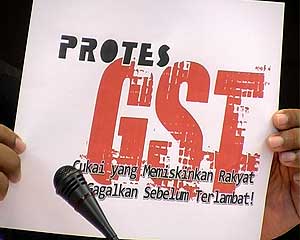 The goods and services tax that was proposed was nothing more than the cynical opportunism that is the hallmark of the UMNO and Barisan Nasional regime to ensure its fiscal debt does not impair the possibility of the regime continuing with funding those projects that would bolster its own stocks by saving the regime’s cronies.
Cheer squad
And if you think this is being overly cynical, do the research and see which business or industry sectors were the loudest in their praise of the regime’s stimulus packages. The first one was hailed loudly but the second stimulus package had the regime’s biggest cheer squad parading wildly in their boardrooms. They saw the possibility of making money and returning little in the way of real value to the real economy. Just look at the unemployment figure in Malaysia, even today.
Not that there is much wrong with any GST if it is introduced after a lot of soul searching and a lot of community-level consultations. Because a 10 percent GST means a 10 percent increase in prices of all goods and services. And 10 percent could tip the scales in not ameliorating but adding to the misery of poverty amongst most Malaysians, including the lower middle classes. And in the short to medium term it would also mean Malaysian exports would be less competitive, especially as the world economy looks likely to bump along the bottom for several more years.
Any GST implementation must see a reciprocal improvement in efficiencies across the board, productivity increases that would lead to increases in real wages. There is nothing more politically disastrous than find the income-output gap widen to the extent that people start rebelling against the regime. Not that they haven’t already but they would be justified to pour into the streets and burn down the UMNO and BN flags. The scale of justice that is the emblem of the BN flag is a lie. So the GST is a lie. Just as the Najib regime is founded on a series of cowardice, lies and deceptions.
Given the state of social, political and economic realities in Malaysia, the GST is unjustifiable. But if it could be justified, then the regime needs to compensate Malaysians and business in sync by reducing income and corporate taxes. Because that would give people back some disposable income but never, from all the evidence I have read from all the countries that have implemented versions of the GST, to truly compensate the people in full.
No evidence
There is not a shred of evidence anywhere that shows GST will bring down prices. That’s pure fantasy and an outright grand lie. GST will — and has — increased prices everywhere. And incomes have not grown for most people sufficient to match price increases that were brought on by the introduction of the GST. In fact, prices rises are linked to exogenous and endogenous factors. Prices that rise outside of the ambit of the GST are related to cost-push and demand-pull factors and resource scarcities.
You can see this through opportunity costs curves. Any price increase from any of these factors will not only climb by that number but greater once slapped with the constant percentage of the GST. It’s a double-whammy that nobody in their right minds ought to put up with if their real incomes are not also rising. And they won’t unless efficiencies are gained and productivity is improved.
The problem here is that there have not been any real microeconomic reforms in Malaysia because, as always, either the UMNO regime has dithered on this yet again or that such reforms are way out of its depth. And Malaysian businesses would be loathed to offer wage and salary increases even if efficiencies and productivity have improved. That’s clear. And if they are to be given, then the incentive must come from the regime with compensatory cost measures, such as decreasing business’s tax burdens.
Problem is, there are good businesses that do things by the book, and there are businesses that do not. The latter are the regime’s cronies. Given this, there is no way in hell for the regime to implement tax reforms that are uniform across the economy and that are wholly transparent. And there has to be income tax cuts too if the GST were to be implemented.
Since the entire GST argument that has been put forth by the Najib regime lacked transparency through and through — and how can it be transparent when the regime itself is not — it is testimony to the political spirit of Malaysians to have raised their doubts and anger as bluntly as they have in stopping the perpetration of this grand fraud by the Najib-led UMNO-BN regime.
MANJIT BHATIA, an academician and writer, is also research director of AsiaRisk, a political, economic and risk analysis consultancy in Australia. He specialises in international economics and politics, with a focus on the Asia-Pacific.


Are you sure you want to delete this comment?
This action cannot be undone.