




What democracy is not
commen t Last March 21 erstwhile Prime Minister Mahathir Mohamad wrote an article in his blog about democracy. To him democracy is
i. about giving power to the majority;
ii. that the majority knows what is best for the whole;
iii. that the minority should therefore be prepared to accept the rule of the majority albeit after presenting opposing views and criticisms; and
iv. that the minority must be prepared to wait for the next election in order to make another bid.
I could not agree with any of these features and would now list my arguments for saying so.
Last March 21 erstwhile Prime Minister Mahathir Mohamad wrote an article in his blog about democracy. To him democracy is
i. about giving power to the majority;
ii. that the majority knows what is best for the whole;
iii. that the minority should therefore be prepared to accept the rule of the majority albeit after presenting opposing views and criticisms; and
iv. that the minority must be prepared to wait for the next election in order to make another bid.
I could not agree with any of these features and would now list my arguments for saying so.
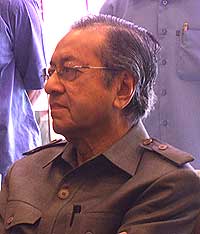
Principally, Mahathir ( left ) seems to equate democracy solely with the principle of franchise or right to vote within context of a political organisation and system. In reality the word majority in fact refers to the decision-making process when alternative opinions and view are put to vote for a (majority) decision - within political or social, economic or even bureaucratic contexts.
Let me illustrate by making an example. The Bar Council, say, is in the process of electing its next President, with two contenders. The council meets and debate about the merits of each candidate and then put their choice to vote. The candidate garnering the majority vote gets the post. This is the concept of the majority in a democracy at work; in this case within context of a social and civic organisation.
The same principle is also true when the government of the day in, this case the Barisan Nasional coalition, debates about a possible new law. The legislative assembly in the house of parliament would debate the case of the GST or even the NEM, for example. All representatives would then contribute their opinions and views. At the end of the debating period the representatives would then put the issues to vote, and if the cases get the majority vote then the GST and NEM become law. If not they will be rejected.
The important point is that when the lawyers vote for their choice for next president, they do so directly in their individual capacity and using their voting power as members. In the government context the individuals vote indirectly, i.e. via their elected representatives.
Either way the power to cast votes and therefore the democratic power rests with the individuals.
To surmise, power in a democratic system of government rests always with the people:
i. The people give the legislators their trust in formulating laws with the legislators therefore acting on the people's behalf.
ii. Once a law is passed it is executed by the people's agents or employees in the form of the civil servants.
ii. Just like the legislators, the civil servants are appointed to do work in the name of the people. Remember the good old days when civil servants sign off with the note of subservience ‘Saya yang menurut perintah' or your obedient servant? This captures the essence of people power governing the government bureaucracy in this case.
iv. All laws are interpreted by the judges, again acting in the name of the truth, fairness and justice.
v. The military and police personnel work to maintain the external and internal safety and security of the people in the name of the people.
vi. Just to make it watertight, all of these legislators, executives, agents and bureaucrats are paid from the coffers of the country - from the money paid as tax by the people. All of these institutions are thereby accountable and responsible to the people who pay them their salaries.
The great thing about democracy and its inherent people power is the following features that it holds, which have in turn evolved from its early birth over one thousand years ago in ancient Greece to the present day:
i. It gives due respect to human rights, as stipulated by the UN Declaration of Human Rights 1948. Every human being is guaranteed his right to seek his own happiness - and freedom of speech, expression, and of religion.
ii. The country adheres to the rule of law, where the law is king. A good feature of a democracy is that the legislative arm of the government holds an arm's length relationship with the executive and judiciary.
iii. There is separation of power between the legislators, the executive and the judiciary; there is this element of check and balance between them. This is an entirely wise evolution for its close implementation will minimise collusion between them. In this way the people's interest will be better protected.
iv. The incumbents in all of the branches of the government do their job with transparency, responsibility and with their greatest talent, knowledge, skill and wisdom. They have to be for these bureaucrats are at any time accountable to the people.
Economic dividends
Modern academics and thinkers have noted that there is a direct co-relation between the development of good democratic practices with the healthy growth and development of an economy. This is of course a broad subject of study, but suffice it is to state that countries like the US, UK, Australia, Canada and most of Western Europe developed their economies to what they are today partly due to their healthy application of the democratic ideal briefly outlined above.
There must be plenty of truth here. Let's take the case of Japan. It was once upon a time an ancient and feudal polity. But at some point the country decided to embrace democracy and as they say the rest is history.
More recently South Korea did the same thing. After a series of military leaderships, the Koreans adopted democracy and today it is reaping the benefits of this transformation. It's per capita income has left us way behind although just a few decades ago they were behind us. It's cars are crowding Malaysian roads, its footballers conquering the world, its golfers the same. Taiwan's economy too is fairly advanced, most probably partly due to its democratic practices.
Indonesia is coming out of its dictatorial past and is now progressing well. China still professes socialism but it is tempered with capitalism and democracy.
The lesson to learn is that apparently good democratic practices yields some good dividends in the form of creating a good healthy climate for economic growth. This lesson should not be lost to our leaders. So should we still wish to join these advanced nations in 2020 we have to begin practising true democracy!
Mahathir's perception that power is given to the majority arises possibly from his experience leading the country for twenty-two years. As the majority of the people in this country are from the Malay ethnic stock.
So as Prime Minister, he engineered the election and voting processes to ensure that the majority of the representatives in Parliament are Malays. Virtually all government public policies were then formulated in favour of the Malays. Mahathir institutionalised racism in government administration, with the prolonged implementation of the NEP a good illustration. It is racist politics coming into play.
It does appear that Mahathir's ‘power to the majority' philosophy is a grand euphemism for a racist form of democracy. I'd cynically call it ‘Mahathircracy' to distinguish it from true democracy.
One thing is certain about racist democracy, or Mahathircracy, it does not work. It has not been able to honour any of the ideals mentioned above. Instead the ills of democracy are rampant in the current Malaysian polity:
i. Violation of basic human rights like freedom of speech, expression, and of religion, is rampant.
ii. The country adheres to the rule of private individuals. The fact is that the arm's length principle of separation of powers has been broken, and the legislators are in control of the executives and the judiciary.
iii. The incumbents in all of the branches of the government do their job with scant regard for transparency and sense of responsibility to the people. They become answerable to their political masters.
The unhappy result is the nightmarish social, economic and political mess we are going through today.
Majority doesn't always know best
Mahathir assumes that the majority knows best. In the case of Malaysia this is tantamount to saying that since the Malays are the majority of people in power then their decisions and the public policies they spew and implement are the best for the country. This assumption is of course grossly subjective and can very often be wrong.
I support my contention by stating that generally speaking the Malay-majority power players have been concentrating their attention to develop and propagate Malay interest. The (prolonged) NEP for example was formulated to cater for Malay interest. The push for Malay to be the national language is another, as is the push to make Malaysia into an Islamic state. To state that public policies such as these were made in the ‘best interest' of the country is a delusion.
There are countless other policies that are blatantly racist in nature. So much so that they tamper with the equation that democracy equals healthy economic development.
Sadly the mainstream Malay person seems unaware of their existence for they live in a constant state of denial and delusion.
The delusion is apparent when we see the end products of these policies: racial polarisation, poor domestic and foreign investment, migration of good talent and experience into other countries.
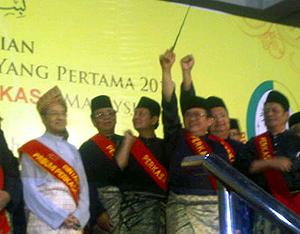 As if on cue, the birth of Perkasa seems to provide a most pertinent example of Mahathircracy waving the flag of ‘power to the majority'. In its first AGM, Ibrahim Ali, founder reportedly stated (
Malaysiakini
Mar 27) that Perkasa as a group aims to "defend Islam, the special rights of Malays and bumiputeras".
As if on cue, the birth of Perkasa seems to provide a most pertinent example of Mahathircracy waving the flag of ‘power to the majority'. In its first AGM, Ibrahim Ali, founder reportedly stated (
Malaysiakini
Mar 27) that Perkasa as a group aims to "defend Islam, the special rights of Malays and bumiputeras".
He is saying in effect that
i. Political power must remain in the hands of the Malay majority. He ignores totally the meaning of majority in an open democratic social economic and political environments. He ignores the all important item that in a democracy power remains in the hands of the people.
ii. That the Malay majority leadership knows what is best for the whole country; which is a delusion as seen from the negative economic, social and political features to which the country is painfully undergoing. We are going through a very difficult period of our development because of the bad calls made by the Ketuanan Melayu leadership.
iii. The non-Malay segments of the population (specifically the Chinese) must be contained and not allowed to bully the Malay.
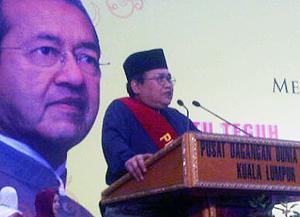 Even casual observers can see that Ibrahim Ali's statements echoes Mahathir's ‘power to the (Malay) majority' standpoint. Indeed it is arguable that the Perkasa movement is the rebirth of Mahathir's racist policies that seemed to have faded. But for reasons best known to him, Mahathir is trying to revive this jaded horse, one that deserves an early death in any case. That Mahathir formally declared open the AGM speaks volumes in support of this contention.
Minority rights
As for Mahathir's exhortations that the non-Malay minority should be prepared to accept the rule of the majority I do think this is another ‘made by Mahathir' form of democracy.
It's hardly a fair thing to ask for. This is because he has hijacked the people's power, deposit it in the arms of the Malay-bloc representatives, allow the Malay representatives to create laws that favours the Malays but could be detrimental to the country, and then expect the minority people to just follow like idiots.
Suffice it is for me to say that in democracy there is this thing called the ‘tyranny of the majority'. When Mahathir did everything to promote Malay majority interest over and above the minority interest, he did so within the context of a win-lose zero-sum game: he takes away non-Malay interest in order to beef up Malay participation in the economy.
In addition he had no tolerance for dissenting views. Such views would come from many sources: the liberals from the Malay community for one, the non-Malays for another and the international human community as well. He ignored all of them.
He also muted potential sources of dissent, he introduced or renewed laws designed to silence dissent, like the ISA and the OSA.
And this where he had to come up with his concept of power to be held by the majority: his regime has been featured by oppression suppression, the breaking down of the rule of law, of the check and balance, breaking down of vital public institutions like the judiciary and education.
Virtually all observers and commentators to the country's wellbeing are agreed on the contention that the country is now on a tailspin to oblivion.
In a nutshell the equation that people power equates with democracy equates with economic development seems to apply here as well. When you take away people power, you tamper with democracy and you get a retarded economic growth. The proof to this contention is clear and everywhere for all who want to see. And this pretty sums up the democracy as perceived and applied by Mahathir.
AB SULAIMAN is an observer of human traits and foibles, especially within the context of religion and culture. As a liberal, he marvels at the way orthodoxy fights to maintain its credibility in a devilishly fast-changing world. He hopes to provide some understanding to the issues at hand and wherever possible, suggest some solutions. He holds a Bachelor in Social Sciences (Leicester, UK) and a Diploma in Public Administration, Universiti Malaya.


Are you sure you want to delete this comment?
This action cannot be undone.