




Local polls benefits outweigh dangers of racial imbalance
Discussions on local elections in Penang rage on with civil society representatives rejecting Putrajaya’s claim that it will cause imbalances in racial representation.
Discussions on local elections in Penang rage on with civil society representatives rejecting Putrajaya’s claim that it will cause imbalances in racial representation.
Putrajaya’s claim that local elections should not be held as it could cause imbalances in racial representation, is unfounded as the benefits of participatory democracy far outweighs any ethnic encumbrances, said a former advisor to the United Nations.
The f
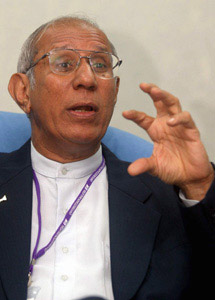 ormer Asia Pacific regional advisor on Urban Governance for the United Nations Anwar Fazal (
left
), said a report on the royal commission of inquiry into the working of the local authorities, popularly dubbed the Athi Nahappan Report , in the early 70s, deliberated in depth on the issue of racial polarisation and inequity.
ormer Asia Pacific regional advisor on Urban Governance for the United Nations Anwar Fazal (
left
), said a report on the royal commission of inquiry into the working of the local authorities, popularly dubbed the Athi Nahappan Report , in the early 70s, deliberated in depth on the issue of racial polarisation and inequity.
“After careful consideration the commission unanimously came up with the conclusion the benefits of local participatory democracy far outweighed any ethnic encumbrances,” he told Malaysiakini .
“And since then the cities have become more culturally diverse, further strengthening the case for democratic local governance; also local participatory governance is not just for the big towns but also the small ones and villages,” he added.
Anwar was responding to a recent remark about local elections by Housing and Local Government Deputy Minister Lajim Ukin who said the Najib administration has rejected the proposal to hold local government elections as it will cause a racial imbalance.
He added that most non-Muslims live in the cities while the bumiputeras are in the outskirts and there will be an imbalance in racial representation in local governments, if elections are held.
Democracy not hindered
The current system was adequate and did not hinder democracy because the public could vote every five years for their MPs and state lawmakers, he further said.
Anwar countered by saying that the weightage of urban constituencies to rural ones is simply too great; a vote in the urban areas is often shockingly less than that of the vote in rural constituencies.
For local government to mean anything, it really must be local and a system of perhaps non party local elections for a fourth vote and smaller based community councils should be established, systematically incorporating resident associations, rukun tetanggas and village committees,” he said.
Since Penang has two very large local authorities which should serve more as metropolitan councils, Anwar proposed a new system of people friendly community liaison officers be created to link with grassroots communities.
“Too many local authorities are often delinked from the grassroots except as enforcers,” he added.
“Overall, local government in Malaysia needs a serious looking into. Perhaps, a royal commission to look at both electoral integrity and local government elections should be considered,” he suggested.
 Penang Local Government Working Group committee member Goh Ban Lee (
right
) said Lajim’s assumption of racial imbalance if elections were held was not well established.
Penang Local Government Working Group committee member Goh Ban Lee (
right
) said Lajim’s assumption of racial imbalance if elections were held was not well established.
In the 50s and 60s when local elections were held, the boundaries of towns, especially state capitals were small and composed of largely non-Malays, Goh told Malaysiakini .
“Since the restructuring of local government with the implementation of the Local Government Act of 1976, the boundaries of local authorities were enlarged and the ethnic mix of most local authorities is rather well balanced,” he said.
“For example, although George Town had a high percentage of Chinese population in the 60s, the present municipality of Penang island has a rather balanced ethnic mix,” added the academic who is interested in urban governance, housing and urban planning.
Wrong assumption
 Goh said it was wrong for Lajim (
left
) to assume that local elections have a history of race biased voters as the election for the George Town municipal council in the 1950s was free of racial bias in the voting pattern.
Goh said it was wrong for Lajim (
left
) to assume that local elections have a history of race biased voters as the election for the George Town municipal council in the 1950s was free of racial bias in the voting pattern.
“The problem of race as a factor in elections is not caused by the proportion of ethnic mix of the electorates, but the existence of race-based parties,” he said.
“If the government is worried about racial imbalance in the local councils, the most appropriate thing to do is to ban such political parties,” he added.
Goh said the present system of appointed councillors and presidents or mayors does not really reflect the wishes of the people.
“For example, there is no doubt that in Selangor, if there were local government elections, the BN would control some municipalities or district councils,” he added.
“Conversely, some local councils in Malacca, Johor or Negeri Sembilan could be under the control of PR. This will make local councils more interesting,” he further said.


Are you sure you want to delete this comment?
This action cannot be undone.