




Religion is the business of the individual
There are two items of Islamic logic that never ceases to puzzle me.
One is the claim that truth in Islam is certain and final and free from doubt and error, so much so that ordinary mortals just have to pay obeisance but never to question it.
There are two items of Islamic logic that never ceases to puzzle me.
One is the claim that truth in Islam is certain and final and free from doubt and error, so much so that ordinary mortals just have to pay obeisance but never to question it. Two, all religious matters and issues are to be delved into exclusively by the ulamas.
I have been pondering over these two items for a very long time. I have this nagging feeling that there seems to be some inherent contradiction within each of them. The first is, if truth is final and certain why then the contradiction in the fear it being questioned?
As to the second, how is it that only the ulamas are qualified to address religious issues?
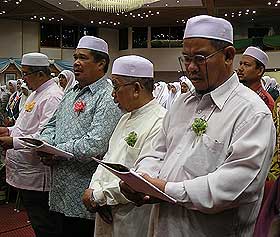 These items have two distinct features. One, they are unilateral declarations to begin with i.e. claims made by solely the collective Islamic philosophy. They thereby do not have second or third party opinions to substantiate them. They are subjective, not objective, claims. They have no third party substantiation.
Secondly, they cannot and would not withstand any strong intellectual or logical and rational scrutiny from second or third parties. They are ‘indefinite knowledge' and ‘cultural truth', two labels I shall describe in detail later below.
Case study
I might be talking too conceptually for some, so let me translate these views with the real world - a case study.
One such case came out to the public domain recently.
It started when a blogger who called himself JB Atheist wrote an article in Malaysiakini (March 18) In defense of atheism where he contended that atheists adhere to human rationality and scientific reasoning.
This was followed a week later by Fathima Idris who wrote that science and faith complement each other (March 26). She replied to the first article and adding that human rationality and scientific reasoning alone is insufficient to explain and understand this world.
There must be elements of faith and belief leading to wisdom to make this world more understandable, more meaningful and more purposeful. So to her the scientific world should be pragmatically complemented with the principles of faith and belief.
Later in the month (March 30) The Star newspaper published an article ‘Let religion be the business of the experts' by Dr Wan Azhar Wan Ahmad from Ikim.
Wan Azhar came with the rather rigid, subjective and exclusive claim that this world is Islamic and that Islam is so fine, so pure and so precise so much so that only the experts can have any idea of its finer points and meanings. So as to its interpretations just "leave Islam to Islamic experts," he said.
 For ordinary non-expert Muslims and all non-Muslims, he just cautioned them to stay away completely.
And so, we have three people expressing three very different views about one common item, religion; on practical, another pragmatic and the third exclusive.
Malaysiakini columnist Mariam Mokhtar has written substantively (‘Experts who control thought, speech' April 5) about this article and now I wish to add my input.
But first, I provide some background information and analysis as I am most aware that this subject is vast, emotive and heavily laden with prejudices and other sentiments. So people can easily misconstrue any alternative views to whatever present perceptions they may hold, and be affected by them. I wish and hope to avoid this.
This issue touches upon the word ‘truth'. Apparently human beings are very jealous of their perception of truth and religious truth is right on top of the heap. Thus any hint of (what appears to be) criticising religious truth is bound to trigger very many emotional (and even practical) shootouts and explosions.
Secondly, this analysis requires the presence of an open mind, i.e. of the readiness to accept the possibility of alternative views and opinions. The generic Malay mind is arguably ethnocentric i.e. having a closed mind and not quite open to new alternative view and opinions. So they have to open up a bit to appreciate the following arguments.
Knowledge and truth
With this in mind I'd limit my attempt to expose these three divergent views to the two operative words knowledge and truth.
Knowledge is the wisdom or awareness of the existence of an idea, thing or people. It is the opposite of ignorance.
Knowledge comes in two forms, definite and indefinite.
Definite knowledge is one its meaning or message of which is accepted by human rationality. As an example I say that ‘the sun rises in the east', or ‘a cow has four legs' statements that are accepted by the human rationality each time and every time.
Other illustrations for definite knowledge are plentiful here and I'd mention just a few. The capital of Japan is Tokyo, the moon moves further away from the earth at the estimated rate of one inch and a bit per year, tsunami are caused by tectonic plate movements and massive coastal landslides, epigenetics is one new area of human study. Who would dare challenge the universal truth of these points?
Indefinite knowledge is when I say something to which the human rationality has not yet accepted as fact, like for example ‘jinns exist'. This usually comes as wisdom the present generation inherits from the past. Such wisdom is seldom if ever given any doubt as to its truthfulness. It's just accepted as true.
Now some segments of the human race, especially Muslims accept their existence as fact. While this is true, the fact still remains that this is true only to Muslims. Other members of the human race, like the Christians, do not believe in the existence of jinns at all.
Directly connected with knowledge is the word truth. Truth is the absence of falsity.
Analogous to knowledge, truth can be categorised into two types, cultural and universal.
Universal truth is when its message is accepted as true by all segments of the human population, just like the illustration of a cow having four legs.
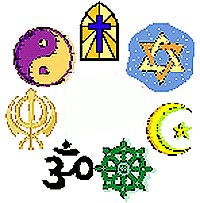 Cultural truth is when its message is accepted as true only by a segment of the human population, while the other segment would not accept it at all. The existence of jinns above is a good illustration, for only the Muslim segment of the human civilisation would agree readily to their existence. Non-Muslims do not believe in jinns, not in the form as perceived by Muslims anyway.
A little pondering over these four principles (definite and indefinite knowledge, universal and cultural truth) will reveal the following conclusions:
i. Indefinite knowledge leads to cultural truth; and,
ii. Definite knowledge leads to universal truth.
Religion, any religion especially the organised ones, would belong to indefinite knowledge. Its truth would thereby be cultural, not universal. This explains why all religions have their own sets of worship, belief parameters, rituals and liturgies.
Commenting on Islamic issues
After this brief analysis we come back to the postulation that non-trained Muslims and non-Muslims must not comment on Islamic issues.
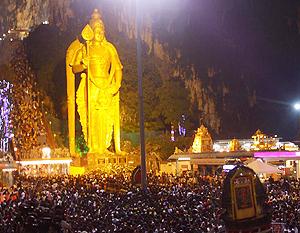 The ‘indefinite' nature of religion has made this wisdom quite arbitrary: there is nothing definite in any religion after all, not only in Islam. For example, Islam believes in the Hereafter. This is the (cultural) truth of the Muslim, and there are one billion Muslims in this world.
But remember Hinduism believes in the transmigration of souls. This is therefore the cultural truth to Hindus, and there are over one billion Hindus in this world.
The fact remains that religion is thus very much an indefinite item. Each belief is true only to its own adherent. So the statement that non-experts should not tinker with Islam is just absurd. It does not hold water. For non-Muslims not to comment on Islam is all the more absurd.
In any case, even within Islam the indefinite nature of religion has produced many different clones or interpretations. I'd mention a few if I may.
First there is the split between the Sunni and the Shiite. Then came the four different Imams Hambali, Maliki, Hanafi and Shafie, leading to their respective four sects. After this we have the many smaller sects like the Fatimids, the Ismailites, and the Ahmaddiah, as well as the Wahhabbis.
I dare say without fear of contradiction that each Islamic country in this world has its own interpretation of Islam. Indonesian Islam has its on variations, as does Mauritian Islam; they do have and are proud of their differences with the Islam as practiced by the Ketuanan Melayu.
Islam in Malaysia
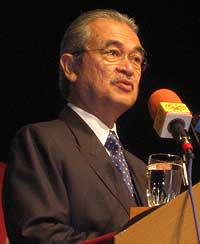
Even here in Malaysia we have Islam Madhani, and during the tenure of Prime Minister Abdullah Ahmad Badawi ( below ), Islam Hadhari.
 Each of these sects and sub-sects had their own ulamas who could then issue
fatwa
. Each state has its own Islamic department also with its own ulamas (in the form of muftis) and they too produce their own
fatwa
. Some
fatwa
can even contradict some other
fatwa
!
Each of these sects and sub-sects had their own ulamas who could then issue
fatwa
. Each state has its own Islamic department also with its own ulamas (in the form of muftis) and they too produce their own
fatwa
. Some
fatwa
can even contradict some other
fatwa
!
These variations vary - some subtly (e.g one government religious department not allowing a religious head from another department to teach in the former's area of jurisdiction), but others fairly enormously (e.g. the Sunni-Shiite split, the persecution of the Ahamadiah or Qadyani sect).
Where then is the definite feature of Islam and its universal truth?
Oh, the split never ends.
So to JB Atheist I say good on you for having discovered your ‘truth' in the form of scientific reality and human rationality. Good on you, too Fathima Idris for having found the balance between the world of faith and of science. You have been able to solve the contradiction between the world of atheism and of religious belief.
You have identified the essence of religion from deep within you and have found the answer that is right for you. Religion is indeed an individual person's choice and belongs to him alone.
But for Dr Wan Azhar, I do request you to ponder over my analysis between definite and indefinite knowledge, and their respective end-products of universal and cultural truth. Try to see the contradiction between JB Atheist's atheism and religion like Fathima has done, as well as the contradiction between Fathima's pragmatism and your Islamic subjectivity and exclusivity.
Try to resolve the contradictions by using the principles of definite and indefinite knowledge and universal and cultural truth. You never know what you might get.
AB SULAIMAN is an observer of human traits and foibles, especially within the context of religion and culture. As a liberal, he marvels at the way orthodoxy fights to maintain its credibility in a devilishly fast-changing world. He hopes to provide some understanding to the issues at hand and wherever possible, suggest some solutions. He holds a Bachelor in Social Sciences (Leicester, UK) and a Diploma in Public Administration, Universiti Malaya.


Are you sure you want to delete this comment?
This action cannot be undone.