




A return of 'Mahathirism'?
Information gags, restrictions and intimidation continue to be part and parcel of daily life for the Malaysian media, as the world marks Press Freedom Day today.
Information gags, restrictions and intimidation continue to be part and parcel of daily life for the Malaysian media, as the world marks Press Freedom Day today.
The past 13 months have been quite rough for the media here, with the alleged return of 'Mahathirism' when Najib Abdul Razak took over as prime minister on April 3 last year.
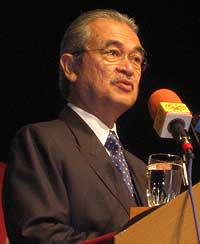 His predecessor Abdullah Ahmad Badawi (
left
), at last year's Umno congress, even clued the public in what turned out to be his outgoing speech as the party president.
His predecessor Abdullah Ahmad Badawi (
left
), at last year's Umno congress, even clued the public in what turned out to be his outgoing speech as the party president.
He warned of some elements in Umno bent on going back to the "old days" of "restricting the freedom of our citizens and silencing their criticism".
"If we revert to the old path I believe we are choosing the wrong path; one that will lead to regression and decay," Abdullah said.
Pundits and opposition stalwarts pounced on his statement, claiming that it was a subtle reference to the return of oppressive policies of his predecessor Dr Mahathir Mohamad, the source of the term 'Mahathirism'.
Whether or not Abdullah actually intended it as such, the many things that have happened in the short time that Najib has been in power, only gives credence to his opponents' accusations of a Mahathir-era revival.
The first strike
Najib fell into the bad books of the Centre for Independent Journalism (CIJ) and the Writers for Media Independence (Wami), when his administration barred online news portal MerdekaReview.com from covering the announcement of his cabinet line-up.
This raised eyebrows, and the perception quickly spread that it was only the beginning of tightening media control, considering that the portal had earlier posted commentaries criticising pro-Najib articles from other publications.
The events that unfolded and the reaction from Najib's administration after that incident only served to reinforce the notion that no longer will the media enjoy the relative freedom afforded by Abdullah in his five-and-a-half years in power.
Not that Abdullah's leadership was without pitfalls, with at least 45 books banned over the course of his tenure including work by noted scholars like John Esposito's What everyone Needs to Know about Islam and Karen Armstrong's The Battle for God: Fundamentalism in Judaism, Christianity and Islam .
 It was also during Abdullah's time when PKR's
Suara Keadilan
and PAS'
Harakah Daily
publications were taken off the streets for several months for their ‘alternative' views on the Perak state government tussle, where BN eventually wrested control of the state from the PR.
It was also during Abdullah's time when PKR's
Suara Keadilan
and PAS'
Harakah Daily
publications were taken off the streets for several months for their ‘alternative' views on the Perak state government tussle, where BN eventually wrested control of the state from the PR.
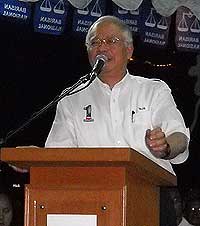
Though it was Najib ( right ) who lifted the ban on both Suara Keadilan and Harakah after he took office, that did little to soften the threats levied against his government's critics.
Malaysiakini came under pressure from the Malaysian Communications and Multimedia Commission (MCMC) to take down ‘offensive' videos of the cow's head incident - which showed protesters kicking and stepping on a cow's head to protest the relocation of a Hindu temple to a Muslim-majority area - and Home Minister Hishamuddin Hussein's defence of the protesters.
The police also got into the act, issuing a ban on any use of the name of murdered Mongolian model Altantuya Shaariibuu in campaign speeches.
Malaysiakini also reported that local television stations were ordered to avoid naming Najib's former aide Abdul Razak Baginda or any news related to him when reporting on the trial.
Speak no evil
Punishment was swift for those who did not comply with strict monitoring of on-air content, as experienced by NTV7's Florence Looi who was demoted to field reporting after panelists and viewers on her show gave not-so-flattering comments on Najib's performance in his first 100 days in power.
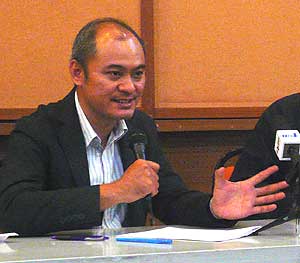 The station struck again in April, when producer Joshua Wong Ngee Choong (
left
)
resigned
after they forced his programme not to touch on the Hulu Selangor by-elections.
The station struck again in April, when producer Joshua Wong Ngee Choong (
left
)
resigned
after they forced his programme not to touch on the Hulu Selangor by-elections.
His claim was that his superiors were pressured to clamp down on his show after they received a text message from the Prime Minister's Department.
Hardly a week later, Chou Z Lam, a producer for RTM's TV2 station, quit after what he claimed was political interference when his documentary on the Bakun Dam was dropped allegedly due to BN's concerns that it might affect its chances in the coming Sibu by-elections.
Chou claimed in a blog post that newsroom head Jumat Engson told him the documentary was taken off the air because it had "sensitive elements that could be harmful (for BN)".
Removed from shelves
In keeping up with book banning tradition, Najib's administration pulled the rug from under the feet of cartoonist Zulkiflee Anwar Haque, better known as Zunar ( below ), when they seized copies of his work not once, but twice for "failing to secure a permit for publication".
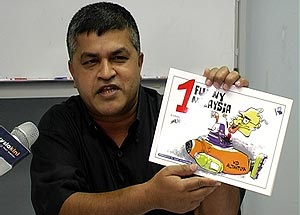 Authorities confiscated Zunar's books, first being
Gedung Kartun
in August last year and later his
1Funny Malaysia
books in January this year, despite his contention that he had acquired the necessary permits.
Authorities confiscated Zunar's books, first being
Gedung Kartun
in August last year and later his
1Funny Malaysia
books in January this year, despite his contention that he had acquired the necessary permits.
Also added to the government's list of undesirable books was the Malay translation of the Bible which contained the name ‘Allah'.
Some 15,000 copies of the translated version of the Bible were seized in Sarawak late last year, sparking a long-drawn legal battle between the church and the government over the use of the name, and a spate of attacks on houses of worship across the country.
Najib had said very early on in his post as Prime Minister that he was all for "embracing" the new media and "promoting a free environment".
But while there has been small victories for the case of media freedom, such as the court decision to overturn a ban on the book Muslim Women and the Challenge of Islamic Extremism published by Sisters in Islam (SIS) earlier this year, there is still a long way to go before Malaysia can truly celebrate World Press Freedom Day.


Are you sure you want to delete this comment?
This action cannot be undone.