




Non-Chinese teachers not welcome
The Sabah Education Department (SED) has ‘given up’ on resolving the snowballing chronic teacher shortage in Chinese primary schools in the state.
The Sabah Education Department (SED) has ‘given up’ on resolving the snowballing chronic teacher shortage in Chinese primary schools in the state.
This reportedly follows their refusal to accept even Chinese-speaking non-Chinese teachers.
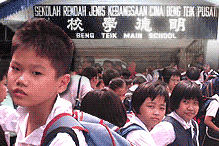 “There are bumiputera teachers who can speak Chinese but the Chinese schools still refuse to accept them. They only want Chinese teachers,” complained state education director Muhiddin Yusin. “I don’t have the figures offhand but these kinds of incidents have happened.”
He assured that Sabah had enough teachers for Chinese schools in the state but not all of them would be, or need to be, Chinese or Chinese-speaking. He denied that the Chinese schools were being very badly treated by the SED compared to government schools.
The state education director sees no reason why the Chinese schools should insist on Chinese teachers for subjects like English. He has seen a non-Mandarin-speaking Chinese accepted to teach the subject, but not a Mandarin-speaking non-Chinese teacher.
Muhiddin was responding to a statement last weekend by LDP (Liberal Democratic Party) secretary-general Teo Chee Kang and others on the simmering issue.
'Loss of identity'
Teo had claimed that Chinese vernacular schools would gradually lose their identity if they opened their doors to teachers who cannot speak the language. This also applied to subjects which were not taught in the Chinese language, according to him.
Likewise, DAP Sabah has been beating the drums on behalf of the teacher shortage in Chinese primary schools in the state.
 “The SED’s offer to send non-Mandarin speaking teachers to Chinese schools is disrespectful,” warned Kota Kinabalu MP Hiew King Cheu (
right
). “It is very obvious that the SED is only good at making excuses to force the issue.”
“The SED’s offer to send non-Mandarin speaking teachers to Chinese schools is disrespectful,” warned Kota Kinabalu MP Hiew King Cheu (
right
). “It is very obvious that the SED is only good at making excuses to force the issue.”
State Minister in Charge of Education Masidi Manjun stressed that the onus is on the Board of Directors of the independent Chinese schools whether to accept non-Chinese teachers or not.
“It’s their decision. We can’t force them. However the SED is ready to provide them with teachers to resolve the chronic shortage,” said Masidi.
He added that the issue of identity raised by Chinese schools doesn’t make sense. “Those who were taught by Englishmen in Sabah during the colonial era did not turn into Englishmen.”
Race not the issue
Teo meanwhile denied that race is an issue.
He sees as the refusal of the SED to recruit temporary teachers as an interim measure as the stumbling block. This has apparently forced some of the better-funded Chinese schools to dip into their own coffers and employ temporary teachers. It is understood that all these temporary teachers are Chinese.
The LDP leader disclosed that he has also since discovered that some trained Sabahan teachers - presumably Chinese - were “exported” to other states instead of filling up the vacancies in Sabah despite the State’s acute shortage of teachers.
He does not know whether this is a deliberate attempt on the part of the SED to frustrate the Chinese schools on the issue, or out of genuine concern to alleviate the shortage of Chinese teachers elsewhere in the country.
“Priority should be given to Sabah which is facing a chronic teacher shortage in Chinese schools,” fumed Teo.
Teachers posted to Chinese schools ought to be able to communicate in Chinese so as to make teaching and learning easier, he added.
He cited Bahasa Malaysia as a case in point, where teachers who can’t speak Chinese are not assigned to teach the language (BM) from Primary 1 to primary 3 in Chinese schools in the state.
“The Chinese schools have an understanding on this with Deputy Education Minister Wee Ka Siong,” claimed Teo. “Government officers should not depart from this understanding.”
The multi-stream education system in the country, continued Teo, is a legacy from our forefathers way before independence, and should not be disturbed.
“In line with the spirit of 1Malaysia, diversity should be celebrated and not be repressed,” he pleaded.
According to estimates provided by the SED, the 83 Chinese primary schools in Sabah are currently short of 180 teachers. Apparently, this is a problem which has been worsening over the years but has now reached a crisis point with political ramifications.
There are four teacher training colleges in the state, sufficient to turn out the required number of teachers for Chinese schools. But it appears that many applicants to these colleges are rejected for any number of reasons.


Are you sure you want to delete this comment?
This action cannot be undone.