




Penang nowhere in sight in the 10MP
The Penang state government is horrified that Prime Minister Najib Razak's newly announced 10th Malaysia Plan does not have a programme for the state.
The Penang state government is horrified that Prime Minister Najib Razak's newly announced 10th Malaysia Plan does not have a programme for the state.
Socio-economic and environmental research institute (Seri) executive director Liew Chin Tong condemned the 10MP where programmes and projects are to be rolled out in two-year phases.
While Najib said it was to provide for more flexibility , Liew felt the premier was ‘misleading' the public with a mere policy speech as there were no mention how these would benefit the various states.
"It is not the Malaysia Plan as we understood it to be, so the PM is bordering on misleading Parliament because the 10MP is just a policy statement which has no details at all," Liew said in his presentation at the roundtable discussion on the New Economic Model and 10th Malaysian Plan at Seri's office in Brown Road today.
"I wonder what we will be doing next week in Parliament when we are asked to spent about ten days debating a policy statement," he added.
10MP--consultants' instant product
About 40 participants attended the discussion, organised by Seri, a Penang-based non-profit think tank and research institute set up in 1997, with focus on facilitating dynamic and sustainable development for the state.
The other speakers included Universiti Malaya's Technology and Innovation Policy professor, Rajah Rasiah and Seri Centre for Economics chairperson Toh Kin Woon.
 Liew, (
left
) who is also Bukit Bendera (DAP) parliamentarian, condemned the Plan which he claimed was "drawn up instantly by consultants".
Liew, (
left
) who is also Bukit Bendera (DAP) parliamentarian, condemned the Plan which he claimed was "drawn up instantly by consultants".
"We cannot have a Maggie mee policy where the PM just gets a group of consultants and sets a few pointers, this (Plan) should be a long-term process which must be based on thinking and vision," added Liew, who is DAP central executive committee member.
He said the 10MP has signified the end of the New Economic Model, which appears to be short-lived as the contents of the former contradicted the visions in the latter.
He added that the major differences in the two policies is that in the 10MP, Najib preferred to look after the 30% bottom income group, and not the 40 percent outlined in the NEM.
"Najib is really short-sighted because the 40 percent group also includes many poor bumiputra who deserve a lot of attention, this would ensure he stays in power longer," said Liew.
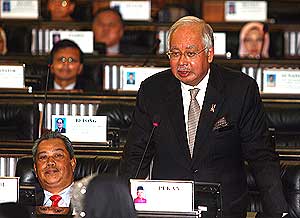 Unveiled on Thursday, Najib's (
standing in photo
) plan included targets of at least
30
percent bumiputera
equity in business ownership and various assistance for the community, from fixed price contracts for class F contractors for small businesses to concessions for privatisation contracts for mature companies.
Unveiled on Thursday, Najib's (
standing in photo
) plan included targets of at least
30
percent bumiputera
equity in business ownership and various assistance for the community, from fixed price contracts for class F contractors for small businesses to concessions for privatisation contracts for mature companies.
The plan also promotes privatisation , where it stated that regulations must be loosened to promote private sector involvement in ventures with the public sector but experts said this drive must be transparent.
Meanwhile, Toh said a development strategy that relies on even more private sector initiatives may be efficient in the generation of economic growth but it may not lead to a more egalitarian society.
"Widening social disparity is an obvious defect or failure of free enterprise, state intervention is necessary to correct this failure but this again may not work if the ideology practised is conservative and right wing," he added, during his presentation at the discussion.
Toh, who is LLG Cultural Development Centre president, said that only market intervention by a ruling coalition that at least adopts social democracy has some "ameliorating effect".
"The ideological orientation of ruling elites does affect the class nature of state intervention," he added.


Are you sure you want to delete this comment?
This action cannot be undone.