




Tian Chua files appeal over 'biting' ruling
Batu MP Chua Tian Chang has filed this afternoon an application seeking leave to appeal against a High Court ruling that found him guilty of obstructing a police officer in a 2007 incident.
Batu MP Chua Tian Chang (Tian Chua) has filed an application at 2.30pm today seeking leave to appeal against a High Court ruling that found him guilty of obstructing a police officer in a 2007 incident.
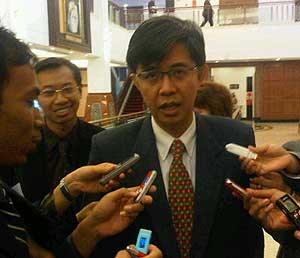 Chua (
right
) has until July 1 to file the application.
Chua (
right
) has until July 1 to file the application.
The move follows the Kuala Lumpur High Court's decision on June 17 to uphold Chua's conviction by the magistrate's court.
Chua was charged for obstructing a police constable after the PKR leader was arrested for involvement in an illegal protest.
Justice Ghazali Cha had decided to reduce the magistrate's court sentence from RM3,000 and six months jail, to RM2,000 or in default two months jail.
The judge said this was in order to prevent the government from having to hold an expensive by-election.
This had however led to uncertainty as to whether the sentence disqualifies Chua as MP.
Article 48 of the Federal Constitution stipulates that a member of the Dewan Rakyat can be disqualified if fined an amount "not less than RM2,000" or sentenced to "not less than one year" in jail by any Malaysian court.
Was arrest legal?
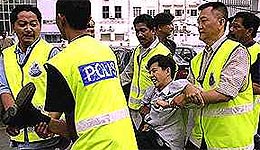 Chua's affidavit makes a 13-point argument on questions of law surrounding the earlier High Court hearing.
It begins by asking whether a fine of RM2,000 has the effect of disqualifying an MP by virtue of Article 48(1)(e) of the federal constitution.
It proceeds to question the use of the video recording evidence, for example whether the Court of Appeal is obliged to view and assess the video recording submitted by the accused as evidence (since the High Court judge hearing Chua’s case did not view it).
It also questions the validity of the charge, asking whether a person can be arrested or deemed to be obstructing the police, when:
a) the person was not in the prohibited area (the parliament compound) which warranted police action,
b) where it was physically impossible for the person to enter the said area, and
c) there was no evidence to suggest that the accused had intended to be part of the illegal assembly.
Finally, the affidavit tackles the question of the police witness, in particular why the Special Branch officer who had ordered the arrest was not called as a prosecution witness, and why the document, said to contain Chua’s name for arrest, on which the arresting officer was acting, was not produced in court as evidence.


Are you sure you want to delete this comment?
This action cannot be undone.