




Sabah wants Putrajaya's help on business woes
Sabah manufacturers want the federal government to seriously study the alarming jump in the cost of doing business in the state and devise ways to bring it down to national and competitive levels.
Sabah manufacturers want the federal government to seriously study the alarming jump in the cost of doing business in the state and devise ways to bring it down to national and competitive levels.
Any foot-dragging on the part of the federal government, warned the Federation of Sabah Manufacturers (FSM), "will make it extremely tough to even partly meet the 2020 targets set for the state".
FSM president Wong Khen Thau called on the federal government to urgently study, together with the Sabah government, six critical areas in the state.
 These include a 1Malaysia 1Price system, the National Cabotage Policy (NCP), the proposed General Services Tax (GST), the New Economic Model (NEM), skills and entrepreneurship training and labour woes.
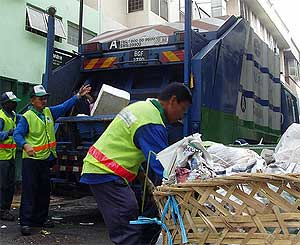
On the labour front in particular, the FSM wants workers, other than those from the Philippines and Indonesia, to be allowed in and the high foreign worker levies to be brought down to discourage illegal immigration.
"We are putting together a memorandum on these issues to bring them to Putrajaya's attention later this month," said Wong. "A copy will be extended to the state government."
The memorandum will argue the case for skills and entrepreneurship training, more subsidies or funds to upgrade infrastructure and a special package, including financial support, for Sabah small and medium industries (SMIs) and small and medium enterprises (SMEs). The FSM wants this to be separate from that in the peninsula, where the undertakings are very much larger.
Cabotage sabotaging two states' growth
 Wong's remarks coincided with the first session of the Sabah Domestic Investment Dialogue and Seminar in Kota Kinabalu yesterday. The first session was chaired by Minister of International Trade and Ministry Mustapha Mohamed (
right
) who, beyond vague assurances, was non-committal.
Wong's remarks coincided with the first session of the Sabah Domestic Investment Dialogue and Seminar in Kota Kinabalu yesterday. The first session was chaired by Minister of International Trade and Ministry Mustapha Mohamed (
right
) who, beyond vague assurances, was non-committal.
"We gave our input as well during the first session,' said Wong. "Some of the issues are inter-linked and may worsen with new policy changes and developments."
The FSM chief described the 1Malaysia 1Price, the NCP and the GST as among the issues particularly linked to one another. The NCP, according to a Sabah Industrial Development Ministry study cited by Wong, "definitely has an effect on the higher prices of goods in Sabah and also affects the cost of doing business".
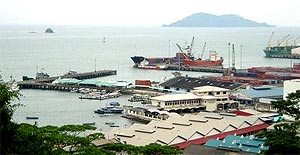 Wong does not see the need for the federal government to continue to protect a handful of shippers in the peninsula at the expense of the people of Sabah and Sarawak. All pleas so far to do away with the NCP appear to have fallen on deaf ears in Putrajaya, he added.
"We hope that the federal government, especially the Transport Ministry, will do away with the NCP for the good of the whole nation.
"At a time when we are preaching about 1Malaysia, there's a glaring and growing economic divide between both sides of the South China Sea, and this should not exist at all," said Wong.
FSM is confident that the abolishment of the NCP will see the emergence of Sabah as the Dubai of the Far East because of the state's central location in the region. If Sabah does well on this score, "the entire nation will benefit".
Wong noted that already 60 to 70 per cent of Malaysian imports now came from countries located nearer to Sabah than the peninsula, unlike in the past. These included China, Japan, Korea, Taiwan and the East Asean growth region.
Shipping interests' political muscle
The stumbling block on the NCP appears to be the MCA and the Transport Ministry which the party holds. Both, it is alleged, "are in the pockets of the powerful local shipping lobby".
On the GST specifically, Wong cautioned against introducing it immediately in the country as proposed by the federal government but was nevertheless supportive of the new tax regime. He feels it is a good move and should be implemented, but not before the prices of goods between both halves of Malaysia "are first standardised". This is again linked with the NCP.
"Currently, the price differential is 30 per cent or more, with Sabah and Sarawak being burdened with the higher prices." Still, Wong is willing to settle for less than 100 per cent parity as long as the price difference between the peninsula and East Malaysia is minimal.
The GST is a direct tax on the consumer, observed Wong, "and it's not fair to those in Sabah and Sarawak as we are very much poorer than even the poor in the peninsula and yet are expected to pay the GST on top of suffering under the NCP".
Wong cites the NEM as a case in point. He does not see how Sabah will be able to achieve the set target of US$15,000 (RM48,500) per capita income by 2020. The current average in the state is US$3,000 to US$4,000 (RM9,700 to RM12,900) , he said, while it's already US$7,000 (RM22,600 to US$8,000 (RM25,800) in the peninsula.
"We would like our workers to take home better salaries, but how is it going to happen in Sabah?" he asked. "If the federal government is talking about an average 6 per cent growth per annum, Sabah has to register double that to get anywhere, or just play catch up."


Are you sure you want to delete this comment?
This action cannot be undone.