




Call to lawyers: Oppose all forms of extremism
A clarion call has gone out to the nation's legal profession to speak out against racism, religious dominance and all forms of extremist views.
A clarion call has gone out to the nation's legal profession to speak out against racism, religious dominance and all forms of extremist views.
Bar Council chairperson Ragunath Kesavan said unity was the way forward for multi-cultural Malaysia.
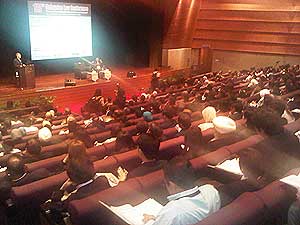 He said this in his opening address at the launch of the 15th Malaysian Law Conference today on the theme
Malaysia: Extending Frontiers, Widening Horizons
.
He said this in his opening address at the launch of the 15th Malaysian Law Conference today on the theme
Malaysia: Extending Frontiers, Widening Horizons
.
"The way forward is to assure the people there is a place for everyone in Malaysia, regardless of race or religion.
"This assurance must be reiterated not only by the government but by all of us. We must believe, and must commit and be united in our efforts to build a nation that progresses on diversity," he added.
 Ragunath (
right
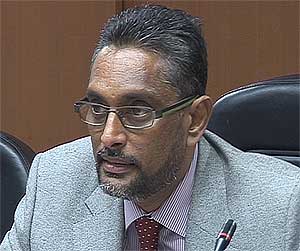
) lists out race and religion as the main challenges facing Malaysia, pointing out that wherever such diversity exists, differences in views and opinions are bound to exist.
Ragunath (
right
) lists out race and religion as the main challenges facing Malaysia, pointing out that wherever such diversity exists, differences in views and opinions are bound to exist.
Pointing to the emergence of groups such as Hindraf and Perkasa as examples, he said their formation may have irked different segments of society.
"Hindraf and Perkasa, and to a lesser extent the Chinese educationist movements, may be seen by some as extremist groups championing the rights of a single race. It is important to understand and accept that the future of this country must be built on a multi-racial, multi-religious approach of respect and acceptance.
"All of us must speak against all forms of racial and religious dominance that have no respect for other races or religions."
He pledged the Malaysian Bar's commitment to the nation-building process and that the Bar would be a strong advocate of the rule of law, human rights and the rights of minorities, including the indigenous peoples.
Need for independent judiciary
Ragunath also said in this modern age, Malaysia must constantly compete to draw foreign direct investments.
"Independence of the judiciary and efficiency of the administration of justice are critical components to attract FDIs," he said.
The Bar Council chairperson admitted that although they do not always agree with the Attorney-General's Chambers and the Bench, all three do have a good working relationship.
He also had strong words for dominating political forces, saying political parties should not govern the country as they pleased.
"Democracy is based on the principle of the rule of the majority, at the same time, democracy also requires that the rights of minorities are safeguarded."
The Malaysian Bar, he said, had consistently reiterated its objective of wanting to see the building of a better and stronger Malaysia "for all our people".
"We want to see a Malaysia united in her diversity. There must be a unity of purpose regardless of our race, religion or political affiliation. This requires all of us to work together in building and moving Malaysia forward."
He reiterated lawyers would never shy away from pushing through the barriers of the law.
Using the example of the "The Walk for Justice" on Sept 26, 2007, Ragunath described it as a milestone in Malaysian history, perhaps serving as the turning point leading to the government forming the Royal Commission of Inquiry into the VK Lingam video clip incident.
"This in turn ultimately led to the setting up of the Judicial Appointments Commission."
Kirby: Respect rule of law
A respected retired Australian High Court judge, Michael Kirby, who spoke on the Rule of Law, said it was a principle that provided the public a place and a largely transparent process to resolve the most heated and significant disputes.
Rule of the law, he said, provided a mechanism to establish and clarify rules for people to live together in peace.
 "The experience of humanity has been that in the absence of law, and effective enforcement, corrupting influences tend to rush, like quicksilver, to fill the gaps," Kirby (
left in
photo
) said.
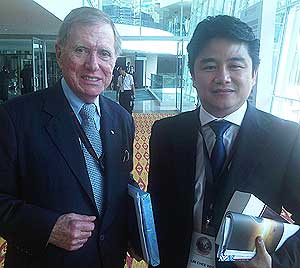
"The experience of humanity has been that in the absence of law, and effective enforcement, corrupting influences tend to rush, like quicksilver, to fill the gaps," Kirby (
left in
photo
) said.
Kirby, who is also a close friend of former Lord Presidents Mohammad Suffian Hashim and Mohamed Salleh Abas, said powerful politicians in most countries have tried to shape and re-shape the judiciary according to their own notions and values.
"However, in mature democracies they rarely succeed. This is why there is special wisdom in maintaining a thick wall between appointed judges and the corrupting pressures and influences of external power and pressure," he said.
Kirby noted that while establishing the rule of law, it is also vital to have an effective and just governmental system.
"The law, in that sense, is therefore not enough. We, as lawyers, must be concerned with the content of the law and the content of the procedures and institutions that deliver law to society.
"Lawyers must be ever-vigilant to see new truths (often revealed by scientific research) which earlier generations did not perceive," the former High Court judge said.
Describing a lawyer's task is a heavy one, Kirby said it gave the profession its nobility and purpose.
He reminded lawyers that law is not and should not simply be for the wealthy:it should be for all.
"It is not just for the popular and the acclaimed. It is for the vulnerable and the disadvantaged. We must never forget this," he added.


Are you sure you want to delete this comment?
This action cannot be undone.