




No flashes of insight at Penang's NEM forum
The public forum’s topic last week at Universiti Sains Malaysia was economic and though the speakers ranged widely the audience would have been better served if the discourse had been guided by a modicum of philosophy.
The subject was the 10th Malaysia Plan and though its subtitle was ‘Policy, Politics and the NEM’, the organisers - Center for Policy Research and International Studies (CenPRIS) of USM - might just as well have titled it ‘10th Malaysia Plan, Period’.
CenPRIS could not have possibly expected the speakers - Finance Minister II Dr Awang Adek Hussin, Sivarasa Rasiah of PKR, Idris Jusoh of Umno, and economist Dr Lim Teck Ghee - to do justice to the topic in the 17-odd minutes allocated to each for initial submissions...
The public forum’s topic last week at Universiti Sains Malaysia was economic and though the speakers ranged widely the audience would have been better served if the discourse had been guided by a modicum of philosophy.
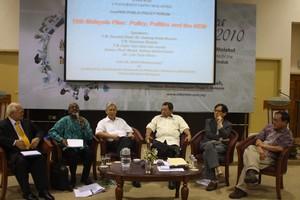 The subject was the 10th Malaysia Plan and though its subtitle was ‘Policy, Politics and the NEM’, the organisers - Center for Policy Research and International Studies (CenPRIS) of USM - might just as well have titled it ‘10th Malaysia Plan, period’.
CenPRIS could not have possibly expected the speakers - Finance Minister II Awang Adek Hussin, Sivarasa Rasiah of PKR, Idris Jusoh of Umno, and economist Lim Teck Ghee - to do justice to the topic in the 17-odd minutes allocated to each for initial submissions.
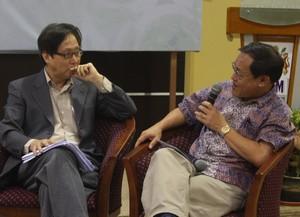
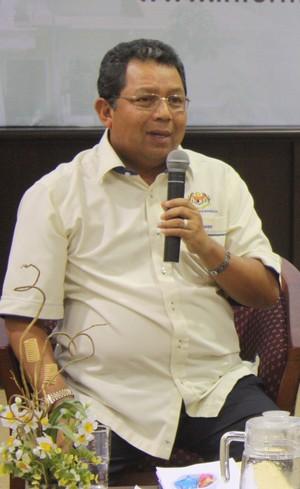 Needless to say, a further five minutes for a second bite of the cherry towards the end was not sufficient time for the speakers to sum up, but Awang Adek (
left
) employed it to robust effect.
Needless to say, a further five minutes for a second bite of the cherry towards the end was not sufficient time for the speakers to sum up, but Awang Adek (
left
) employed it to robust effect.
He repelled Sivarasa’s initial, admittedly partisan, onslaught by bringing up the Selangor Pakatan Rakyat government’s affrays over sand mining and councilor corruption. Governing looks easy from the outside, Awang Adek mockingly told an unfazed Sivarasa.
Given the title’s expansive scope, all four speakers understandably chafed at the time-limits, but subject-range curbs rather than time-limits would have been the greater aid to thematic coherence.
In the event, Idris Jusoh was all over the place; Awang Adek was by turns focused, earnest and combative; Sivarasa was deft and pointed in scoring points for Pakatan; and Lim Teck Ghee was scholarly and analytical.
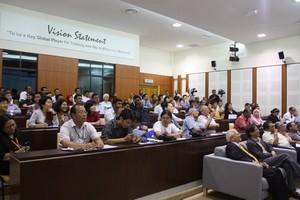
If, at the end, the 100-odd members of the audience were left with no ray of enlightenment by the discussants on the subject of the 10th Malaysia Plan, it may have had more to do with economics being the “dismal science” of Thomas Carlyle’s description than to shortcomings of the speakers.
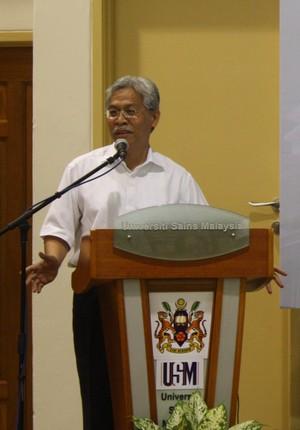 True, Idris Jusoh’s moaning that there were no “perfect democracies” in the world (ostensibly, this was said as extenuation for Umno-BN’s delinquencies) and no “perfect free markets”, betrayed fundamental misconceptions; the other speakers, though, did not suffer chaff on their threshing floor.
Idris ( right ) approached things the wrong way round. Obviously, he had not heard that democracy as a system of government has many weaknesses until you have considered the alternatives, and that free markets provide the least inefficient means of allocating resources.
But even if all the speakers had drawn their arrows more precisely from their quiver, one suspects the forum’s topic would have eluded their attempts at a comprehensive grasp.
Income disparity vs poverty eradication
And that was best illustrated by a point brought up by Sivarasa in his initial submission.
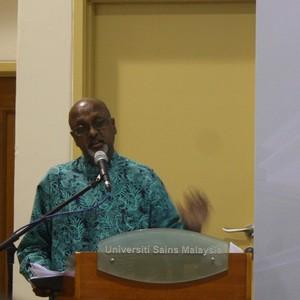 He said Malaysia’s Gini coefficient of 0.462 was the second highest in Asia after Papua New Guinea.
The Gini coefficient measures the inequality of income distribution within a country. It varies from zero, which indicates perfect equality, with every household earning exactly the same, to one, which implies absolute inequality, with a single household earning a country's entire income.
In Sivarasa’s telling, the equating of our income inequality situation with lowly Papua New Guinea implied that something was very wrong with Malaysia’s developmental trajectory.
But when it was the turn of Awang Adek to reply, he held the fact that the incidence of absolute poverty, as distinct from relative poverty, was reduced from 50 percent of all households at independence to 3 percent today was a statistic to be proud of all over the world.
 Most people would view statistics like the one cited by Sivarasa, on income inequality, and by Awang Adek, on poverty reduction, as variations on ‘the glass is half-full’ or ‘the glass is half-empty’ interpretive theme.
Perhaps, this was where last Wednesday’s discussion at CenPRISS would have benefitted from a dash of philosophy, to wit, David Hume’s view that no statement of value could be derived from a statement of fact.
Both Sivarasa and Awang Adek had aired statements of economic fact but as gauges of economic reality, both assertions were opaque.
That both tried to wring maximal effect from statements that were inherently ambiguous gave an ad hoc tinge to the debate – you felt their opinions were dependent on empirical data; new information meant revised opinions.
 People don’t come to forums for the satisfaction of a hunger for enlightenment; they come for flashes of insight that may help to crystallise ideas simmering in them.
It was not that the CenPRISS’ forum was devoid of those flashes: its Himalayan scope virtually guaranteed that void.
The best thing that could be said about it was that the New Economic Model, which Awang Adek espoused in his submissions as an earnest of Prime Minister Najib Razak’s vision of the future, was a programme that could be better achieved by the philosophy of governance propounded by Pakatan Rakyat.
In other words, what was aired at the forum was a reflection of the worth and value of the evolving two-party system in Malaysia: the ideas of each side have infiltrated the other far more deeply than the disputants realise.


Are you sure you want to delete this comment?
This action cannot be undone.