




DPM Muhiyiddin Yassin's trapeze act
COMMENT The post of deputy president of Umno, and by extension deputy prime minister, can seem like a trapeze act with no safety net.
Occupants are faced with the delicate task of riding in the No 1’s slipstream, to avoid seeming disloyal, while subtly promoting personal agendas, without which their viability as heir presumptive is not sustainable.
COMMENT The post of deputy president of Umno, and by extension deputy prime minister, can seem like a trapeze act with no safety net.
Occupants are faced with the delicate task of riding in the No 1’s slipstream, to avoid seeming disloyal, while subtly promoting personal agendas, without which their viability as heir presumptive is not sustainable.
Too much ardour in the first instance invites derision while a lack of finesse and discretion in the latter role begets destructive tensions.
A fine balance must be struck between being a loyal deputy and promotion of the belief that a worthy successor is at the ready.
The deputy role is a tough act to bring off under most circumstances; it’s vexing in the current scenario.
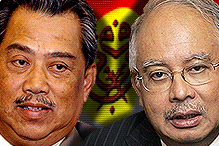 To be sure, Deputy Prime Minister Muhyiddin Yassin from the start was saddled with an age problem: being seven years older to Prime Minister Najib Razak, now 57, inevitably meant that he can’t wait too long cooling his heels.
Also, at the time, April 2009, when Najib and Muhyiddin became the No 1 and 2 respectively in Umno and the country, the political climate had changed drastically, affording a wide berth to differences in opinions about how to respond to the challenge.
The myth of Umno-BN invincibility was broken in the March 2008 general election and changes were imperative if the ruling coalition wanted to continue to stay in power.
It was easy to agree on the need for change, less so on how and to what extent change was needed.
Not to go too far or too fast
In a sense, Muhyiddin had his role cut out for him. While agreeing on the need for change, he could choose not to go too far or too fast in pursuit of it.
Thus in response to Najib’s ‘IMalaysia’ initiative, which implied that the race question was going to be de-emphasised, Muhyiddin claimed that he was “Malay first” and Malaysian at the same time, brushing aside criticisms that the stance was oxymoronic.
Then when Najib unveiled the New Economic Model, which suggested that race-based quotas were going to be deprioritised, Muhyiddin made placatory gestures towards Perkasa, the Malay pressure group that was launched to maintain the status quo on affirmative action.
When the government shaped to give legitimacy to an inter-faith panel, Muhyiddin dismissed the panel as a “minor committee” to appease Islamic supremacists disturbed by the implied recognition of parity for other religions.
When Hishammuddin Hussein mused that the Home Ministry’s insistence on the ban on Christians’ use of the term ‘Allah’ in Bahasa Malaysia was ill-considered, Muhyiddin rebuked the MCA for joining the DAP in calling on the government to desist in its appeal of the High Court decision allowing such use, a logical follow-through on Hishammuddin’s lament.
In short, Muhyiddin could rhetorically be for change and then seem to stand athwart it.
No need for a delicate and nuanced positioning of himself as loyal deputy and capable alternative to steer Umno-BN back to its supremacy of old.
Instead, Muhyiddin opts for an expedient paddling of the pros and cons of still-fluid issues such that he can see where the tide is heading, the better to lever for advantage.
It’s shrewd gamesmanship. But the times call for mould-breaking leadership. It’s a strategy suitable for winning battles but the larger war for the return to Umno-BN supremacy may be lost in the process.
TERENCE NETTO has been a journalist for close on four decades. He likes the occupation because it puts him in contact with the eminent without being under the necessity to admire them.


Are you sure you want to delete this comment?
This action cannot be undone.