




Suhakam chief: Diplomacy the way to go
New Suhakam chief Hasmy Agam believes that diplomacy is the way to go in pressing human rights issues home.
After sitting in the chairperson's seat for the past three and a half months, the retired career diplomat believes the human rights watchdog could benefit from taking a softer approach in getting their message across.
New Suhakam chief Hasmy Agam believes that diplomacy is the way to go in pressing human rights issues home.
After sitting in the chairperson's seat for the past three and a half months, the retired career diplomat believes the human rights watchdog could benefit from taking a softer approach in getting their message across.
 He admits that his predecessors may have had little success in taking the "friendly" approach in pushing their recommendations across - particularly with the government - but sees even less progress if they go in with all guns blazing.
And with his four decades of experience in talking others into seeing things his way, Hasmy is cautiously optimistic that he and his team can make a difference.
He says engagement is his game, and he aims to convince everyone - from layperson to minister - that upholding human rights is the way forward in becoming a truly developed society.
And to do this, Hasmy wants to launch a two-pronged approach to build human rights awareness within the executive and public spheres.
While pointing out that Malaysia's human rights situation is "not too bad" when compared to other countries in the Asia-Pacific region, he stressed that education and politics are two areas that need attention if we are to move forward.
It takes two
In the public sphere, Hasmy said that people need to be made aware of their rights so they can speak up for themselves, while the authorities need to understand those rights so they can uphold them.
 "This needs education, so people at all strata of society know their rights and the authorities know to respect those rights," he said in a
Malaysiakini
exclusive interview.
"This needs education, so people at all strata of society know their rights and the authorities know to respect those rights," he said in a
Malaysiakini
exclusive interview.
And this is where NGOs and civil societies step in. Hasmy said that while Suhakam will engage the public directly, they operate on limited resources and can only reach out to so many people.
"What we could do is work with civil societies... some of them have got better resources than Suhakam," he quipped.
He said that Suhakam will on the other hand prioritise engagement with enforcement agencies, particularly senior officers as they are the ones who set the tone for how the authorities react with the public.
"We could, and will, engage with the rank and file, but they basically take orders from the top. It is more important to target the senior people, because it is those people who issue orders and create policies."
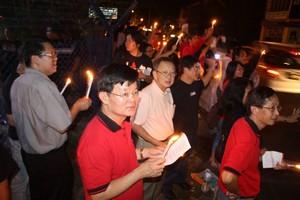 Hasmy said Suhakam needs to be pro-active in getting the authorities to notice them, as they did by sending two observers to the recent
anti-ISA vigil
(
left
) earlier this month.
Hasmy said Suhakam needs to be pro-active in getting the authorities to notice them, as they did by sending two observers to the recent
anti-ISA vigil
(
left
) earlier this month.
He acknowledged that it did little to stop the police's violent response to the peaceful protest, but pointed out that their engagement with the authorities must start somewhere.
"When we approached them (the police) to say that we wanted to observe the protest, their initial reaction was not so good, because their impression was that is sounded like a protest (by Suhakam).
"But we appreciate that the police recognise (Suhakam's role to monitor human rights violations), and we will work out a SOP (standard operating procedure) on how they should handle peaceful protests," he said.
Depoliticising human rights
Hasmy however admitted he was taken aback by the politicians' handling of human rights issues, which he described as being overly "politicised".
 While Suhakam continues to convince the government to eventually table their annual human rights report in parliament, Hasmy stressed that politicians themselves need to take stock of their arguments and decide whether they are raising issues in the interest of the people or simply to gain political mileage.
"We are continuously engaging the government. We met the Minister in charge of law and parliament, Nazri (Aziz) and in principle there was no objection to our request for our report to be debated in parliament.
"But we hope that when this does actually happen, MPs and politicians learn to depoliticise the issues... if not it will be hard to progress. It is time for volunteerism on both sides of the divide. This cuts across political boundaries because a Malaysian is a Malaysian," he said.
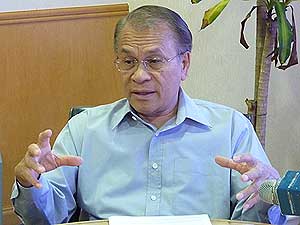 Hasmy (
right
) admits that even under the best circumstances, running a human rights watchdog is no mean feat with unending reports and complaints streaming in from all levels of society.
Hasmy (
right
) admits that even under the best circumstances, running a human rights watchdog is no mean feat with unending reports and complaints streaming in from all levels of society.
He noted that he is "persuaded to the view" that Suhakam's role be upgraded to have at least powers to refer cases to court, but cautioned that if they are forced to exercise such powers it defeats their goal of education and awareness.
"Going to court should be a last resort, and if it comes to that it means we have failed in promoting human rights. We want to engage all stakeholders, from the government to civil society, the judiciary and the media.
"If everyone understands and respects human rights, then there won't be any need for Suhakam to have enforcement powers," he said.
‘Reaching low first’
 In the meantime, Hasmy said he and his team of seven commissioners will do their best and focus on what is "do-able" in the three years that they are contracted to serve.
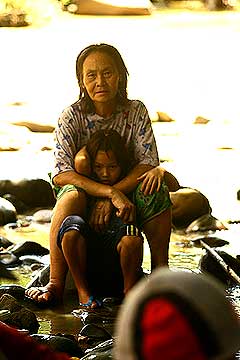
He added that they are planning on raising a national inquiry soon, after they decide on which of three topics they will bring before the public: indigenous rights, women's rights or the plight of the aged.
"We've got to be realistic. It's like how (former premier) Abdullah (Ahmad Badawi) said; you reach for the low-lying fruit first, while keeping an eye on those that are higher.
"Of course we would like to tackle fruits that are quite high up, like the ISA, but let's focus on what we can achieve now... we'd like to do the doable first," he said.


Are you sure you want to delete this comment?
This action cannot be undone.