




Quality products crucial in wake of stronger ringgit
Malaysia has to be more competitive and not use the exchange rate to manipulate economic growth, although it often reflects the strength of the economy, says an economist.
Malaysia has to be more competitive and not use the exchange rate to manipulate economic growth, although it often reflects the strength of the economy, says an economist.
Hence, a stronger ringgit is not a major concern for growth, especially exports, provided the country produces quality goods for the global market.
"What is important is that fundamentally, the exchange rate must reflect the strength of the economy. It shows at present that we are still quite strong," says Ramon Navaratnam.
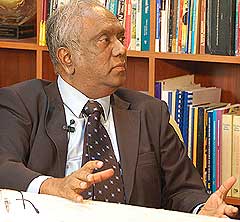 Ramon (
left
), who is also the Chairman of the Asian Strategy and Leadership Institute's (Asli) Centre of Public Policy Studies told Bernama this when met at Prime Minister Najib Razak's Hari Raya open house in Putrajaya today.
Ramon (
left
), who is also the Chairman of the Asian Strategy and Leadership Institute's (Asli) Centre of Public Policy Studies told Bernama this when met at Prime Minister Najib Razak's Hari Raya open house in Putrajaya today.
The ringgit is trading at its highest level of 3.11 to the dollar in 13 years amid foreign funds returning Malaysia.
Recently, MIDF Research house reported that JP Morgan's upgrade of Malaysia to "overweight" from "neutral", is news of a big funds inflow into the country.
The upgrade cites the strengthening of the ringgit, robust domestic demand and credit growth, being expected to entice fresh funds from foreign investors needing to rebalance their portfolios.
On another note, Ramon said by next year, the country's competitiveness ranking should be much better provided all parties involved in the Government Transformation Plan (GTP) deliver the measures and strategies proposed in the blueprint fast, effectively and efficiently.
In the World Economic Forum's Global Competitiveness Report 2010-2011 released yesterday, Malaysia slipped two notches to 26th spot from a 24th ranking previously, with higher education, institutions and labour market efficiency among the concerns.
"There are some improvements but the full impact of the reforms and transformation are not seen on the ground yet," he said.
Problem with higher education
Meanwhile, the European Union ambassador to Malaysia, Vincent Piket said the competitiveness report would not dampen investor interest extensively as they looked at a medium to long-term scenario.
"Most industries in Malaysia are developed and still growing. Investors are still interested in fundamental factors and therefore the country remains an interesting destination," he explained.
Commenting on higher education being a concern in the competitiveness report, the Higher Education Minister Mohamed Khaled Nordin said the ministry is looking into the details of measurement used in the report.
"In the first place, I don't know how they (report) came to that. It wasn't very clear as it is just mentioned as higher education. Is it because we are lacking in producing a highly skilled workforce?" he asked
He added that if this is the concern, then, the ministry would concentrate on delivering a skilled force by bringing in technical and vocational demand into the mainstream as part of the transformation in the higher education plan.
- Bernama


Are you sure you want to delete this comment?
This action cannot be undone.