




Mixed views on PKR deputy presidency debate
The opportunity to offer cogent arguments for the advantage of his approach over his rival’s to party and national affairs remains the most compelling argument for holding a debate between contestants for the post of PKR deputy president.
Since the two most likely candidates – incumbent party vice-president Azmin Ali and its Pakatan Rakyat policy co-ordinator Zaid Ibrahim – are more familiar to the PKR electorate by their images than by their actual substance, this is the time to put the latter under an exacting lens so that voters can make a more informed choice...
The opportunity to offer cogent arguments for the advantage of his approach over his rival’s to party and national affairs remains the most compelling argument for holding a debate between contestants for the post of PKR deputy president.
 Since the two most likely candidates – incumbent party vice-president Azmin Ali and its Pakatan Rakyat policy co-ordinator Zaid Ibrahim – are more familiar to the PKR electorate by their images than by their actual substance, this is the time to put the latter under an exacting lens so that voters can make a more informed choice.
Not everyone agrees, as Malaysiakini found in a random survey of disinterested - insofar as the suitability of the rivals is concerned - opinion within the party and outside.
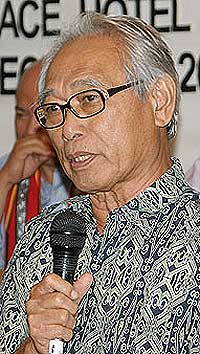 Daniel Tajem, a former deputy chief minister of Sarawak and presently an elder statesman of sorts to PKR efforts to win Dayak support, said a debate would accentuate divisions already existing in the party.
“I would rather do things to keep those divisions from hardening,” he commented.
“I fear a debate would expose internal arguments and would receive a more public airing which would cause fence-sitters in the run-up to the state election in Sarawak to think that PKR is disunited and therefore not dependable,” he elaborated.
“I’m aware of the merits of allowing party voters to see what each candidate has to offer but in the present circumstances when we are trying to project unity and build public confidence, I don’t think we should do this,” said Tajem.
New political culture
His view was the diametric opposite of Hishamuddin Rais’.
The critic who defines himself as NGI (non-governmental individual), said the idea of the debate was an innovation that would do the process of democratic selection based on informed choice a power of good.
“Y
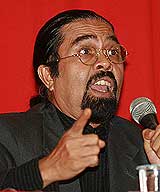 ou know what I like about the idea - that it will project PKR as an innovator, as a trend setter,” said Rais.
“Which party in the country has done a thing like this? PKR is out to reform the political culture of this nation. That is why it has opted for giving every party member the right of choice.
“It is a daring move and a debate between rivals for the No 2 position will place PKR well ahead of its rivals in terms of openness with regard to leadership selection,” explained Rais.
Dominic Puthucheary, senior constitutional lawyer who is part of Anwar Ibrahim’s informal circle of advisers, said the lack of an intellectual culture in Malaysia made the idea of a debate “exciting”.
“It makes a statement by the party vis-a-vis this problem of the aridity of our intellectual culture,” said Puthucheary.
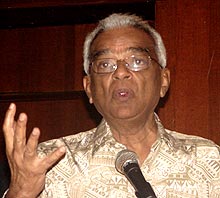 “Our universities do not evoke public debate and intellectual culture. Non-governmental bodies strive but are unable to fill that void.
“Thus our political culture suffers from this absence of rational discussion of clashing ideas and our public are starved of the fodder for discriminating choice from among contending viewpoints,” Puthucheary expatiated.
“A debate between contenders for the party’s No 2 position would go some distance to revealing something about PKR’s attitude towards the whole question of the aridity of our intellectual culture,” he remarked.
Sleek packaging vs substance
Dr Mohd Nasir Hashim, chairman of Parti Sosialis Malaysia and state assemblyperson for Kota Damansara, said a debate would help to promote a more informed choice by PKR voters on who is to lead the party in the near future.
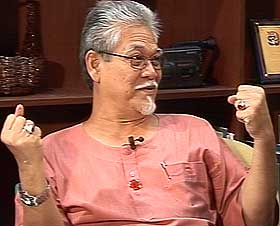 “Properly organised, such a debate would be a welcome development in Malaysian politics,” he offered.
“It will offer voters the chance of observing their candidates’ disposition under pressure from a live audience and possibly a television-watching wider viewing,” added Nasir.
“But we should not place too much emphasis on a debate’s value. Clever positioning and self-projection have enabled candidates to excel at the sound bite than at substantive argument.
“This would promote sleek packaging over substantive presentation,” theorised Nasir.
So the jury is still out on the idea of a public debate to separate the contestants in the looming contest for the deputy leader of PKR.


Are you sure you want to delete this comment?
This action cannot be undone.