




'1M'sia milk' soon for schools
Sabah, a major milk producer, may get the chance to supply ‘1Malaysia’ milk to schools nationwide under a programme sponsored by the federal government.
Sabah, a major milk producer, may get the chance to supply ‘1Malaysia’ milk to schools nationwide under a programme sponsored by the federal government.
The revival of the National School Milk Programme (NSMP), suspended in 2007, is expected to be announced in Kota Kinabalu soon.
Market watchers said the revival of
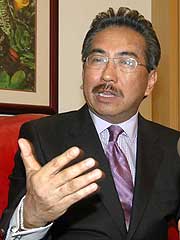 the NSMP follows Chief Minister Musa Aman Musa’s briefing on milk production in the state, during Prime Minister Najib Abdul Razak’s visit on July 20.
A company has already designed the 200ml milk packet with the 1Malaysia logo after being commissioned by the state government. The design is said to have received the approval of both Musa (right) and Najib.
Sabah International Dairies Sdn Bhd (SiD), which has been in operation for 30 years and was state-owned until 1998, is said to have clinched the NSMP deal.
When contacted, CEO Brig Gen ( Rtd) A Arulpragasam would not confirm or deny this. However, he said SiD is ready to take up the challenge if appointed.
The company has had a contract since 1980 to manufacture, supply and deliver 200ml UHT packet milk three times a week to all kindergartens and primary schools registered with the Education Ministry.
The company exports recombined low-fat milk - 30 percent skim milk powder from New Zealand blended with 70 percent local fresh milk - to Sarawak, Labuan, Brunei and Peninsular Malaysia.
SiD’s milk production is on the rise. From the initial 300,000 litres per month when the Sabah School Milk Programme (SSMP) was launched, the company’s present production has reached 700,000 litres per month.
“We support the local dairy industry by purchasing all the fresh milk produced,” said Arulpragasam.
The number of dairy farmers in Sabah has fallen from a height of 342 before 1997 to 127 today.
Still, milk production is expected to total 8.5 million litres this year, up from the 5.4 million litres, according to Arulpragasam.
“Dairy farmers are subsidised between RM 1.50 and RM 1.25 per litre depending on the grade.”
Another contender?
The word in the industry is that Dutch Lady Malaysia, another market leader, is also lobbying for the contract to supply milk to schools nationwide.
Both D
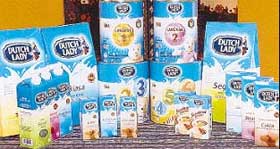 utch Lady and SiD were involved in the school milk programme which began in 1985.
SiD was the biggest producer of milk for schools in Malaysia. In addition to the federal programme, SiD has monopolised the Yayasan School Milk Programme - suspended in 2008 - and the SSMP which continues.
By the time of the suspension of the NSMP and that in Sarawak, SiD was manufacturing, supplying and delivering milk to 500,000 pupils in Sarawak, Labuan and the northern and southern states of Peninsular Malaysia.
The Education Ministry stopped the NSMP following allegations that the milk was contaminated, in the wake of food poisoning cases in Peninsular Malaysia.
This was done before sample tests proved that the spate of food poisoning had nothing to do with SiD, according to Arulpragasam.
The ministry also ordered the destruction of undelivered packets of milk, resulting in losses running into the millions of ringgit for SiD.
SiD, according to Quality Assurance and R&D manager Hanna Moo, takes no chances with the milk for temperature, pH (acidity), specific gravity, the presence of antibiotics, protein stability and fat content (between 3.5 and 4 percent).
“We also pick samples at random and send these to an accredited external lab in Kuala Lumpur once a month. Our products are in compliance with the Malaysia Food Act and Regulations 1985,” said Moo.
Every two to three weeks, the external lab tests water samples from the processing plant for Biological Oxygen Demand and Chemical Oxygen Demand.
The milk is also put through microbiology tests for total bacteria count in the milk, and yeast and mould count.


Are you sure you want to delete this comment?
This action cannot be undone.