




Dr M pooh-poohs Najib's offshore ringgit trading plan
Former prime minister Dr Mahathir Mohamad has urged the government to explain its suggestion to lift the ban on offshore trading of the ringgit.
Former prime minister Dr Mahathir Mohamad has urged the government to explain its suggestion to lift the ban on offshore trading of the ringgit.
According to Mahathir, the move would put Malaysia at risk to currency speculators who he blames for the depreciation of the ringgit, leading to the 1998 Asian financial crisis.
“If we fully free our ringgit, the risk of being attacked by currency traders will once again be faced by us. Do we really want to have the financial crisis once again?
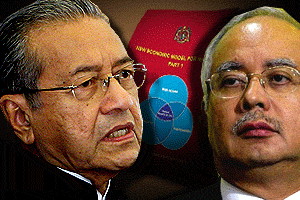 “So I hope the government will explain why it wants the ringgit to be traded again. I hope it is not because we want to be good boys who will always do what we are told to do,” said Mahathir in a posting on his blog today.
Mahathir was commenting on Prime Minister Najib Abdul Razak’s statement that his administration considering allowing the ringgit to trade offshore if it helps the economy.
“We are quite adaptive and if we think it’s going to help us and the economy, we would review the situation,” Najib told CNBC during an interview on Sept 11.
FDI a double-edged sword
Banned in 1998 at the height of the financial crisis, offshore trading of the ringgit was repeatedly mooted, with government officials stating that it would be re-allowed when conditions were right.
Mahathir writes that one of the main arguments for offshore trading of the ringgit was that this would encourage foreign direct investment (FDI).
However, he warns that FDI itself - which he described as “double-edged” - must be treated carefully, especially when dealing with the value of the ringgit.
Mahathir, who was also formerly finance minister, said that the influx of FDI was “so successful” in creating jobs that while resolving unemployment, it created labour shortages.
“This led to an inflow of foreign workers and the expatriation of billions of ringgit back to their countries. FDI no longer helped Malaysia’s growth,” he said.
Constantly keeping tabs on Najib
He argues that there was a general misunderstanding that FDI necessarily guarantees inflow of capital.
“But actually only about 10 percent of the capital needed was brought in. The rest is borrowed from local banks, preferably foreign-owned banks. It is therefore Malaysian money that is invested.
“Apart from tax exemption, Malaysia also subsidised the operations of foreign-owned companies through subsidised electricity, fuel and domestic transportation,” he said, adding that Malaysians also contributed to foreign companies through cheap labour.
This is Mahathir’s latest criticism of Najib’s administration, despite vowing not to meddle with government affairs after his retirement in 2002.
Previously, Mahathir had attacked Najib for the ambiguity of the 1Malaysia concept and also spoke against the New Economic Model target of gradually lifting pro-bumiputra affirmative action policies to encourage competition.
Related story:


Are you sure you want to delete this comment?
This action cannot be undone.