




Time Dr Dzul takes the bit between the teeth
COMMENT PAS MP Dr Dzulkefly Ahmad, like his compatriot Khalid Samad, is one of the more thoughtful parliamentarians around.
The pair’s faith in persuasion through reasoned argument is probably why they are foremost among Pakatan Rakyat politicians opposition-supporting members of the intelligentsia desire to see well placed in a future government.
 With them empowered, events - untoward incidents, sleeper issues that suddenly ignite, and other exigencies apt to trouble a sitting government - won’t be in the saddle and ride the Pakatan government.
Which is why the squirm that Dzulkefly went through in a panel discussion on ‘National Unity through Religion, Law and Shared Values’ during the 5th National Congress on Unity organised by the UCSI University on Malaysia Day was distressing to watch.
The cause of the writhing was the Islamic state objective of his party that came up in a panel discussion at which Dzulkefly was the invited speaker...
COMMENT PAS MP Dr Dzulkefly Ahmad, like his compatriot Khalid Samad, is one of the more thoughtful parliamentarians around.
The pair’s faith in persuasion through reasoned argument is probably why they are foremost among Pakatan Rakyat politicians opposition-supporting members of the intelligentsia desire to see well placed in a future government.
 With them empowered, events - untoward incidents, sleeper issues that suddenly ignite, and other exigencies apt to trouble a sitting government - won’t be in the saddle and ride the Pakatan government.
Which is why the squirm that Dzulkefly went through in a panel discussion on ‘National Unity through Religion, Law and Shared Values’ during the 5th National Congress on Unity organised by the UCSI University on Malaysia Day was distressing to watch.
The cause of the writhing was the Islamic state objective of his party that came up in a panel discussion at which Dzulkefly was the invited speaker.
The Kuala Selangor MP was at pains to argue the point that although the Islamic state is a sacrosanct goal of PAS, its raison de’tre if you liked, the numbers were against its realisation in Malaysia.
Dzulkefly was virtually saying that seat-sharing arrangements among Pakatan components would mean that PAS cannot contest all 96-Malay majority constituencies on the Peninsula; they have to share the Malay-majority portion of our 222-seat Parliament with PKR.
Even if arrangements did allow that, and PAS were to sweep all 96 seats, the total won’t be sufficient for the party to command a two-third majority to amend the Federal Constitution to enact syariah law. Hence the Islamic state goal is a dead-in-the-water issue. There’s no cause for non-Muslim anxiety about this aspect of PAS’ agenda; arithmetically, it is unrealizable.
Irrefutable argument but...
Dzulkefly’s argument is irrefutable on the face of it. But the problem is that this goal of PAS just won’t be daunted by the impossible mathematics.
For starters, would it be proper for Muslim MPs of PKR to oppose if PAS were to move the constitutional amendment, given that support for syariah is a religious obligation?
Would PAS ideologues accept as legitimate democratic dissent the shortfall in Islamic rectitude of Muslim MPs declining to support the amendment?
What about the Muslim MPs in the opposition (of Umno, presumably): would the ideologically inebriated among the PAS cabal not appeal to them, on the basis of religious duty, to support the amendment? Would those opposition MPs ignore the opportunity to undermine a ruling Pakatan coalition by supporting an amendment they reckon could bring its downfall?
Admittedly, all this may be needless peering into hypotheses that are hedged by too much that is contingent. The politics of governing is a practical business, why bother much about scenarios inherently improbable?
This argument reminds one of the doctor in a story by the didactic writer GK Chesterton, who tells his friend with guff humour, “I’m a practical man and don’t know much about religion and philosophy”. Tart was the reply: “You’ll never be a practical man until you do.”
Pragmatism on this Islamic state issue requires a shift away from the argument of its mathematical improbability in Malaysia to one that is more intellectually robust.
One supreme flaw
For that perhaps, we have to re-examine the argument for the Islamic state espoused by the great Indian poet, Mohamed Iqbal, in 1930 when he explained his reasons for his opposition to independence for an undivided India.
Iqbal had argued that without a separate Islamic state of Pakistan, Islam would go the way Christianity did in Europe and cease to be itself. Iqbal’s argument went like this.
Islam is not only an ethical ideal; it is also a certain kind of polity. Religion for a Muslim is not a matter of private conscience or private practice, as Christianity can be for the man in Europe. There never was, Iqbal said, a specifically Christian polity; and in Europe after Martin Luther the universal ethics of Jesus was displaced by national systems of ethics and polity. There cannot be a Luther in Islam because there is no Islamic church-order for a Muslim to revolt against.
To accept Islam is to accept certain legal concepts. The religious ideal of Islam, therefore, is organically related to the social order which it has created. The rejection of the one will eventually involve the rejection of the other. Therefore, the construction of a polity on national lines, if it means a displacement of the Islamic principle of solidarity, is simply unthinkable to a Muslim.
Iqbal was saying in a philosophical way that in an undivided India Islam will be in danger, will go the way of Christianity in Europe and cease to be itself. Muslims, to be true to Islam, need a Muslim polity, a Muslim state.
Iqbal’s argument - logically reticulated, premise leading inexorably to conclusion - had, in retrospect, one supreme flaw: it has not panned out to be true.
Even a cursory look at what has happened to the Muslims in Pakistan and those in India will tell you that while sublime poetry may have been Iqbal’s forte; a political prophet he was not.
Syariah in a plural society
Besides examining why Iqbal got it wrong, it would pay to explore the reservations about fiqh (rule by Islamic jurists) that the Ayatollah Hossein Ali Montazari, a man who enjoyed a stature equal to Khomeini’s, expressed throughout the rule by the mullahs in Iran (1979 till now).
Montazari died last December, a critic till the end of the theocracy which had placed him under house arrest at various times. Why did a man like Montazari, who suffered imprisonment under the Shah, have doubts about theocratic rule?
 Iqbal’s misreading and Montazari’s reservations may be the spawning grounds for someone seeking to construct an intellectual defence for the position that holds that it is not the wise thing to do to impose syariah in a plural society, even if meant only for Muslims.
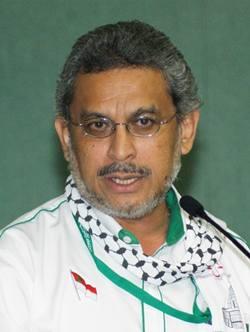
It is time that Dr Dzulkefly Ahmad - like his colleague Khalid Samad ( right ), trailing reason and equilibrium in their saunters through the halls of public debate in Malaysia’s historic time of searching for the golden mean of democratic governance - takes the bit between the teeth where the issue of the Islamic state is concerned.
For that he must eschew the fragile numbers argument for the refulgence of intellectually more viable demurrals over the Islamic state issue. In doing so, he may well discover the truth of the philosopher Alfred North Whitehead’s dictum that “a clash of doctrines is not a disaster; it is an opportunity.”
TERENCE NETTO has been a journalist for close on four decades. He likes the occupation because it puts him in contact with the eminent without being under the necessity to admire them.


Are you sure you want to delete this comment?
This action cannot be undone.