




Time for PSM to admit reality
What has Fidel Castro’s reported admission that, ‘The Cuban model doesn’t even work for us anymore’ got to do with opposition politics in Malaysia?
What has Fidel Castro’s reported admission that, ‘The Cuban model doesn’t even work for us anymore’ got to do with opposition politics in Malaysia?
Quite some, but first a bit of background: The seemingly retired Cuban supremo, 84, back on his feet after abdominal surgery that obliged him to step aside four years ago for brother Raul, made the admission to an American journalist to whom he the other day granted an interview.
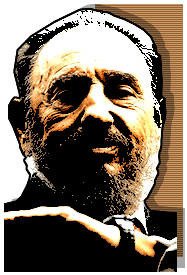 Outside of North Korea, Fidel (
left
) remained the last person to stay faithful to two delusions that were the warp and woof of the socialist fallacy in the last century. One was that it was not just possible but imperative to construct an economy where each worker would give according to his ability and receive according to his need.
Outside of North Korea, Fidel (
left
) remained the last person to stay faithful to two delusions that were the warp and woof of the socialist fallacy in the last century. One was that it was not just possible but imperative to construct an economy where each worker would give according to his ability and receive according to his need.
The second delusion is that history is a relentlessly progressive unfolding which if discerned by a vanguard of self-sacrificing few (think of Che Guevara) would lead to a socialist paradise.
Sundry effects of the two delusions that took hold in Cuba in January 1959 have eventuated in the following: an average monthly wage of US$20, hospital patients obliged to bring their own sheets, thousands of Cuban doctors unable to find work except in Venezuela which is supporting the Cuban economy the way the Soviet Union once did, and now a decision by Raul that the public sector must shed a half-million jobs.
All this is prologue to the point that the Parti Sosialis Malaysia (PSM), the minuscule organisation with one MP (Dr Jeyakumar Deveraj - Sungei Siput) and one state assemblyperson (Dr Nasir Hashim – Kota Damansara) ought to do some earnest thinking on their party’s future.
After a 10-year legal recognition battle that was referred to the courts where it was unavailing, the Registrar of Societies, in a fit of propriety, recognised PSM’s right to lawful existence in 2009.
It is doubted the ROS was motivated by anything noble: the more opposition parties the easier for BN to stay in power, especially as both successful candidates of the PSM in the last general election (March 2008) had campaigned on a PKR ticket.
Former MIC members
PSM has about 500 card-carrying members. Their active supporters would be five times that number. Together, the numbers are still minuscule, as relative sizes of political parties in Malaysia go.
For PSM, an existence as a separate entity would be quixotic in a time in Malaysian political history where the underlying paradigm of race-centric politics is shifting to some
Alone among political parties in Malaysia, PSM is singularly free of race-based considerations. It is a majority Indian Malaysian party led by a Malay, Dr Nasir, whose persona is so free of sectarian parochialisms it epitomises the socialist ideal, best rendered by Pablo Neruda, the Chilean poet and Nobel laureate: ‘I know only the skin of the earth/and I know it has no name’.
 Merger with PKR would brighten PSM’s prospects of realising the minimum goals of its agenda. PKR is a social democracy; its egalitarian economic and political agenda attest the fact. PSM’s minimum agenda would be realized when PKR is empowered.
It now transpires that PKR is a majority Indian Malaysian party -up to 40% of its total 400,000 members. But it is speculated that the bulk of these are former MIC members; they bring with them all the frailties of that mind-set. Of PKR’s Indian Malaysian members, there are two categories.
One category, in which former MIC members are dominant, believes that there must be race- based affirmative policies for Indian Malaysians. Otherwise, they contend, the race will continue to languish.
The other group feels that such an approach will only harden existing racial cleavages in Malaysian society. This group holds that once PKR’s egalitarian economic and political prescriptions are implemented all presently disadvantaged Malaysians would be privileged and racial profiling will recede. This position is a facsimile of PSM’s.
When Hindraf organised their historic demonstration of Nov 25, 2007, PSM was the only opposition party that declined to lend support. They took the position that the issue of Indian Malaysian poverty was indivisible from that of the rest of the disinherited in Malaysian society.
Ideology has no charm
It was a principled position, coming from a party that was majority Indian Malaysian in membership. Its identity with the position of the second category of Indian Malaysians in PKR provides grist for the argument that rather than preferring a separate existence as a minuscule player, PSM should opt for merger with PKR.
There are other reasons why a merger would be beneficent. PKR is beginning to fall for elitist temptations. Some in its hierarchy like to hide the fact that it is an Indian Malaysian majority party and not a Malay majority one. The current contest for the deputy presidency is being fought within the confines of this elitism.
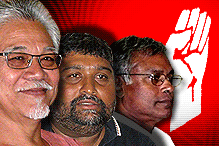 Another reason for a PSM-PKR merger is that PSM cannot, in seat-sharing negotiations within opposition coalition Pakatan Rakyat, hope to gain more seats than they already have – which are the Selangor state wards of Semenyih and Kota Damansara, and the parliamentary seat of Sungei Siput in Perak.
PSM is active in something like 17 areas in five states in Peninsula Malaysia where their engagement with local issues gives them a presence that is more recognisable among the local population than that of their more muscular opposition party counterparts. But PSM, in seat negotiations, cannot parlay a figure of 17 into something that is larger than the three seats they presently have.
However, as part of PKR, the scenario changes radically. Hence a continued separate existence for PSM serves ends no more than merely quixotic.
With an epigone like Castro admitting to modernity’s wreck of the socialist agenda, PSM can no longer sustain the notion that their ideology enjoys a charm impervious to the reasoning of historical experience.
TERENCE NETTO has been a journalist for close on four decades. He likes the occupation because it puts him in contact with the eminent without being under the necessity to admire them.


Are you sure you want to delete this comment?
This action cannot be undone.