




Managing expectations of local gov't democracy
If civil society organisations were asked to select a word or two that would best describe the overall performance of the Pakatan Rakyat controlled Selangor government on the occasion of its second anniversary of coming into office, those words would turn out to
be 'still waiting'.
If civil society organisations were asked to select a word or two that would best describe the overall performance of the Pakatan Rakyat controlled Selangor government on the occasion of its second anniversary of coming into office, those words would turn out to
be 'still waiting'.
That this is so should not be immediately assumed to serve as an indictment of the failure of the Pakatan in the administration of the state.
That assumption would be too simplistic. It would also be wrong.
 Certainly there have been missteps. The one that immediately springs to mind was the suggestion by the Menteri Besar Khalid Ibrahim (
right
) in the early days of taking over the reins of government that there should be a levy imposed on each foreign worker.
Certainly there have been missteps. The one that immediately springs to mind was the suggestion by the Menteri Besar Khalid Ibrahim (
right
) in the early days of taking over the reins of government that there should be a levy imposed on each foreign worker.
Such a levy, to be paid for by those who chose to employ the services of foreign workers, would help to defray the expenses incurred by the Selangor state government in providing for the transition and training of foreign workers.
The aim was noble - to help foreign workers adjust to a new country and culture, to a different working environment. But the thinking behind it was somewhat naive. Most came to the conclusion that a potential employer would simply add the levy to the already long list of expenses that he would seek to recover from his foreign workers through the deduction of their wages.
 Rather than improve the situation of foreign workers this proposal would exacerbate it. To those civil society organisations, foreign workers rights defenders and ethical employment advocates, such a suggestion was unpalatable as well as unworkable.
This combination of idealism and naiveté quite perfectly characterised the new Selangor state government. It is now quite clearly accepted that in the run-up to the general election on March 8, 2008, no one would have imagined that the reins of power could have, or indeed would, change hands.
Many from Pakatan who offered themselves as candidates for the Selangor state assembly were either long-time political operatives or those who had cut their teeth in non-governmental organisation (NGO) activities.
Many had spent years serving and operating in opposition to the state government. None had much experience in local government, if at all, let alone a state government. Those who found themselves wearing the mantle of governmental leadership in the aftermath of this watershed election result were now in something of a quandary. What would be their policies?
Each party had crafted some form of political manifesto but these were primarily party-based - DAP, PAS and PKR.
They did not address a situation in which these three parties would be thrust together in coalitional politics. Second, such manifestos were centre focused, federally-biased documents devised and dictated by national-based political considerations.
They did not speak too much to state-based issues, save perhaps with the exception of states like Penang and Kelantan, which were always seen as key battleground states.
Further, some of the manifestos represented an agglomeration of wish lists of civil society organisations which the political parties were more than happy to adopt, if only because it meant the possibility of attracting the voting support of members and followers of such organisations. As already noted, some of the electoral candidates had previously been part of the leadership of such civil society organisations.
‘We are now in government'
Reality soon set in and, with it, the challenge of actually governing a state. Leaders had first to be chosen. Constitutional provisions had to be observed, for example, choosing a Muslim leader to be menteri besar, even if that possibly meant that he would not come from the
party with the largest number of seats. Audiences with the Sultans and Yang di-Pertua Negeri needed to take place. The composition of state executive councils had to be agreed on and portfolios designated.
 In Selangor there was the additional distraction of having to deal with the wholesale disappearance of documents from the offices of the previous members of the Selangor government. Stories of late night leaching of documents from such offices into the backs of lorries abound, disappearing into the darkness.
In all states the reality of working with federally-appointed senior state officers, and federally-appointed presidents of local authorities, meant that change, if it came, would come slowly. For 51 years the civil service had had to deal with only one coalition of political
parties in government in Selangor.
Now it had to deal with a different one. It would not be business as usual. There would be a different ethos of government, which chafed at the collars of those used to the ancien régime. State executive councillors would have to face outright opposition from vested interests within the bureaucracy.
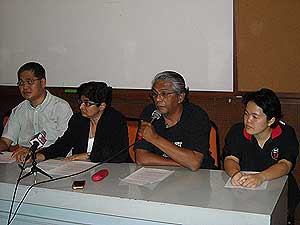 As if this were not enough to deal with, there were the demands of civil society. It was an instinctive and therefore wholly natural response on the part of civil society organisations to the victory of Pakatan to assume that, now in power, those wish lists that had formed the foundation of party political manifestos would be worked on and gradually turned into reality.
This was the culmination of years, possibly even lifetimes, of ground-level grind and grassroots mobilisation.
One of the best illustrations of this dichotomy between hope and reality is the issue of local government elections. Both the DAP and PKR had stated that they would reintroduce elections for local authority councils in the event they were brought to power. Prior to the elections, civil society organisations in Selangor had come together to establish a Coalition for Good Governance.
With its focus on greater transparency and accountability the CGG, as it came to be known, championed, among other things, the reintroduction of local government elections as a means of choosing members of a local authority council.
A few conferences and seminars were carried out to promote this idea in different parts of the country.
 The first dose of reality came when existing local authority councillors refused to vacate their offices on the grounds that their terms had yet to expire. Second, once that hurdle had been overcome there was great expectation that the 24 seats in each of the local authority councils in Selangor (and elsewhere) would be doled out to party apparatchiks as a reward for political support and loyalty.
After all, this was how it was done by the Barisan Nasional government all along. One can, therefore, imagine the disappointment on the part of civil society organisations, which naturally felt betrayed by their former colleagues, now in government, in having sold out their ideals in the name of political power and expediency.
It did not help that state governments were now stating that their hands were tied because of provisions in the law which made the reintroduction of local government elections near-enough impossible without the consent and cooperation of the federal government.
This, of course, was not surprising, although reflective of a narrow and misguided perspective. Simply put, the federal government did not desire to accede to requests to reintroduce local government elections for fear that it would lose political control of and power over local authority councils.
While this may well be true, such a phenomenon would have had equal applicability in states controlled by Pakatan. One of the huge lessons quickly learnt now that Pakatan was in control of the Selangor (and other) state governments was how large local authority budgets actually were.
Some local authority budgets represented huge percentages of the budget of the entire state government. If local government elections were eventually held, and control of local authority councils was lost in such elections, it would represent a significant loss over the course and conduct of vast amounts of state funds.
Pakatan would not have struggled to gain power only to give it away so easily through the reintroduction of local government elections. The sword, as it were, cuts both ways.
In states where BN is in government, it could lose control of local authority councils to Pakatan, and vice versa . No wonder neither now is keen to reintroduce local government elections, at least (where Pakatan is concerned) not in the short-term.
To its credit, the Selangor government commissioned a study to consider the implementation of local government elections. However, upon the production of the report on that study, other arguments have also been canvassed for the delay in reintroducing local
government elections, namely the potential for lawsuits challenging a unilateral reintroduction by the states.
Clearly there is divided opinion as to whether states can reintroduce local government elections by themselves, without the cooperation of the federal government and other federal agencies.
There could be a huge cost in defending any potential law suit. There was also the possibility of having to challenge any non-cooperation by the Election Commission (whose role in local
government elections is constitutionally mandated), and finally the actual cost of carrying out an election.
One initiative now taking place in certain Pakatan Rakyat-controlled state governments is to focus on the improvement in and efficiency of the provision and delivery of local government services first.
Once these have achieved a satisfactory level of attainment, then only would local government elections be contemplated. This is to give the Pakatan a real chance to prove itself in the area of provision and delivery of local government services, and to have a reasonable record to defend in such eventual local government elections.
For these and other reasons, the reintroduction of local government elections appears not to be on the horizon. Instead, representatives from civil society organisations have been appointed as local authority councillors. However, this move has proved somewhat unsatisfactory because local chambers of commerce and industry representatives have been included in the allocation of places set aside for civil society organisations.
Civil society organisations do not consider chambers of commerce and industry as being in the same category as themselves. Civil society organisations are still expecting the Selangor
government to clearly set aside a fixed quorum of seats to be reserved for their representatives and also to publish criteria as to how all local authority councillors are to be appointed.
Calls for such criteria to be made public have recently been heeded. CGG on its own has developed a set of criteria. Another round of appointments of local authority councillors will arise in 2010, yet no discernible public scrutiny or selection process has been put in place by the Selangor government.
This does not bode well for the development of local democracy. CGG is looking to develop a series of questionnaires that will be used by residents to evaluate their local authority councillors in the hope that such feedback will assist in determining whether local authority councillors are re-appointed or not.
In addition, CGG is planning to mobilise public interest and demand at the very least a pilot project of local elections whereby the winners of such an election will be appointed as local authority councillors.
Whether or not the Selangor government agrees to this halfway house will determine whether it is seen as truly desirous of transforming the way Selangor is governed, albeit through incremental steps.
A piece of the PIE
Local government elections are but one leg of a triad of issues being promoted by CGG. Under the acronym ‘PIE', these are participation, information and elections. In the area of information, the Selangor government has been bold to propose a state Freedom of
Information enactment.
 State executive councillor Elizabeth Wong (
right
) has been spearheading a combined initiative between the Selangor government and civil society organisations to introduce legislation at the Selangor state assembly.
State executive councillor Elizabeth Wong (
right
) has been spearheading a combined initiative between the Selangor government and civil society organisations to introduce legislation at the Selangor state assembly.
The Selangor government has adeptly manoeuvred its way through the ins and outs of the Official Secrets Act 1 972 and capitalised on provisions that give power to the menteri besar or an officer appointed by him to declassify certain categories of documents and information. This initiative was nearly railroaded due to political difficulties of a personal nature faced by Wong in 2009.
However, both she and it are back on course again.This state Freedom of Information enactment could well lead the way in creating a more open and transparent form of governance, not just for Selangor but for other states and possibly even the federal government. The proof of the pudding, as it were, will be in its eating.
The third of the triad, participation, hinges on the commitments made pursuant to Local Agenda 21. This is not a new initiative, having been launched many years ago by the previous Barisan Nasional-led Selangor state government.
The challenge here is for both the Pakatan-controlled Selangor government and civil society organisations to encourage greater public participation and involvement in local affairs. The development of a well-informed, participative and enfranchised democracy is critical to the evolution of a mature and progressive society.
Local Agenda 21 was hitherto seen as a project in itself, in isolation. The strength of seeing it as but a leg in a three-legged stool is to give the whole ethos of accountability and transparency a more stable and solid foundation.
From a civil society perspective, there are outstanding concerns in respect of the accountability of the senior elected representatives in Selangor. Promises of regular meetings with representatives of civil society organisations have not been fulfilled. In 2008 the menteri besar promised at least two meetings a year; this has not been honoured.
Having had to face the repercussions of the conflict between the federal and the state government, the recent embracing by the Selangor government of the Bar Council's MyConstitution campaign is to be welcomed. All of us will benefit from a deeper and closer study and understanding of the federal constitution, and in particular the various provisions governing the relationship between the federal and state governments.
In the area of land reform, the decision of the Selangor state government not to appeal the case of Sagong Tasi marks a high point in the recognition of Orang Asli (indigenous peoples) traditional land rights.
 The Selangor government has also been pro-active in creating a task force to look into various issues relating to Orang Asli. This task force has met on several occasions.
This discussion started with the assertion that judgement on the success of the Pakatan-controlled Selangor government is ‘still waiting'. The jury is still out. Or to put it another way, it is a ‘work in progress'.
It was much easier to wish in opposition than to deliver in government. This is probably the most difficult lesson that has been learnt. Those in government have had to pacify their friends and colleagues as to what has been achievable in the first two years.
Early exuberance has given way to managed expectations. Visions of a tsunami-like sweeping away of the old have turned into incremental change to bring about the new.
An election must be called in 2013, if not sooner. The people cannot be left waiting for a delivery of promises which, though made, are never fulfilled.
The boldness and courage of the electorate in voting for change on 8 March 2008 should not be rewarded by timidity, by the focusing on the excuses as to why it was not possible to deliver. There are challenges; there are institutionalised difficulties. We have come to realise these.
Perhaps they were always there, but we chose not to see them, preferring instead our hopes and dreams. The ultimate challenge of the Pakatan-controlled Selangor government now is how well and how much it will be able to turn those hopes and dreams into reality. Two years is time enough to have got off the blocks. Now it must pick up speed and run and finish well.
Soon after writing this chapter, both the Pakatan-controlled Selangor government and the Pakatan-controlled Penang government publicly declared that they would support local government elections.
Both state governments announced that they had written to the Election Commission to ask it to assist in the conducting of elections for local authority councils within their respective states. This is in accordance with Article 11 3(4) of the federal constitution.
In turn, the federal overnment has indicated that it did not see a need to bring back local government elections, citing politicking as the main reason.
ANDREW KHOO is a lawyer and has a partnership with Daniel Lo. After graduating from King's College London in law and history and philosophy of religion he has worked in Canada, Jamaica and northern Uganda on relief, rehabilitation and community development projects. He is chair of the Bar Council's human rights committee and deputy chair of the trade in legal services committee. He also serves the Islamic finance and legal profession committees.


Are you sure you want to delete this comment?
This action cannot be undone.