




Consul calls for direct Indonesia-Sabah trade
Indonesian Consul in Kota Kinabalu, Rudhito Widagdo, cannot understand why sea trade between even Nunukan Island, across the international border, and Sabah has to go through Port Klang on the west coast of the peninsula.
Indonesian Consul in Kota Kinabalu, Rudhito Widagdo, cannot understand why sea trade between even Nunukan Island, across the international border, and Sabah has to go through Port Klang on the west coast of the peninsula.
He suggested that Sabah establish its own port for direct shipping with Indonesia.
"We hope the Malaysian government would study the need for direct trade between Indonesia and Sabah to boost the economic growth of both sides," said Widagdo.
He was elaborating on his remarks at a presentation, "Business Opportunities in Remarkable Indonesia" earlier this week at the Indonesian Consulate in KK.
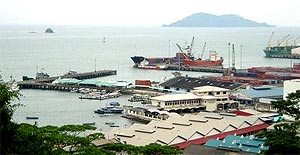 He disclosed that many Indonesian products imported into Peninsular Malaysia were re-branded and shipped via Port Klang as local products to Sabah.
He added: "We want consumers in Sabah to know that many of the products they buy originate in fact from Indonesia."
He conceded that the transportation system in Sabah needed improvement but still hopes that a start could be made by first doing away with the ruling that Port Klang be the feeder port for Sabah and Sarawak.
Huge potential for wealth generation
He sees Sabah-Indonesia trade as still largely untapped. Last year, Widagdo pointed out, Indonesia only exported RM2.97 billion worth of products to Sabah and imported RM1.99 billion.
This works out to a small percentage of the Malaysia-Indonesia trade which last year stood at US$ 11.4 billion (RM343.9billion) i.e. US$ 6.53 billion (about RM51 billion) being Indonesia's total exports to Malaysia and US$4.91 billion (around RM15 billion) being imports.
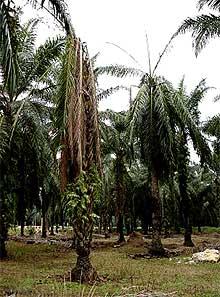 If direct shipping between Sabah and Indonesia could materialize, the Indonesian consul sees oil palm plantations, infrastructure, furniture and agriculture as some of the sectors in the state with potential for investment and trade opportunities with his country.
In direct trade alone, the prospects between Sabah-Indonesia are in building materials, automotive components and seafood and other food products. Sabah could import cocoa, coal, paper, rattan and automotive materials from Indonesia.
Direct Sabah-Indonesia trade, according to Widagdo, will also see an increase in the two-way traffic flow between both territories including for business, visits, shopping, learning and looking at the traditional culture which shares similarities with Indonesia.
"An increasing number of visitors from Malaysia are flying direct to 14 cities in Indonesia and Sabahans should be part of this trend," said Widagdo. "There has been a tremendous increase in business relationship between the two countries."
 Citing some statistics, he said that 18 per cent or 1.3 million of Indonesia's seven million visitors last year were from Malaysia. He did not offhand have the figure for the number of Sabahans visiting Indonesia. Likewise, 2.4 million of the 23.6 million people who visited Malaysia, including Sabah last year, were from Indonesia.
Widagdo's remarks have struck a cord with the local Chinese chambers of commerce.
The Labuan Chinese Chamber of Commerce president, Chin Chee Kee, fumes that the high transportation costs to the island via Port Klang and Kota Kinabalu have jacked up prices on the island despite its duty-free status.
Innocent parties shouldering blame
"The trading activities from offshore companies have created an economic spin-off demanding an ever-increasing volume of goods," said Chin whose accountancy firm acts as a secretariat for international offshore companies operating on the island.
Tuaran Chinese Chamber of Commerce chair, Tan Kim Beng, has given up on Port Klang being weeded out as a feeder port for Sabah. "The rakyat (people) in Sabah, especially the Chinese business community, rasa bosan (feel bored)," said Tan. "We are fed-up. The issue is pusing, pusing, bergilir-gilir (turning and repeating). The problem is never solved."
He expressed concern that consumers are blaming Sabah's Chinese business for the price disparity with Peninsular Malaysia. This was a big misunderstanding, stressed Tan, since the traders were the victims of the unfair trade pattern.
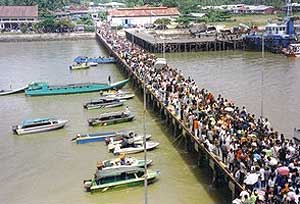 The Transport Ministry is reportedly studying, yet again, the National Cabotage Policy (NCP) which designates Port Klang as the feeder port for Sabah and Sarawak. This follows Prime Minister Mohd Najib Abdul Razak's visit to Kota Kinabalu in early August during which he had a meeting with the Federation of Sabah Manufacturers (FSM).
The FSM has already identified the NCP as one of the three major factors affecting the cost of doing business in Sabah. The other two factors are the inconsistent supply of labour, both local and foreign, and industrial land tenure and extension of lease.


Are you sure you want to delete this comment?
This action cannot be undone.