




The woman behind Lee Kuan Yew
One cannot but be moved by the tribute paid by Lee Kuan Yew to his wife who died last Saturday at the age of 89 after a long illness. In spare sentences, with as little flourish, Singapore’s Minister Mentor gave glimpses of their 63 years as partners.
One cannot but be moved by the tribute paid by Lee Kuan Yew to his wife who died last Saturday at the age of 89 after a long illness. In spare sentences, with as little flourish, Singapore’s Minister Mentor gave glimpses of their 63 years as partners.
Few men could have said so much that was so vivifying in so little a time about so cherished a relationship as Lee had with Kwa Geok Choo whom he eulogized in a funeral service held mid-week.
It was a relationship that was pivotal to the future of Singapore, the malarial crossroads that Lee transformed into a cynosure for Asia and even the rest of the world.
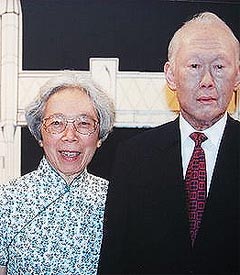 Let’s face it, these are not times in which a woman of high academic accomplishment from Raffles College and Cambridge can be expected to find fulfillment in being the helpmate of someone as achievement oriented as Lee Kuan Yew.
Since the time home appliances liberated women from domestic drudgery, their careers have merited attention. Mrs Lee’s in the practice of the law was wholly subordinated to her husband’s career in politics and to the raising of their children.
According to Lee, they were an ideally complementary pair. "Without her, I would be a different man, with a different life," was Lee’s compliment of deadpan simplicity to Geok Choo.
If Aristotle’s take on happiness is true – he defined it as the fulfillment of one’s naturally endowed faculties along points of excellence – then, clearly, Lee's happiness lay in him finding his m é tier in politics while Geok Choo’s had a narrower field of fulfillment in breadwinning work and family nurture – a not very feminist stance, you may say.
Dedicated socialist
But 'Tory men' employing 'Whig measures' (the phrases are from Disraeli’s novel Coningsby, and they refer to politically conservative men who are for progressive though not liberal measures), that is what Lee is, do not like feminists.
It’s interesting what Lee said of his wife’s uncanny intuition about the character of individuals she encountered in her husband’s political orbit.
 One of them, Johor-born Lim Chin Siong, was highly regarded by leftwing Malay leaders in Singapore and Malaya. Though he was Chinese–educated, he supported the notion that Malay be the official language of the Singapore-Malaya region.
Lim was a dedicated socialist with a spartan lifestyle, and read novels; that is also something Lee said his wife was fond of doing, Jane Austen being a favorite author. She disliked Chin Siong.
There was no love lost between Lee and leftwing Chinese educated leaders like Chin Siong. The former thought the latter were stooges for the Malayan Communist Party. Friends of Chin Siong, including the late Samad Ismail and James Puthucheary among others, laughed off the proposition.
Operation Cold Store
Was he Red? This is one of those historical questions that are never likely to be satisfactorily resolved, like whether the communist rebellion of the 1948 hastened independence for Malaya in 1957 or that Malaya would have obtained independence in any case by then; or further afield, whether Ngo Dinh Diem’s cancellation of elections for a unified Vietnam in 1956, mandated by the Geneva Accords of a year earlier, was the trigger for the Vietnam war between the North and South.
The issue of Chin Siong’s actual leanings tantalisingly pops up against a backdrop in which what Lee has wrought on the island republic, and what the DAP’s Lim Guan Eng promises to achieve in Penang, jostles with the larger question of whether a good Chinese leader can be accepted by the Malays of the Malaysia-Singapore region.
Clearly, in his valedictory interview with the New York Times last month, Lee believes that he would have brought up the Malays of the region faster and better if Singapore had not been been "turfed out" of Malaysia. Verily, Guan Eng can be a good leader for the Penang Malays.
Chin Siong was the earliest of the Chinese leaders with pan-Malayan appeal. His detention and the destruction of his cohort in the Barisan Sosialis under Operation Cold Store in 1963, and Lee’s antipathy towards democratic dissent, runs like a geographic fault through the rich pasture of all that the Singapore patriarch has achieved.
The upshot: very few in both countries believe that an ethnic Chinese can be a good leader for the Malays and vice versa. It comes as a dismaying reminder that womanly intuition had a role in this sad reality that bedevils inter-racial relations in the region.
TERENCE NETTO has been a journalist for close on four decades. He likes the occupation because it puts him in contact with the eminent without being under the necessity to admire them.


Are you sure you want to delete this comment?
This action cannot be undone.