




Two more PKR veep hopefuls on key issues
On Oct 26, Malaysiakini emailed a list of questions to all 17 PKR vice president hopefuls, providing them an equal platform to express their stands on key issues, like party hopping and Anwar Ibrahim's position as a de facto leader.
Last Wednesday, Malaysiakini published the responses of four candidates - R Sivarasa, Mohd Yahya Sahri, Fuziah Salleh and Nurul Izzah Anwar, who was, till Nov 8 leading in the race, after 87 divisions delivered their results.
On Oct 26, Malaysiakini emailed a list of questions to all 17 PKR vice president hopefuls, providing them an equal platform to express their stands on key issues, like party hopping and Anwar Ibrahim's position as a de facto leader.
Last Wednesday, Malaysiakini published the responses of four candidates - R Sivarasa, Mohd Yahya Sahri, Fuziah Salleh and Nurul Izzah Anwar, who was, till Nov 8 leading in the race, after 87 divisions delivered their results.
Now it's the turn of party strategic director Tian Chua , who closely trails Nurul Izzah at 3,933 votes, and Penang deputy chief minister Mansor Othman who until the last weekend had garnered 3,552.
This will be the final round of answers, as other candidates failed to respond. Excerpts of their responses follow, edited for language and brevity. Answers similar in content have been dropped.
Who do you prefer as deputy president; Zaid Ibrahim, Azmin Ali or Mustaffa Kamil Ayub?
Tian Chua : I am prepared to work with any individual elected by the grassroots. However, I will observe the conduct of the candidates during the campaign period.
 (He must be) able to generate synergy by working as a team with other leaders and have the humility to respect viewpoints and criticisms from the grassroots.
(He must also) have the courage to withstand repression and be willing to lead mass mobilization and articulate the party's core principles and be mindful of party's public image.
Mansor Othman : The person must be loyal to the party, tested as a team player, brave enough to take a stand and must not use the media to condemn the party. (These are) the traits of a good leader with vision.
How would you propose strengthening party unity after the party elections?
Chua : First we must accept PKR is a party of plurality and diversity. All leaders must be tolerant and respect divergence of opinions (while the party) must provide the platform for exchanging views.
In the long term, to achieve greater party unity, members must develop shared common values. This will be attained through dialogue, debate, and perhaps even conflict or crisis.
Mansor : We have gone through many hardships and must reconcile. I look forward to strengthening the organizational structure and empower the party's grassroots.
Why do you think PKR members recognise Anwar Ibrahim as their de facto leader? Do you think the post is undemocratic, given that he has not been elected?
Chua : The sacking and subsequent imprisonment of Anwar marked the turning point of national awareness for democratic change (and had) ignited the Reformasi movement whose momentum ...finally brought about massive victory in 2008 general election.
Throughout the years of hardship, Anwar was the icon of resistance against oppression. Now he represents a new hope for Malaysia.
In fact, Anwar was 'elected' de facto leader via a Congress resolution in 2007, when he was barred by the Registrar of Societies from vying for party president.
Although the period of prohibition is over, the ongoing legal prosecutions and harassment continue to threaten his personal liberty.
Mansor : Anwar is not only a leader recognized by this country, but also in this region, and most importantly, by all leaders of the world as a great statesman. If Pakatan comes into power he should rightfully be the prime minister.
T
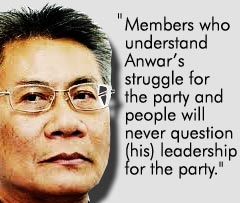 here is no question about (his) position in the party; members who understand Anwar's struggle for the party and people will never question (his) party leadership.
The issue of democracy does not arise at all, thus the question of (his position as a de facto leader) as undemocratic is irrelevant to the members of PKR.
Do you think PKR will suffer greatly if Anwar is found guilty in the latest sodomy charges?
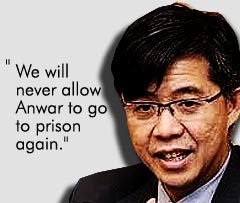
Chua : No...prison walls cannot stop him from providing leadership to the party. I am confident that the entire party leadership and the rank-and-file will vow to stand in solidarity with Anwar. We will never allow Anwar to go to prison again.
If the regime stubbornly repeats the previous conspiracy, a new generation of reformis will arise to chart a new wave of people's power.
Mansor : PKR is ready. Even if he is found guilty...we believe that he will come back not only as a leader of PKR but also as the leader of the nation.
PKR is viewed as the weakest link in Pakatan Rakyat, to what extent do you think this perception is accurate? Why are PKR members considered to be the least dependable of Pakatan parties in terms of discipline and machinery?
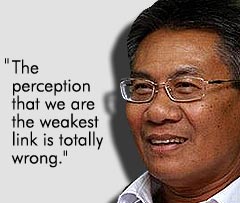
Mansor : PKR is the bridge linking DAP with PAS. The perception that we are the weakest link is totally wrong...because of our position and strength (poses) a great challenge to Umno and BN component parties, explains why PKR gets attacked the most.
 Chua
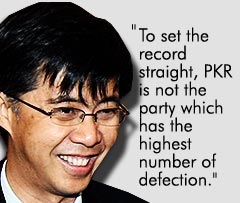
: To set the record straight, PKR is not the party which has the highest number of defections. Many other parties previously had suffered even greater number of desertions.
Chua
: To set the record straight, PKR is not the party which has the highest number of defections. Many other parties previously had suffered even greater number of desertions.
(But) PKR emerged as a result of the mass protest movement. It was hastily converted into the framework of a political party in order to face elections.
In the first decade of our existence, the party experienced tremendous repression and we had no opportunity to consolidate structure and machinery.
How would you propose to control/prevent leaders/members from party-hopping?
Chua : We need to institute more stringent procedure and thorough screening for candidate selection.
The problem of party hopping is rooted in Malaysia's corrupt political culture. There must be a review of election laws to eradicate political bribery and to prevent the betrayal of people's mandate.
Mansor : We need a very strong and effective disciplinary committee. The committee must formulate, implement and educate party members about (our) struggle and (show them) this is the party of the future.
Do you think Pakatan Rakyat can take over Putrajaya in the 13th general election? How and what are the strategies you would suggest to win people over to the coalition?
Chua : The question is not whether we can--we must. We have no choice but to take over the central government to save Malaysia from sliding into a failed state.
The key strategy for Pakatan Rakyat is to overcome the information blockade imposed by the ruling parties. PKR will have to devise a comprehensive plan to disseminate information on our programs for change in all corners, especially in the interiors of Sabah and Sarawak.
 Mansor
: Our struggle categorically states that we are going to take over Putrajaya, and one day we shall. We are committed (to this) because we believe that we can do better than the BN.
Mansor
: Our struggle categorically states that we are going to take over Putrajaya, and one day we shall. We are committed (to this) because we believe that we can do better than the BN.
This is proven in the development records and performance of the four states under the Pakatan. To be specific, Penang has even been named by Transparency International as the best state for being free of corruption.


Are you sure you want to delete this comment?
This action cannot be undone.