




Georgian women put M'sia's death penalty in spotlight
Two Georgian women are facing the death sentence in Malaysia in a case that human rights campaigners say has highlighted worries over the continued imposition of capital punishment for drugs offences.
Two Georgian women are facing the death sentence in Malaysia in a case that human rights campaigners say has highlighted worries over the continued imposition of capital punishment for drugs offences.
Babutsa Gorgadze, 26, and Darejan Kokhtashvili, 37, were arrested last month in Malaysia after they were found with more than 10 kilos of methamphetamine.
Under strict Malaysian laws the pair, both mothers, are now facing mandatory death penalties if convicted and efforts are under way by Georgian authorities to stop the pair being sentenced to death if convicted.
 Human rights campaigners say the case has brought into focus the dangers of imposing capital punishment for drugs crimes.
The case took a new turn this week when Georgian media reported the husband of one of the women had confessed to Georgian police that he had been behind the drug smuggling, and that the women had gone to Malaysia unaware that they were carrying illegal narcotics.
Patrick Gallahue of the International Harm Reduction Association (IHRA), which has led a series of studies into the imposition of the death penalty for drug offences and campaigned against it, told IPS : "Cases like this highlight concerns over capital punishment, especially when enforced as a mandatory punishment.
"When there is no individualised consideration of the circumstances in a capital case, to impose a death sentence is a cruel and inhuman punishment as well as an arbitrary deprivation of life."
More than 1,000 executed
There are currently 32 countries which retain the death penalty, in some cases as a mandatory sentence, for narcotics offences.
Research by the IHRA, among others, has shown that in some countries drug offenders make up a significant proportion of all annual executions. Available statistics show that hundreds of people are executed worldwide for drugs crimes every year. But many countries do not release figures on executions and it is believed that the real figure could be more than a thousand.
However, while many states retain capital punishment for narcotics offences but do not use it and others do so only rarely, a handful of countries, including Malaysia, Singapore, China, Iran, Vietnam and Saudi Arabia, have been identified as carrying out high numbers of executions every year.
These countries say that capital punishment acts as a deterrent to traffickers. But critics reject the claim.
Tsira Chanturia, South Caucas regional director for Penal Reform International, told IPS : "In Indonesia, Malaysia, Singapore and Thailand, reports indicate that a high proportion of death sentences are imposed upon those convicted of drug offences. However, this does not deter individuals from committing such crimes.
"There is no credible evidence that the death penalty deters serious crime in general more effectively than other punishments."
They also argue mandatory use of capital punishment in cases of drug offences is an inappropriate punishment when the circumstances of many of those convicted are taken into account.
"In many countries, those arrested tend to be foreign, young, vulnerable and from difficult circumstances. In some cases, there is a very real possibility they were deceived about what they were transporting.
"At the very least, there is a chance that those who were arrested were misled about the risks involved," said Gallahue.
Debate on death penalty continues
The specific legal paragraph of Malaysian law under which Goradze and Kokthashvili have been charged breaks international legal standards as it assumes the defendant is guilty unless they can prove their own innocence, according to Amnesty International.
Under the International Covenant of Civil and Political Rights (ICCPR), countries retaining the death penalty should only use it for "the most serious crimes."
Human rights bodies, including the UN's Special Rapporteur on Torture and other cruel or inhuman punishments, have said that drug offences should not be defined as among the most serious crimes and that
countries still using capital punishment should only impose it for wilful murder.
Governments of countries using the death penalty for drug offences have repeatedly said that drugs offences are among "the most serious crimes" and pointed to rulings in their own courts justifying its legality. They also say capital punishment is an accepted social norm in their society.
Some also justify it on the grounds that is serves the needs of society as a whole despite concerns over the rights of the individual.
 In a commentary published in the UK newspaper
The Guardian
in June this year for instance, Singapore's ambassador to Ireland, Michael Teo, wrote: "Every society strikes its own balance between the rights of the individual and the rights of society.
In a commentary published in the UK newspaper
The Guardian
in June this year for instance, Singapore's ambassador to Ireland, Michael Teo, wrote: "Every society strikes its own balance between the rights of the individual and the rights of society.
"Capital punishment is an integral part of our successful comprehensive anti-drug strategy. Our tough stance against drugs has saved tens of thousands of lives from the drug menace."
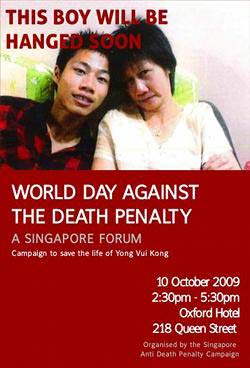
A Malaysian, Yong Vui Kong , was scheduled to be hanged in Singapore in August after being convicted for smuggling 47 grams of heroin into the island republic when he was then 18 three years ago. However, he was given a last-minute extension for his clemency appeal to be heard.
- IPS


Are you sure you want to delete this comment?
This action cannot be undone.