




GM mosquitoes: 'Wait for Cayman trials results'
According to Ricarda Steinbrecher, a geneticist and co-director of British-based NGO EcoNexus, the Malaysian trials must not proceed until a full, long-term environmental assessment of the Cayman trials has been performed.
According to Ricarda Steinbrecher, a geneticist and co-director of British-based NGO EcoNexus, the Malaysian trials must not proceed until a full, long-term environmental assessment of the Cayman trials has been performed.
 This was reported by another British-based NGO Science and Development Network (
SciDevNet
) on its website, expressing concerns over the clandestine nature of trials taking place in the Cayman Islands.
This was reported by another British-based NGO Science and Development Network (
SciDevNet
) on its website, expressing concerns over the clandestine nature of trials taking place in the Cayman Islands.
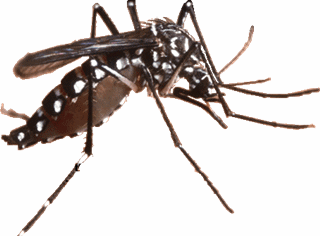
SciDevNet reports that since 2009, UK biotechnology company Oxitec has been performing ongoing field trials of the OX513A strain of the dengue-carrying aedes aegypti mosquito in the Caribbean British territory.
A large release of three million GM mosquitoes was performed in May and October this year and preliminary results were only presented on Nov 4 to the American Society of Tropical Medicine and Hygiene’s annual meeting in the United States.
Steinbrecher said the lack of information about the Cayman Island trials was a cause for concern, adding that it was not even raised at the fifth meeting of the Parties to the Cartagena Protocol on Biosafety - that addresses international safety issues relating to GM organisms - in Nagoya, Japan, last month.
She said that the lack of publicity about the trials was “worrying, both from the scientific perspective as well as public participation perspective".
‘Unproven technology’
According to SciDevNet , the results from the Cayman Island trials have shown a 80 percent reduction in the wild mosquito population in a 16-hectare urban area.
However, the same report warns that Oxitec may be claiming success too early as the unintended impact on the environment remains unknown.
 “Oxitec's unproven technology could make things worse in the long term. There is no possibility of recall if something goes wrong. Who takes responsibility in that case?" Kathy Jo Wetter, a researcher with the Canada-based Action Group on Erosion, Technology and Cooperation, told
SciDevNet
.
“Oxitec's unproven technology could make things worse in the long term. There is no possibility of recall if something goes wrong. Who takes responsibility in that case?" Kathy Jo Wetter, a researcher with the Canada-based Action Group on Erosion, Technology and Cooperation, told
SciDevNet
.
The field trials in Malaysia will be carried out in early December in Alor Gajah, Malacca and Bentong, Pahang involving between 4,000 to 6,000 male GM mosquitoes.
It is reported that Malaysia will be using the same OX513A strain of aedes aegypti mosquitoes developed by Institute for Medical Research (IMR) and Oxitec.
Video: Cayman Islands government's educational video on GM mosquitoes field trials | 5:31min


Are you sure you want to delete this comment?
This action cannot be undone.