




Anwar's a good rhetorician but poor governor
COMMENT Former New York governor Mario Cuomo once observed that politicians campaign in poetry but govern in prose.
His dictum meant that winning support on the campaign trail requires gauzy rhetoric, the beguiling of crowds with tantalising possibilities, and the conjuring away of problems just because people want a leader to do so.
In contrast, the prose of governing demanded negotiation with recalcitrant partners, the necessity for compromise, often messy and maddening, satisfaction with partial or incremental improvements, and half victories that leave principals unhappy and supporters disgruntled.
Campaigning can be vague but governing has to be specific. Being good at the former does not translate into prowess at the latter...
COMMENT Former New York governor Mario Cuomo once observed that politicians campaign in poetry but govern in prose.
His dictum meant that winning support on the campaign trail requires gauzy rhetoric, the beguiling of crowds with tantalising possibilities, and the conjuring away of problems just because people want a leader to do so.
In contrast, the prose of governing demanded negotiation with recalcitrant partners, the necessity for compromise, often messy and maddening, satisfaction with partial or incremental improvements, and half victories that leave principals unhappy and supporters disgruntled.
Campaigning can be vague but governing has to be specific. Being good at the former does not translate into prowess at the latter.
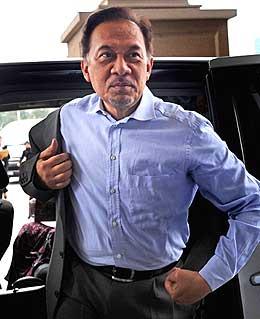 PKR supremo Anwar Ibrahim, in just over two-and-a-half years after leading Pakatan Rakyat to a signal watershed in Malaysian political history, has revealed that he is better at the poetry of campaigning than he is at the prose of governing.
Obviously, Anwar likes to think that when he gets to the top of the greasy pole, he would be better at the prose than he is with the poetry.
The manner in which he attracted Zaid Ibrahim to join PKR in June last year and the way he tackled the competitive spite Zaid’s presence provoked among his cohort revealed his strengths as a crusader for reform and his weaknesses as governor.
However, Zaid is a febrile character who would cause problems anywhere he goes. So Anwar’s initial success at co-opting Zaid and subsequent failure at keeping him must be placed against the perspective that a wealthy parvenu would always be difficult to manage.
The Jeffrey Kitingan problem
But in a miscellaneous political world, there is one opportunity and now another.
This one comes out of Sabah where Anwar is trying to keep the mast of Dr Jeffrey Kitingan securely fastened to the PKR flagship.
In October last year, Anwar was strongly advised to appoint Jeffrey as head of the state chapter. Anwar disdained to do so, showing a visceral dislike for the leader of the powerful Kadazan-Dusun-Murut faction in PKR.
 The dislike has got to do with what Jeffrey is alleged to have done while he was Sabah Foundation chief from the mid-1980s to the 1990s. The distribution of scholarships to deserving applicants was reportedly far from ideal.
Say what you like about Anwar Ibrahim, contrary to Umno’s propaganda, he is averse to any move that shortchanges the Malay or Muslim cause.
In the event, Anwar slighted Jeffrey’s claims to leadership of Sabah PKR and though there was a compromise later that patched up things, the truce was unstable and made worse when a contest for deputy president of PKR between Azmin Ali and Zaid became inevitable.
Now, in the immediate aftermath of Zaid’s withdrawal from the PKR No 2 race and his resignation from the party, fears are abroad that Jeffrey would join Zaid should the latter form a new political party.
This is a misreading of the situation. Though he is an ally of Zaid’s, Jeffrey is more devoted to putting things right as far as Sabah’s merger with the Federation of Malaya is concerned than he is with becoming an appendage of yet another peninsula politician.
Mistrust of peninsula politicians, Anwar included, is rife among Sabah and Sarawakian leaders.
In Sabah, Anwar is saddled with the additional disadvantage that he was complicit in the schemes that upended the Parti Bersatu Sabah-led state government in 1995 and its replacement with Sabah Umno, which led to a worsening of the state’s myriad problems.
Instead of making amends for that bit of nasty business in 1995 against the Kadazan-Dusun-Murut (KDM) community, of which PBS was the standard bearer, Anwar has been blasé about the need for contrition.
Will Pakatan hold together?
A few days ago, in the teeth of Zaid Ibrahim’s gyrations, Anwar passed word to Jeffrey that the latter could control the naming of PKR candidates for the 20 KDM majority seats (there are 60 in the state assembly) in the fast approaching general election.
Jeffrey is leery of Anwar’s word, for good reason. In the run-up to the recent Batu Sapi by-election, Anwar assured Sabah PKR that they enjoyed full autonomy on candidate selection.
Anwar then went on to name Ansari Abdullah, an inveterate foe of Jeffrey’s who was not on the shortlist of candidates a committee headed by Jeffrey had compiled.
Yet again, Anwar showed that he’s maladroit at managing the factions in PKR.
The very public Zaid-Azmin feuding of recent weeks has damaged PKR in the eyes of a watching public keen to know if the PKR-led Pakatan Rakyat coalition is actually going to hold together once endorsed at the next general election.
The public will be inclined to forgive the PKR contretemps over Zaid. It is not likely to do so when Jeffrey makes his move which is expected very soon and which Anwar can only forestall by being outstanding, in this instance at least, in the prose of governing PKR.
TERENCE NETTO has been a journalist for close on four decades. He likes the occupation because it puts him in contact with the eminent without being under the necessity to admire them.


Are you sure you want to delete this comment?
This action cannot be undone.