




Overseas voters want to be counted
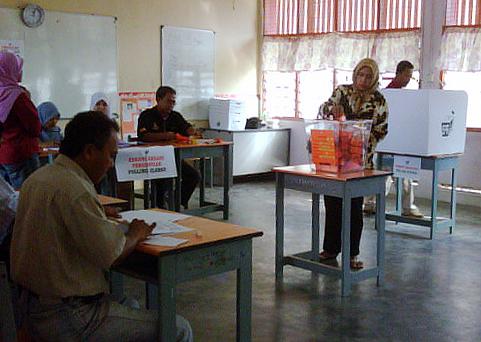
Hundreds of thousands of Malaysians living abroad have been locked out of voting in every federal election since 2002 because Malaysian law discriminates against them.
Hundreds of thousands of Malaysians living abroad have been locked out of voting in every federal election since 2002 because Malaysian law discriminates against them.
Laws under which the country's Election Commission operates allow only four categories of citizens residing overseas to cast their votes as ‘absent voters', defined in general terms as registered voters living outside Malaysia.
These absent-voter categories are only for military personnel, public servants, full-time students and their spouses, who may participate in elections by voting at the high commissions or consulates in the countries they live in.
All other citizens living abroad are not have no choice but to return to Malaysia if they want to vote whenever an election is called.
But just as a potentially huge voting force is fenced off from this basic democratic process, a growing movement of Malaysians who want to be counted in federal elections has taken shape.
Since 2008, when the last Malaysian vote saw the Barisan Nasional government lose its two-thirds majority - which for 53 years had allowed it to rewrite the Federal Constitution at will - Malaysians from Australia to England and elsewhere have been agitating for their right to be registered as absent voters.
Andrew Yong, co-ordinator of MyOverseasVote (MOV), a campaign recently founded in London, is in Malaysia exploring legal avenues to rectify constitutional defects to provide for the legitimate voting rights to all Malaysians living overseas, without any form of discrimination.
The MOV website,
www.myoverseasvote.org
, states: "Our legal
 advice is that the discriminatory provisions are an abuse of the Election Commission's discretion under the law and a violation of the grant of equality under the Federal Constitution."
The campaign lists, among its objectives, "To end discrimination against Malaysian citizens who are living outside Malaysia, re-enfranchise Malaysian citizens overseas and to re-engage them in charting the future course of Malaysia."
Says John Khoo, founder of SABMOZ (Saya Anak Bangsa Malaysia Australia) in Sydney: "Malaysians citizens simply want to participate in the future.
It's the right of the people to choose
"The right to vote is a fundamental tenet of a practising democracy - it is the right of the people to choose their political representatives and, by extension, their government."
Disturbingly, Khoo said, diplomatic offices in some countries have turned away full-time students, eligible under EC law, from registering as absent voters in their countries of residence.
News has emerged, through a network of like-minded Malaysian organisations, that full-time students who have wanted to register as absent voters have been told that "only government scholars" are eligible.
Medical student Amanda Lim was a 21-year-old registered voter in London before the last election. Unable to fly home to vote, she applied to her embassy for a postal vote, but was rejected.
"I was told that this would not be possible as I wasn't a government scholar," Lim said.
"I felt extremely insulted. My parents work hard and pay taxes in Malaysia, and I worked hard to earn a place to study medicine at King's College in London.
"I intend to return to serve my country. So I find this kind of discrimination really gutting. It puts people off voting and discourages the young from returning to Malaysia."
The frustration with the EC is palpable and growing, as is the
 gnawing suspicion that a ruling BN is ever reluctant to allow voting by all Malaysians living abroad: after all, today's privileged absent voters owe their livelihood, their very salaries, to the serving government; ditto the ‘government scholars'.
But the recent voices of agitation have not gone unheard.
An official of Malaysia's EC said in a Sydney-KL telephone interview on Nov 25: "EC is aware of the issue. Malaysians have contacted us to raise this issue. We are looking at it seriously."
However, asked if change to the law was imminent, he said a statement would be forthcoming. No statement has been issued as of now.
But Yong and Khoo are not waiting.
MyOverseasVote in London is also calling for "legal proceedings against the Election Commission to challenge the discriminatory provisions in the 2002 Regulations".
In Australia, Khoo and equally determined Malaysians have set up SABM chapters in Sydney, Melbourne, Perth and Adelaide with the collective objective of, among other goals, giving SABMOZ a voice on behalf of Malaysians who want to be considered as voters by the EC.
'Do what you can... give some money'
So far, all the pushing is coming from the ground up, and Opposition politicians visiting Australia on fund-raising and awareness campaigns appear to be embracing pragmatism.
Malaysia's next general election may be only months away, leaving little time for legislative change - in favour of a more strident and public call for equal treatment of all Malaysians by the EC.
Recently, Pakatan Rakyat de facto leader Anwar Ibrahim visited Sydney, but he made no mention of postal voting at a dinner at which about 150 people paid for the privilege of sharing an evening with a man whose political trajectory has seen him go from being prime minister-in-waiting to prisoner to PM-hopeful again.
The Opposition leader said he hoped to return in a different capacity soon, and to that end implored the faithfully gathered to do whatever they could, give some money, send a message, blog. Then he went as far as to mirror previous PR visitors to the New South Wales capital city, who implored Malaysians to "fly back and vote".
But if the Malaysians now striving to bring change from without have
 their way, the nation's absentee voters may not have to pay to vote.
Yolanda Augustin, a supporter of Friends of Pakatan Rakyat in Britain, minces no words in summing up the shared sentiment: "We are committed to seeing the growth of democracy, transparency and good governance in Malaysia.
"This has to start with clean, free and fair elections."
The EC's discriminatory practices on the voting rights of Malaysians living abroad, Augustin said, "are neither fair nor free".


Are you sure you want to delete this comment?
This action cannot be undone.