




North Korea - China's petulant bastard child
OPINION When North Korea late last month rained rockets on Yeonpyeong island, near its border with South Korea, the term ‘sabre rattling’ took on new meaning. It’s not as if petulant children or angry protestors were yanking at the neighbour’s wire-fence.
Nor were North Korea’s rockets a subtle message to its southern brethren. They were, at first blush, aggression of the war kind. Yet closer scrutiny of footage and all the posturing and analyses suggest that this was managed aggression. What’s behind it?
OPINION When North Korea late last month rained rockets on Yeonpyeong island, near its border with South Korea, the term ‘sabre rattling’ took on new meaning. It’s not as if petulant children or angry protestors were yanking at the neighbour’s wire-fence.
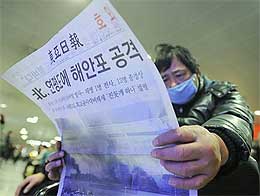 Nor were North Korea’s rockets a subtle message to its southern brethren. They were, at first blush, aggression of the war kind. Yet closer scrutiny of footage and all the posturing and analyses suggest that this was managed aggression. What’s behind it?
WikiLeaks gives a few clues. It released more classified documents of governments, principally the US. These cables shed light on foreign -policy thinking in various capitals, especially through their diplomatic missions and spy agencies.
Among
 these were glimpses of China becoming frustrated with its North Korean client state, led by the virulently corrupt, sickeningly repressive and heinously murderous dynastical communist regime of Kim Jong Il
(left)
. Beijing likens Pyongyang to a ‘spoilt child’.
these were glimpses of China becoming frustrated with its North Korean client state, led by the virulently corrupt, sickeningly repressive and heinously murderous dynastical communist regime of Kim Jong Il
(left)
. Beijing likens Pyongyang to a ‘spoilt child’.
Pyongyang’s actions on Yeonpyeong aren’t the antics of a spoilt child, though. Many experts claim North Korean aggression again exhibited its psychological cry-for-help, rendered by a nihilistic, masochistic regime that craves constant attention and gratification.
Expert incantations like these are lame and banal. They ignore a more troubling context. An immediate one is Pyongyang’s disclosure of an apparently operational uranium enrichment programme that could used to build nuclear weapons.
This scares South Korea and Japan witless, both of whom are, incidentally, Washington’s client states. Beijing, too, is worried. In fact Pyongyang’s recent actions are a spat in China’s face. After more than 60 years of Chinese protection and ideological succour, the Kim dynasty seems bolder nowadays.
Among Beijing’s fears is that Pyongyang may be venturing to the point of no return.
Earlier a N
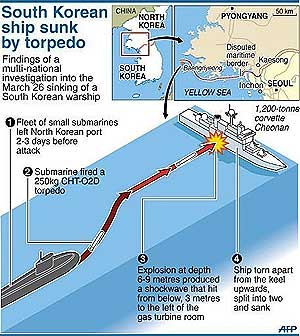 orth Korean submarine had torpedoed and sunk a South Korean warship, killing a number of its crew. Now it has bombed the South Korean island, killing some civilians. It is willful, obnoxious, odious ‘statecraft’.
The Six-Party talks - aimed principally at ‘talking’ Pyongyang out of building nuclear weapons altogether - is a wholly miserable failure. Intelligence estimates put North Korea as possessing 8-12 nuclear bombs. This gives the regime the licence for violent posturing.
Beijing has been frustrated with Pyongyang for some time. It’s conceivable now that China may be seeking to cut off the umbilical cord to its testable bastard child.
Beijing should not wait for Kim’s death to cut the cord. Neither must it hope that a gentler, kinder, saner regime will replace that of Kim. Pyongyang is in the midst of a succession play that will see the unrivalled installation of Kim’s son, Jong Un.
China’s responses
But none of this makes the regime an irrational state. No doubt North Korea is an international pariah, and a failed and illegitimate state. The regime’s leaders, including the military brass, should be indicted for crimes against humanity - its own citizens.
Yet, by definition, every seemingly suicidal action taken by Pyongyang is rational insofar as it wields a pre-defined logic and purpose, regardless of the end result or consequences, intended or otherwise, and even if its actions, in the final analysis, border on idiocy, or lunacy, or both.
Nobody has perfect knowledge of the outcomes of their actions or thinking. In a world of imperfect information actions are often considered correct and realistic at the time of their making. All are founded on asymmetrical realities, and usually wind up being costly miscalculations.
There’s no cry-for-help psychology here. Neither do the jungle of international suspicion, condemnation and economic sanctions help assuage regional fears. Whether it wants to become part of the international community sharply contrasts with the fact that others have been trying to make this decision for Pyongyang - but in their bid to protect their own ‘national interest’.
This is why Beijing has been reluctant to sever its umbilical cord with Pyongyang. It knows that a wild and woolly North Korean regime cast adrift during a state of flux, especially amidst leadership change, will acutely worsen regional and international geopolitical balances - and undercut its own expanding influence.
North Korea hasn’t the clout to whack regional economies like Japan, South Korea and China’s. Indeed Beijing has long invoked a slimmer version of George Keenan’s ‘containment’ policy, on assumptions that the world has accepted North Korea’s pariah status and its renegade qualities are often amplified by rehearsed (and sometimes unrehearsed) moments of madness.
China’s respons
 es to Pyongyang are calculated. Beijing will condone Pyongyang’s ‘rationalism’ whilst seeking ways to abort its bastard child. Until then, though, Beijing will accept, grudgingly, the bludgeoning of its own image as a naked economic emperor without unadulterated geopolitical authority.
It also explains Washington’s ‘soft’ exhortations for Beijing to do more about its client. Sending US warships to join South Korea in war games southwest of the North-South border is to extort deterrence from Pyongyang. It’s also a show of strength that the US is still Number One - not China, and not any time soon.
Furthermore, Beijing does not want a sudden implosion of the North Korean militarist state. This would spell carnage beyond human imagination, forcing China to deal with the fallout with massive economic and politico-military resources.
An exodus of North Korean refugees could easily destabilise China’s booming northeastern industrial heartland, with rippling effects on an economy that is poised between the potential of crisis and continued rapid growth.
The grossly inefficient and corrupt socialist economic order in North Korea, plus the massive international sanctions, point to Pyongyang’s domestic political desperation. Its foreign policy is built on the sand of aggression, which stems from the regime’s historical siege mentality. It’s this that, in turn, puts Pyongyang in a perennial state-of-war psychosis.
This neurosis perversely allows the regime to place primacy of politics over the economy. Like Burma, it lends depraved legitimacy to the military to lord over domestic security and provide regime security by protecting it. The military is a social and political class unto itself. Without it, the Kim dynasty would have long crumbled.
Curiously, China has the same approximation. Only its economy, being much more buoyant, gives the Chinese totalitarian one-party state the means to smooth all political feathers - or almost all. Nonetheless Beijing faces a horrendous dilemma over what to do with its bastard child.
MANJIT BHATIA is an Australian academic, writer and journalist. He is also research director of AsiaRisk, a risk analysis consultancy. He now divides his life and work between Australia, Britain and the US.


Are you sure you want to delete this comment?
This action cannot be undone.