




Sedition Act stays, says KL High Court
The Sedition Act 1948 is 'necessary in the public interest', the Kuala Lumpur High Court ruled today in dismissing lawyer P Uthayakumar's bid to quash the law under Article 4(1) of the federal constitution.
The Sedition Act 1948 is 'necessary in the public interest', the Kuala Lumpur High Court ruled today in dismissing lawyer P Uthayakumar's bid to quash the law under Article 4(1) of the federal constitution.
Judge Ghazali Cha also rejected Uthayakumar's application to have the charge against him under the Act to be suspended or revoked.
Ghazali said freedom of speech, which is guaranteed under the constitution, must be balanced with the public interest.
"...and the Sedition Act is in the public interest," he said.
 He also dismissed the potential for “selective prosecution” by the public prosecutors, based on a claim by Uthayakumar
(right)
that the government has threatened and punished vocal individuals such as himself.
He also dismissed the potential for “selective prosecution” by the public prosecutors, based on a claim by Uthayakumar
(right)
that the government has threatened and punished vocal individuals such as himself.
“Under Article 145 of the federal constitution, the discretion of the prosecution is unfettered and cannot be questioned," said Ghazali
“Once the public prosecution formulates charges based on its discretion, it should go to trial and it is not for the court to curtail. It is still premature to decide on the prosecution’s action now."
‘No action against politicians’
Uthayakumar was represented by N Surendran and Edmund Bon, who had argued that the government has used the Sedition Act against individuals with “social conscience”.
Surendran informed the judge that the defence will lodge an appeal at the Court of Appeal in the next few days.
Pending the outcome, he asked for a stay of Uthayakumar’s sedition trial in the KL Sessions Court, fixed for Feb 17.
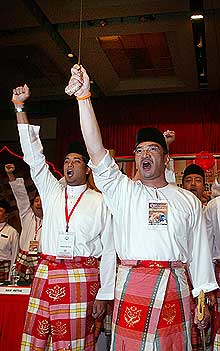 In their arguments, the defence lawyers had also pointed out that the public prosecution headed by Attorney-General (AG) Abdul Gani Patail had not acted against politicians or individuals linked to the government.
“(Incumbent) Home Minister Hishammuddin Hussein had threatened non-Malays by waving his keris (dagger) during the Umno general assembly in 2006 but the AG did not prosecute him,” said Surendran.
DPP Melissa Mohd Akhir rebutted that the Sedition Act does not contradict the federal constitution.
Melissa said that the Act is intended to protect social well-being, peace and the nation’s security.
A retrograde step
Speaking to reporters later, Surendran said he was disappointed as the High Court “lost an opportunity to assert the right of the people against the encroaching and overwhelming power of the state”.
“For us it is a retrograde step..
 . the court said that Parliament has the right to impose limitations on the right of the people to (speak up), but the question is whether this restriction is reasonable?
“The government has lots of powerful and oppressive laws in its arsenal. The Sedition Act is one of the worst. All he (Uthayakumar) did was to speak up in the public interest."
He also complained about Ghazali’s decision not to touch on the AG’s decision to prosecute Uthayakumar.
“This is one man in the country, high up on the hierarchy, whose actions cannot be questioned by anyone. No single person should be given such extensive and absolute powers but the AG has that power and the court has pronounced this today,” said Surendran.
“It is untrammelled power, there is no such thing as untrammelled power in a democracy. If there is untrammelled power in a democracy, it is not a democracy any more, it is something malignant."
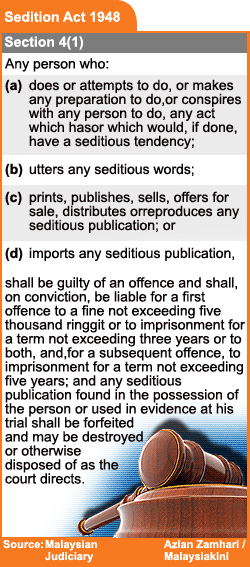
On Dec 11, 2007, Uthayakumar had claimed trial before Sessions judge Sabariah Othman to a charge of publishing a seditious letter on the Police Watch Malaysia website.
The charge under Section 4(1)(c) of the Sedition Act 1948 carries a fine not exceeding RM5,000 or imprisonment up to three years, or both, on conviction.


Are you sure you want to delete this comment?
This action cannot be undone.