




Najib will have to go for broke
COMMENT In the last few days, the public has had the clearest indicators yet that the Najib Razak administration is in dire need of a new electoral mandate. Otherwise it would continue its slide into incoherence.
A stutter was perceptible virtually from the start of the administration, now nearly two years old, when, as the prime minister shaped to liberalise a sector, his deputy, Muhyiddin Yassin, would enter caveats, aimed at restraining the liberal thrust of the PM's moves.
Of course, the spin from both parties was that there were no deep divergences on policy; only minor differences in emphasis and nuance...
COMMENT In the last few days, the public has had the clearest indicators yet that the Najib Razak administration is in dire need of a new electoral mandate. Otherwise it would continue its slide into incoherence.
A stutter was perceptible virtually from the start of the administration, now nearly two years old, when, as the prime minister shaped to liberalise a sector, his deputy, Muhyiddin Yassin, would enter caveats, aimed at restraining the liberal thrust of the PM's moves.
Of course, the spin from both parties was that there were no deep divergences on policy; only minor differences in emphasis and nuance.
Whether it was on the economy or on politics, Najib would strike a liberalising pose, with minister Mohd Nazri Abdul Aziz swift to amplify the assenting chorus and generally convey the notion that things ought to go the way the chief says it should.
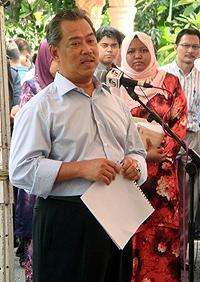 But, then, Muhyiddin (
left
) would weigh in like an angler reeling in the catch. The deputy prime minister, while taking care not to seem too averse to swimming in Najib's slipstream, would take positions that showed him writing his own subtext to the PM's agenda.
But, then, Muhyiddin (
left
) would weigh in like an angler reeling in the catch. The deputy prime minister, while taking care not to seem too averse to swimming in Najib's slipstream, would take positions that showed him writing his own subtext to the PM's agenda.
That the administration sported a split personality was clear. Less clear was that the new PM could only resolve this dilemma by going for a new mandate, as nearly all his predecessors had done when newly installed, in order to clear the coast for reform.
However, recurring adversity – from Teoh Beng Hock's mysterious death to the current contretemps over a literary textbook – stymies Najib's administration, challenging him to respond like his liberal inclinations would prompt him to.
The problem is how far to go in liberalising without imperiling encrusted and entrenched interests which he has to beguile into support for him even as he cuts the ground from under their feet.
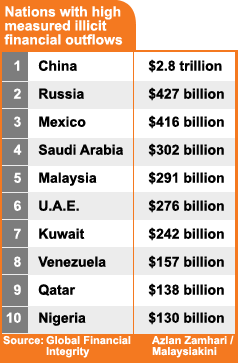 The PM's response to news reports that RM888 billion in
illicit funds
exited the country between 2000 and 2008 typified his dilemma.
The PM's response to news reports that RM888 billion in
illicit funds
exited the country between 2000 and 2008 typified his dilemma.
Najib temporized by calling attention to the issue's complexity and requesting that the public wait for a comprehensive statement from Bank Negara.
This is the sort of reaction a politician, surveying the pros and cons of a still-fluid situation, opts for - to make room for manoeuvre in the event the blowback is nasty.
The schizoid character of the administration was best exemplified by two deputy ministers' contrasting responses to the issue.
One, Donald Lim, the finance deputy minister, said Bank Negara would investigate the matter; the other, Mukhriz Mahathir, deputy at international trade and investment, cast doubt on the source of the Global Finance Integrity report.
Lim was out for ventilation; Mukhriz for obfuscation. In a sense, the two were like Najib and Muhyiddin, the yin and yang on issues that come up.
U-turn, time and again
Watch how the latest issue – amendments to the Printing Presses and Publications Act – pans out.
The Home Ministry has proposed changes that would undermine assurances that the Internet would not be censored by the government, given in the Bill of Guarantees that accompanied the launch by Dr Mahathir Mohamad of the Multimedia Super Corridor in 1996.
 If the blowback from the proposed changes is bad, Najib is likely to manoeuvre to come out of it as best he can - on the liberal side.
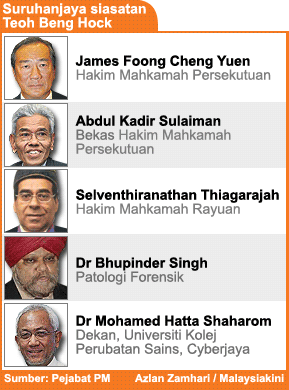
Just as he has done by expanding the scope of inquiry of the Royal Commission of Inquiry into Teoh Beng Hock's death - from the initial brief of mere examination of the Malaysian Anti-Corruption Commission's practices to the additional one of probing the causes of death.
The oscillations in the policy pendulum cannot go on for too long before it stutters into terminal incoherence.
In other words, an election the PM is not obliged to call has become a necessity for the propulsion victory would give him to make bold changes.
But what if, in gambling on an election, he loses it?
TERENCE NETTO has been a journalist for close on four decades. He likes the occupation because it puts him in contact with the eminent without being under the necessity to admire them. It is the ideal profession for a temperament that finds power fascinating and its exercise abhorrent.


Are you sure you want to delete this comment?
This action cannot be undone.