




'MAS must return to basics'
INTERVIEW In the 1980s, he led Malaysia Airlines Systems (MAS), as the national carrier was known from 1970-1991, and saw it through thick and thin.
In doing so, he built up a respectable international fleet that was once ranked third best airline in the world.
INTERVIEW In the 1980s, he led Malaysia Airlines Systems (MAS), as the national carrier was known from 1970-1991, and saw it through thick and thin.
In doing so, he built up a respectable international fleet that was once ranked third best airline in the world.
But years on, after privatisation and after it was re-acquired by the government, MAS is in a downward spiral that includes being laden with debt. Even low-cost carrier Air Asia Bhd, a company started in the late 1990s has overtaken MAS in both reputation and achievements.
In an interview, former MAS chief executive officer Abdul Aziz Abdul Rahman shared what went wrong with the national carrier and how to turn the situation around.
“I am quite saddened by what I see ... Since privatisation (of the airline) to Tajudin Ramli and re-acquisition by the government, a lot of MAS assets have had to be sold off. This truly saddens me,” he said.
 The airline’s debts were a result of accumulation and alleged mismanagement during Tajudin’s tenure. He now faces several
legal suits
, but has filed a counter-claim against the government.
The airline’s debts were a result of accumulation and alleged mismanagement during Tajudin’s tenure. He now faces several
legal suits
, but has filed a counter-claim against the government.
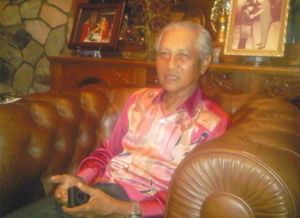
Abdul Aziz ( right ), a former magistrate and Sessions Court president, joined the airline as company secretary in 1971 and then became its director of legal affairs. He was later promoted to CEO and chairperson.
Reminiscing about his time in MAS, he pointed out that he had been hands-on in managing the company, often going on the ground to identify problems and come up with practical solutions.
He was also prepared to be strict. Once, he went to the airport at 3am and noticed an officer literally sleeping on the job.
“I thought it was improper for a uniformed personnel to behave (like this) on the job. So I told him that the next time (this happened), I would hang him. That was the last I saw him sleeping on the job,” he said.
“I learnt a lot from the British style of managing people. I served as an assistant district officer when I was stationed in Pasir Mas before Independence. At one point of time, the district officer who was a Briton, sent me to negotiate with local residents to build roads.
“It was indeed a challenge. In those days, we built the roads together with the residents. The district officer would provide food supplies such as rice, and we would build the road together. Such a feeling is not prevalent nowadays.”
Questionable decision
Abdul Aziz questioned the validity of certain business decision that could further erode MAS’ earnings.
For example, he has found out that the management has hedged the price of fuel at US$100 a barrel for three years since 2009.
“The price of oil was lower than that. Yet MAS, under Idris Jala, entered into a deal with oil companies to hedge the fuel price at US$100 for three years.
“During my time, we would not enter into such a long agreement. Any such agreement would (be only for) a few months - at least six months - and not up to three years,” he said.
 Idris
(right)
, who was once with oil giant Shell, is now a minister without portfolio in the Prime Minister's Department. He is in charge of implementing the Key Performance Index and the National Key Results Area.
Idris
(right)
, who was once with oil giant Shell, is now a minister without portfolio in the Prime Minister's Department. He is in charge of implementing the Key Performance Index and the National Key Results Area.
English-language daily Star had reported in 2009 that MAS would lose RM3 billion in hedging costs over the next two years, while its competitor Air Asia Bhd would enjoy the benefits when the price of crude oil falls.
MAS hedged 64% of its fuel requirements for the financial year (FY) ending Dec 31, 2009 at US$100 per barrel, and 40% of FY10 needs at US$95 per barrel, when the price of crude oil is hovering around US$40 per barrel.
Hedges are essentially derivatives which airlines use to lock in the fuel price in advance to protect themselves from oil price volatility.
Abdul Aziz expressed doubt about the turnover announced by MAS under Idris, saying this merely amounted to a recovery of losses over the years.
“Has this happened (the turnover)? I really do not think so,” he said.
Moving forward
Another business decision that is cause for concern is linked to MAS’ purchase of the world’s largest aircraft, the Airbus A380.
“Has MAS thoroughly thought this out by conducting marketing studies on whether such a purchase is feasible? Or is MAS just climbing on the bandwagon because other airlines are doing the same?”
MAS has placed an order for six units of the A380, a double-decked, wide-body aircraft which can accommodate 500 passengers.
 Abdul Aziz said Kuala Lumpur is not like high-end cities like Singapore, Hong Kong and those in Japan, where passengers can afford the fare for seats on the A380.
“I fear that such purchases will be a waste of money and lead to overcapacity - meaning the aircraft will fly empty as not many passengers will be able to afford the fare. In my time, we tried to prevent overcapacity to prevent losses.”
However, MAS recently said it may rescind its order for the six units if the manufacturers continues to delay delivery.
If MAS is to survive, it has to “return to basics” and recoup its losses, while working to regain its market share in terms of passenger load, said Abdul Aziz.
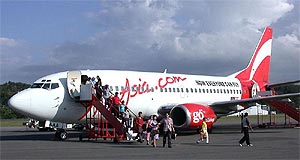 While he does not agree with giving too much leeway to Air Asia, he said the co-existence of the airlines would have to be accepted.
It would be better that MAS and AirAsia negotiate their respective routes to avoid an overlap, he said.
“In my time, I went to Singapore or Bangkok to resolve landing rights and passenger issues so as to ensure MAS would make some profit. I believe the time has come for MAS and Air Asia to sit down and discuss this to ensure a win-win (situation that benefits both parties),” he said.
More than that, he emphasised the need to deploy the right people in taking MAS forward.


Are you sure you want to delete this comment?
This action cannot be undone.