




Azmin tells Muslims to go for breadth
Malay Muslims were exhorted to put aside narrow modes of thought for intellectual breadth commensurate with the economic vibrancy of the region they inhabit for a potent new synthesis that would be their best response to the challenges of the New Asian Century.
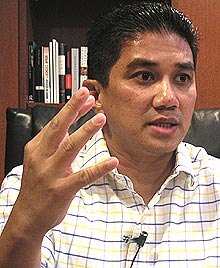
In a keynote address to a one-day seminar on the ‘Reconstruction of Malay Islamic Thought', that was supposed to be delivered by Opposition Leader Anwar Ibrahim, who was away in New York, his PKR deputy Azmin Ali began by referring to the new epoch dawning in Asia as the New Asian Century.
 The New Asian Century that Azmin spoke of was an intriguing variation on the theme enunciated by the founder of Time magazine, Henry Luce, who in a speech in 1941, called on Americans to meet the responsibilities of a global power with a humanitarianism that would advance the cause of free enterprise and democratic freedoms. The essay was entitled ‘The American Century'.
"It is clear that we are facing The New Asian Century," said Azmin.
"The new paradigm for our understanding of the age would have to be entitled ‘Islam and the New Asian Century' rather than what was the dominant paradigm of before, which was ‘Islam and the West'," Azmin asserted.
"Thus the way we should prepare ourselves for this new age is to understand the civilisations of China and India and their hybrids which were dominant in Asia prior to the arrival of Vasco da Gama and Alfonso de Albuquerque.
“Before the arrival of the Portuguese, Dutch and the English, Southeast Asia was the arena for the fusion of the Chinese and Indian civilisations. After the passage of half a millennium, we are about to return to that fusion of yore," he expatiated.
Democratic constitutionalism
Azmin opined that the Malay part of the Islamic universe has yet to make its contribution to its civilisation. He said the Arabs, Turks and Persians all made their separate contributions, but Muslim Southeast Asians have yet to do so.
He said for this reason Southeast Asian Muslims were regarded as inhabiting the fringes of the Muslim world, as peripheral players in the ongoing dialogue of civilisations.
Azmin said this unflattering reality must change and the opportunity for that has arrived with the rapid economic growth of both China and India, a development that is certain to pull other Asian nations into the zone of growth.
He held that Malay Muslim society, by insisting that economic progress is accompanied by democratic constitutionalism, would ensure that the New Asian Century would be an epoch of economic well-being and freedom for its people to choose the governance they want.
He said Malay Muslim intellectual advancement could only come about through openness to the traditions of thought and wisdom prevalent in the plural cultures found in Southeast Asia.
"The brilliance of Islamic civilisation of the past was achieved by the religion's openness to streams of thought from civilisations that preceded its birth," asserted Azmin.
Closing of the Muslim mind
He cited the thesis of Islamic thinker Professor Seyyed Hossein Nasr, whose book ‘Science and Civilization in Islam’, advanced the notion that Islamic thought unified different streams of intellectual speculation under the concept of ‘Tauhid’.
Azmin said Islamic civilisation started to decline when this habit of openness waned and, borrowing a phrase from American academic Allan Bloom, Azmin held that the ‘closing of the Muslim mind’ occurred when the process of ‘ijtihad’ (consensual interpretation) began to ossify.
Azmin urged the Muslim intelligentsia in the Malay world to be in the forefront of the struggle to ensure that their countries would be free from authoritarian, corrupt and racist rulers.
"The people are thirsty for political paradigms that will free them from the weight of racialist obstacles that retard the economic and social progress of believers.
“Recall what the famous historian Arnold Toynbee said about the threat to human civilisation by the twin specters of racial and colour discrimination. Toynbee said Islam's strength lay in its being free of the any taint of racialism. In Islam's heyday, cultural pluralism and cosmopolitanism were basic features of Muslim civilisation," asserted Azmin.
Malay world’s turn to contribute
Azmin closed his wide-ranging speech which touched on many streams of thought by citing prediction of the modern Islamic thinker, Sheikh Taha Zabin al-Alwani, who after a two-decade stay in Kuala Lumpur, offered the view that it was turn of the Malay world to contribute to Islamic civilisation.
"The rise of Asia presents the opportunity to the Malay world to make this contribution. This can only be done if the Muslim intelligentsia makes a concerted effort to free society from the yoke of tyrannical rulers," said Azmin.
He concluded by citing a famous quotation from Edmund Burke who said: "All that is necessary for the triumph of evil is for good men to do nothing."
Azmin said "to do nothing" was not an option for Malay intellectuals desiring to contribute to the progress of Islamic civilisation.


Are you sure you want to delete this comment?
This action cannot be undone.