




Malaysia chalked up 7.2% growth last year
The country registered a growth of 7.2 percent in 2010, a rise of 8.9 percent compared with the 1.7 percent contraction in 2009, boosted by higher private and public sector spending.
The country registered a growth of 7.2 percent in 2010, a rise of 8.9 percent compared with the 1.7 percent contraction in 2009, boosted by higher private and public sector spending.
A Bank Negara statement released today says Malaysia finished the fourth quarter of 2010 with a 4.8 percent growth.
It shows growth to have slowed down, compared with the first three quarters of the year, which recorded growths of 10.1, 8.9 and 5.3 percent respectively.
 The central bank also expects slower growth in this year, due to moderating external demands.
However, the better-than-expected economic growth put Malaysia back on track to become a high-income nation by the year 2020, it said.
According to the Economic Transformation Plan introduced by Prime Minister Najib Abdul Razak, Malaysia needs to achieve six percent growth in the next 10 years to double its income per capita to US$15,000 (RM45,500).
Higher private and public spending
The central bank pointed out that higher private and public sector spending in the fourth quarter of last year contributed to the expansion in domestic demand, but the slower growth in the global economy had led to weaker growth in external demand.
"On the supply side, all economic sectors, with the exception of the primary sectors, continued to expand further during the quarter."
In terms of economic sectors in the fourth quarter, both the services and manufacturing sectors continued to lead with 6.2 percent growth. They were followed by the construction sector, with 5.6 percent growth.
The agriculture and mining sectors registered contractions of 4.3 and 1.3 percent.
In the external sector, both gross exports and imports increased at a more moderate pace of 3.7 percent and 10.1 percent respectively, in line with the moderate performance of the global economy.
 Gross inflows of foreign direct investments (FDIs) increased to RM11.8 billion in the fourth quarter, while the net FDI increased to RM8.3 billion. It was channelled mainly into the services, manufacturing and mining sectors.
Investments in the service sector were primarily undertaken by companies in finance, insurance and business services, as well as by the wholesale and retail trade sub-sectors.
In the manufacturing sector, FDIs were channelled into electrical and electronics industries as well as in petroleum-related industries.
Domestic demand to back f uture growth
Bank Negara also expects the uneven global economic recovery and uncertainties over weak fiscal positions, high unemployment and constrained lending conditions to affect the local economy.
However, the growth outlook for Asia remains favourable, supported by robust domestic demand despite the continent being confronted with the challenges of rising inflationary pressures, particularly from high commodity and fuel prices, and large and volatile capital flows.
It said the moderating external demand would have an impact on Malaysian economy.
"Growth will, nevertheless, be supported by continued firm expansion in domestic demand. Private consumption spending will continue to benefit from the favourable labour market conditions, firm commodity prices and access to financing."
The central bank added that the roll-out of construction and infrastructure activities and the implementation of the economic transformation programme by the government were likely to provide significant support to the growth momentum in private investment.
Petrol price hike pushed up inflation
The bank also recognised that the price hike of RON 95 petrol and diesel had contributed to the inflation rate, which had increased to two percent in the fourth quarter of 2010, slightly higher than the 1.9 percent in the third quarter.
 "The increase in inflation was attributable mainly to higher prices of food and non-alcoholic beverages, which rose by 2.9 percent and transport (4Q 2010: 2.5 percent; 3Q 2010: 2.1 percent) reflecting the further removal of fuel subsidies by the government which resulted in an upward adjustment of 5 sen/litre for RON 95 petrol and diesel prices."
Other economic highlights in the fourth quarter of 2010:
• Domestic demand strengthened by 5.7 percent in the fourth quarter (3Q: 5 percent), mostly due to the strong expansion in private consumption and capital spending.
• Private consumption increased by 6.5 percent (3Q: 7.1 percent) supported by favourable labour market conditions, positive consumer confidence and higher income levels.
• Public consumption declined by 0.3 percent (3Q: -10.2 percent), arising from lower expenditure on supplies and services.
• Gross fixed capital formation increased by 9.2 percent (3Q: 9.8 percent), driven by both public and private capital spending.
• Growth in the services sector was higher at 6.2 percent (3Q 10: 5.4 percent), with expansion in all subsectors, supported mainly by domestic economic activity.
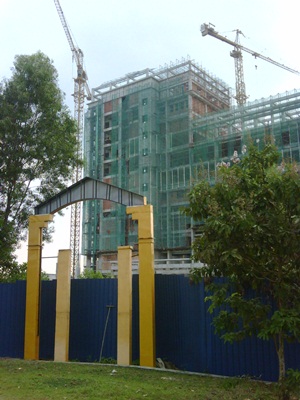 • The construction sector also registered higher growth of 5.6 percent (3Q: 2.8 percent), reflecting expansion in the non-residential and civil engineering sub-sectors.
• The manufacturing sector expanded at a more moderate pace of 6.2 percent (3Q: 7.5 percent), mostly on account of the weaker external demand.
• The agriculture sector, however, registered a contraction of 4.3 percent (3Q: 2.7 percent), attributed to the decrease in palm oil output.
• The mining sector contracted further (-1.3 percent; 3Q: -1 percent), due to continued the decline in production of crude oil.
• Trade surplus widened to RM25.5 billion (3Q: RM22.3 billion).
• Both gross exports and imports increased at a more moderate pace of 3.7 percent and 10.1 percent respectively (3Q: 10.4 percent and 16.5 percent respectively).
• Gross inflows of FDIs were higher at RM11.8 billion in the fourth quarter (3Q: +RM8.5 billion), reflecting mainly larger inflows of equity capital.
• After adjusting for gross outflows due to repayment of inter-company loans, net FDIs increased to RM8.3 billion (3Q: +RM4.4 billion).
• Direct investment abroad (DIA) by Malaysian companies recorded a lower net outflow of RM3.2 billion in the fourth quarter (3Q: -RM5.4 billion), due to lower net extensions of inter-company loans to subsidiaries abroad.
• Portfolio investment registered a smaller net inflow of RM2.8 billion in the fourth quarter (3Q 10: +RM9.8 billion), due partly to net foreign liquidation of debt securities in November as investors reacted to the sovereign debt concerns in the Eurozone.
• The international reserves of Bank Negara Malaysia amounted to RM328.6 billion (equivalent to US$106.5 billion) as at Dec 31, 2010.
• As at Jan 31, 2011, the reserves position amounted to RM333.5 billion (equivalent to US$108.1 billion), or 4.2 times the short-term external debt and sufficient to finance 8.7 months of retained imports.


Are you sure you want to delete this comment?
This action cannot be undone.