




Anwar: Growth or not, M'sia losing competitiveness
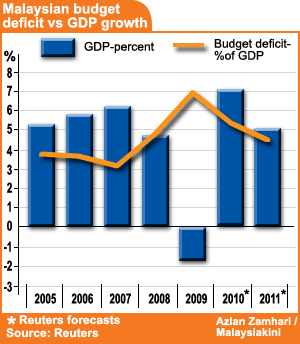
Opposition leader Anwar Ibrahim today cast a critical view of the recent announcement of the nation’s 7.2 percent economic growth last year, saying that it falls behind the performance of its immediate neighbours.
Opposition leader Anwar Ibrahim today cast a critical view of the recent announcement of the nation’s 7.2 percent economic growth last year, saying that it falls behind the performance of its immediate neighbours.
Shooting down the
 optimistic view
of Bank Negara, which hailed that the country is back on track to becoming a high-income nation by 2020, Anwar stressed that Malaysia is continuing a trend of under-performance, especially when compared to Singapore and Indonesia.
optimistic view
of Bank Negara, which hailed that the country is back on track to becoming a high-income nation by 2020, Anwar stressed that Malaysia is continuing a trend of under-performance, especially when compared to Singapore and Indonesia.
“The 7.2 percent growth should not be viewed in vacuum and must be compared with what our neighbours had achieved in 2010. Singapore and Indonesia registered a growth of 14.5 percent and 6.1 percent respectively in 2010,” he said in a statement today.
“Both (countries) outperformed Malaysia’s growth by miles especially considering that Indonesia’s 6.1 percent growth was calculated on a higher base as Indonesia did not face economic contraction in 2009, unlike Malaysia or Singapore.”
Anwar, a former deputy premier and finance minister in the late 1990s, said the huge economic growth gap between Malaysia and Singapore is due to the former’s failure to stem the declining demand of Malaysian manufacturing products.
“The reality is our manufacturing products are steadily losing its competitiveness in the global market as we are relegated to the lower rung of the value chain, while competitors like Singapore upgrade higher and higher on the value chain.
“This was pointed out a decade ago, yet nothing effective has been put in place to stem this decline apart from continuous rhetoric paid for by taxpayers’ money,” he said.
Anwar said the situation in Malaysia is not helped by contractions in its mining and agriculture sectors, knocking down growth to just 0.2 percent and 1.7 percent respectively – which he described as a symptom of a stagnating economy.
Indonesia is far ahead
Shifting his comparison to Indonesia, the PKR advisor pointed out that the republic has managed to avoid falling into a recession in 2009 and is now riding high with a strong inflow of foreign direct investments (FDI), valued at US$12.8 billion and second only to Singapore in Southeast Asia last year.
 Anwar (
left
) noted that new investments in Indonesia – ranked among the top-20 rich and developing countries last year – contributed 32.2 percent to their economy, while government spending accounted for only 9.1 percent.
Anwar (
left
) noted that new investments in Indonesia – ranked among the top-20 rich and developing countries last year – contributed 32.2 percent to their economy, while government spending accounted for only 9.1 percent.
He said their sterling performance followed moderate spending by the Indonesian government, which faces a fiscal deficit of just 1.1 percent and public sector debt hovering at 28.3 percent of its gross domestic product.
“Malaysia’s economic story is the opposite of Indonesia’s. The total federal government debt has ballooned to RM407 billion as at the end of 2010, representing 53.1 percent of the GDP.
“The stagnation in private investments had caused the government to rely on pump priming to fuel the economic growth, so much so that fiscal deficit remains one of the biggest economic problems the country is facing.
“Fiscal deficit peaked at 7 percent in 2009 and only moderated to 5.6 percent in 2010, above the government’s own target of 5.3 percent as set out in 10th Malaysian Plan. Malaysia only managed to attract USD7 billion worth in FDI in 2010 compared to USD37.4 billion achieved by Singapore,” Anwar said.
Najib must be honest
To regain Malaysia’s lost ground in regional competitiveness, Anwar stressed that Prime Minister Najib Abdul Razak ( below ) and his administration need to be honest and admit to the “big disconnect” between his Economic Transformation Plan and the reality faced by Malaysian businesses and the public.
 Taking a swipe at the BN-led federal government, he said they are “incapable of embracing political reforms” which must go hand in hand with economic reforms to improve the country’s economic standing.
“There is a high degree of scepticism that the series of announcements made are only a smokescreen that will benefit the same type of ruling and business elites while the fundamental problems of the economic are left unhealed.
“Against this backdrop, the 7.2 percent growth is yet another proof that our economy is sliding downwards relative to our neighbours. We are losing our competitiveness and our fiscal position is in a lot worse shape compared to the neighbours.
“No amount of glossing and public relations campaigns can confuse the public of the urgent need to institute vital economic reforms to reverse the slide,” he said.


Are you sure you want to delete this comment?
This action cannot be undone.