




Sabah PKR sees urgent need for land policy
The newly-established Sabah Parti Keadilan Rakyat (PKR) Presidential Council (SBC) has called on the state government to urgently draw up a long overdue land policy.
The newly-established Sabah Parti Keadilan Rakyat (PKR) Presidential Council (SBC) has called on the state government to urgently draw up a long overdue land policy.
Existing legislation on land matters which observe colonial era legislation in the breach, according to the SBC, merely puts "the cart before the horse".
"At present, the state government only has a land alienation mechanism based on the Sabah Land Ordinance of 1930," said senior lawyer and land rights activist Kong Hong Ming who holds the Land Management and Development portfolio in the SBC.
 He reiterated that a land policy must come before legislation on land matters and the alienation mechanism.
Kong, also the PKR Tawau division chief, was elaborating on the first official statement yesterday from the SBC on the vexing issue of land which appears to be coming to a head in the state.
He was speaking on behalf of PKR president Wan Azizah Wan Ismail ( left ) who heads the SBC.
The opposition alliance, he pledged, would return all native land to the natives and draw up a land policy "when it comes to power in the state".
This includes 60,000 hectares of state land alienated to one private company and ten Forest Management Units (FMUs) covering some one million acres of NCR land to ten companies for 100 years.
Wrath of the people
Kong dared the ruling BN to take up the challenge and beat the opposition to it on a land policy or continue to risk the wrath of the people in the rural areas.
He urged the state government to base the proposed land policy on the native customary rights (NCR) concept practiced in the state before the advent of modern government.
A land policy, explained Kong who has fought many land rights cases in court, would be a comprehensive approach covering native customary rights, land usage, land alienation, conservation, environmental issues, development and management.
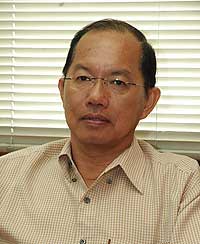 He pointed out that Article 9 of the Royal Charter to the British North Borneo Chartered Company in 1881 was the nearest that came to a land policy.
Article 9, according to Kong ( right ), was based on the approach of the natives on settling, developing and managing land in harmony with nature.
"Article 9 recognised the property rights of the native communities," said Kong in pushing for a land policy to prevent native communities from losing the social safety network afforded by NCR land.
Unlike the Chartered Company, the present state government has run foul of Articles 153 and 161(A)(5) of the Federal Constitution and needs to pull back from the brink," stressed Kong. "The Federal Constitution guarantees the welfare and legitimate interests of the native communities and this includes recognition of their property rights."
In the absence of a land policy, there's rampant and indiscriminate alienation of NCR land to big corporations and government-linked companies (GLCs) and re-gazetting of forest land to cover native land, lamented Kong.
This has meant the natives ending up as trespassers on their own land, continued Kong, and run the risk of being prosecuted for various so-called infringements of the law.
He cited the case of six farmers who were found guilty by the magistrate's court in Tenom last Nov for trespassing on the Kuala Tomani Forest Reserve and cultivating hill padi.
The errant six, disclosed Kong, will know their final fate on March 4 when Sabah and Sarawak High Court Judge David Wong will provide a written judgment in a landmark decision pertaining to NCR land.
NCR cannot be extinguished
The Federal Court has already ruled in another case that NCR cannot be extinguished. However, the Tenom Magistrate's Court has held that natives cannot claim NCR pertaining to land gazetted as forest reserve.
"The natives in Sabah are being unjustly deprived of their NCR land and thereby becoming landless and eventually poorer," said Kong. "They are no longer free to enter the so-called state land or to take jungle produce as they had done since time immemorial."
Kong estimates that 32,532 native families have become victims of state-sanctioned land grabs totaling some 349,500 acres of NCR land in 18 districts in the state.
Between 2005 and 2010 alone, there were 977 complaints on land cases in Sabah, compared with 654 in Peninsular Malaysia and 251 cases in Sarawak, said Kong in citing the Malaysian Human Rights Commission (Suhakam).
He hinted that the sum total of the complaints could be the basis for a class action suit, notwithstanding and despite the adoption of any land policy.
The complaints aside, Kong noted that many natives who applied for small plots of between five and 15 acres of state land have been waiting 30 years or more for just an answer from the authorities.
Apparently, these are lands that they have occupied and cultivated for generations.
Elsewhere, the issue of communal titles under Chapter 76 of the Sabah Land Ordinance has been described as one solution to the NCR woes of the rural folks, observed Kong, "but this device is only employed to force the natives to enter into joint-ventures with big companies".
Land resources, summed up Kong, must be managed by the state to serve the basic needs of every man or woman who is a citizen instead of selectively feeding the greed of a few politically well-connected men.
"We cannot continue to have law without order and justice," he said. "Law enforcement must respect fundamental and human rights."


Are you sure you want to delete this comment?
This action cannot be undone.