




'Bruises from post-mortem staining, not strangulation'
Thailand's forensics pathologist Dr Pornthip Rojanansunand had drawn ‘dangerous' conclusions after only observing the second post-mortem on Teoh Beng Hock.
Thailand's forensics pathologist Dr Pornthip Rojanansunand had drawn ‘dangerous' conclusions after only observing the second post-mortem on Teoh Beng Hock.
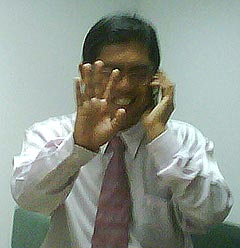 Hospital Tengku Ampuan Rahimah pathologist Dr Khairul Azman Ibrahim (
left
), who conducted the first post-mortem on Teoh, disagreed that the bruises pointed out by Pornthip could have been the result of strangulation.
Hospital Tengku Ampuan Rahimah pathologist Dr Khairul Azman Ibrahim (
left
), who conducted the first post-mortem on Teoh, disagreed that the bruises pointed out by Pornthip could have been the result of strangulation.
He testifying before the Royal Commission of Inquiry into Teoh's death in a courtroom at the Jalan Duta Court Complex in Kuala Lumpur today.
In the inquest that had investigated Teoh's death, Pornthip said she noticed injuries that suggested he was strangled, and said he was unconscious when he fell.
The inquest was held after Teoh was found dead on the fifth floor landing of Plaza Masalam, Shah Alam on July 16, 2009, after being held overnight by the Selangor Malaysian Anti-Corruption Commission (MACC) on the 14th floor of the same building.
Khairul was responding to MACC lawyer Muhammad Shafee Abdullah, who asked for his opinion on Pornthip's suggestion that there were two contusions, one below the chin and another below the left side neck.
"I disagree with the conclusion because she was observing the second post-mortem, which (was done) months after the deceased had died," he said.
"We couldn't find the two contusions when we did the first post-mortem. It could be post-mortem staining. Staining is discolouration that results from the breakdown of blood. If Teoh was strangled, there would be less bleeding, said Khairul.
Internal bleeding
Earlier, Khairul said he discovered "a lot of internal bleeding" in Teoh's neck region, which was more than expected if compared with common cases of strangulation.
"In normal cases, there will be more abrasions, more redness, scratch marks, and bruises if the person was strangled," he said.
He also agreed with a suggestion by Muhammad Shafee that Teoh's thyroid bone was not broken, which would have been if the deceased was strangled.
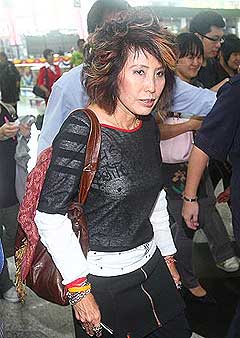 Pornthip (
left
), an expert with the Thai Ministry of Justice's Forensic Science Institute, deduced that the contusions and other injuries indicated an 80 percent probability that Teoh's death was homicide.
Pornthip (
left
), an expert with the Thai Ministry of Justice's Forensic Science Institute, deduced that the contusions and other injuries indicated an 80 percent probability that Teoh's death was homicide.
Her other finding was that Teoh's skull fracture could have been caused by a blow with a hard object but Khairul objected to this, saying he did not find any external marks on the skull.
"The blood on Teoh's skull was concentrated on the top and didn't flow down, which would occur if Teoh was hit on the head," he added.
University Malaya Medical Centre (UMMC) pathologist Dr Prashant Naresh Sambekar, who was quizzed after Khairul, proceeded to point out his theory that Teoh was squatting on the window sill from where he had fallen.
Prashant also submitted photographs of the crime scene, which he had taken during his visits to Plaza Masalam during the inquest.
The inquiry resumes tomorrow with Prashant on the stand to explain his theories on Teoh's fall and Hospital Sungai Buloh's Dr Shahidan Md Noor, who performed the second autopsy on Teoh.


Are you sure you want to delete this comment?
This action cannot be undone.