




Meltdowns may have occurred in two reactors
Japan battled a feared meltdown of two reactors at a quake-hit nuclear plant today as the full horror of the disaster emerged on the ravaged northeast coast where more than 10,000 are feared dead .
Japan battled a feared meltdown of two reactors at a quake-hit nuclear plant today as the full horror of the disaster emerged on the ravaged northeast coast where more than 10,000 are feared dead .
 An explosion at the ageing Fukushima atomic plant blew off the roof and walls around one of its reactors yesterday, a day after the biggest quake ever recorded in Japan unleashed a monster 10-metre tsunami.
The atomic emergency widened today as the cooling systems vital for preventing overheating failed at a second reactor. In a nightmare scenario, back-up generators were disabled by tsunami flooding.
Asked whether meltdowns had occurred, Japan's top government spokesman Yukio Edano said: "We are acting on the assumption that there is a high possibility that one has occurred" in the plant's No 1 reactor.
 "As for the No 3 reactor, we are acting on the assumption that it is possible," he was reporting as saying by
AFP
of the plant situated 250km northeast of Tokyo.
"As for the No 3 reactor, we are acting on the assumption that it is possible," he was reporting as saying by
AFP
of the plant situated 250km northeast of Tokyo.
Radiation levels surpassed the legal limits at the Fukushima I plant at 882 microsievert per hour and briefly topped 1,204, Edano said.
Japan allows an hourly exposure of 500 microsievert, which measures the biological effects of radiation.
Experts said they believed the meltdown in the No 1 reactor had been stopped but there was a new danger of it occurring in the No 3 reactor, the NHK reported.
Workers raced against the time to douse the stricken reactor with sea water to try to avert catastrophe.
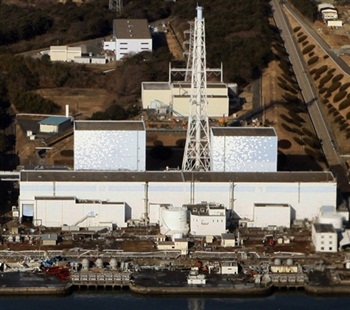 Earlier today, plant operator Tepco informed the government that radiation levels have risen above the safety limit in the area and declared an "emergency situation".
Teams were working to prevent cooling liquid from evaporating and exposing the fuel rods to the air, which could trigger a major radiation leak.
The cooling systems failed after back-up electricity generators were disabled by tsunami flooding.
There are a total of 10 reactors at the troubled Fukushima No 1 and No 2 plants, both located 240km north of Tokyo.
Ron Chesser, director of the Center for Environmental Radiation Studies at Texas Tech University, said it was critical to cool the reactor core to avoid a meltdown that would result in "a large release of radiation".
"Reactors are not like your car that you can turn off and walk away. They're going to continue generating a great amount of heat until the core is disassembled," he told the US-based ScienceDaily website.
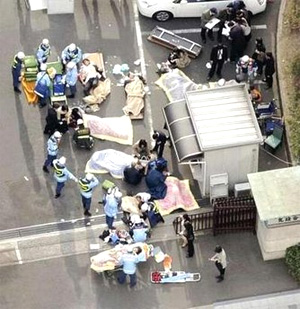
As strong aftershocks continued to shake Japan's main island, the desperate search for survivors from Friday massive earthquake and tsunami pressed on and the death toll was expected to rise.
Thousands spent another freezing night huddled over heaters in emergency shelters along the northeastern coast, a scene of devastation after the 8.9 magnitude quake sent a 10-metre wave surging through towns and cities.
Kyodo news agency said the number of dead or unaccounted was expected to exceed 1,800. It also reported there had been no contact with around 10,000 people in one small town, more than half its population.
160 people exposed to radiation
The government insisted radiation levels were low following yesterday's explosion, saying the blast had not affected the reactor core container, and the International Atomic Energy Agency (IAEA) said it had been told by Japan that levels "have been observed to lessen in recent hours".
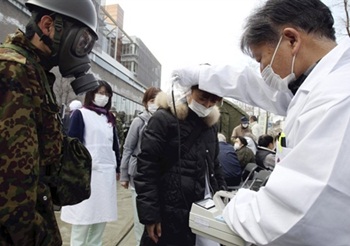
But Japan's nuclear safety agency said the number of people exposed to radiation from the Fukushima Daiichi plant could reach 160. Workers in protective clothing were scanning people arriving at evacuation centres for radioactive exposure.
Intense efforts were underway to eliminate the threat of widespread contamination.
"They are working on relieving pressure and pumping in water into the No 3 reactor," chief cabinet secretary Yukio Edano told a news briefing.
"This will result in some radiation leakage, although at a level that won't affect peoples' health. It wil help stabilise the situation."
Officials ordered the evacuation of a 20km radius zone around the plant and 10km around another nuclear facility close by. Around 140,000 people had left the area, the IAEA said, while authorities prepared to distribute iodine to protect people from radioactive exposure.
 "There is radiation leaking out, and since the possibility (of being exposed) is high, it's quite scary," said Masanori Ono, 17, standing in line yesterday to be scanned for radiation at an evacuation centre in Fukushima prefecture.
Helicopters from Japan's Self-Defence Forces lifted 195 people from retirement homes and hospitals inside the exclusion zone.
Before news of the problem with reactor No 3, the nuclear safety agency said the plant accident was less serious than both the Three Mile Island accident in 1979 and the 1986 Chernobyl nuclear disaster.
An official at the agency said it had rated the incident a 4 according to the International Nuclear and Radiological Event Scale (INES). Three Mile Island was rated 5 while Chernobyl was rated 7 on the 1 to 7 scale, the official said.
Devastated coastline
Along the northeast coast, rescue workers searched through the rubble of destroyed buildings, cars and boats, looking for survivors in hardest-hit areas such as the city of Sendai, 300 km northeast of Tokyo.
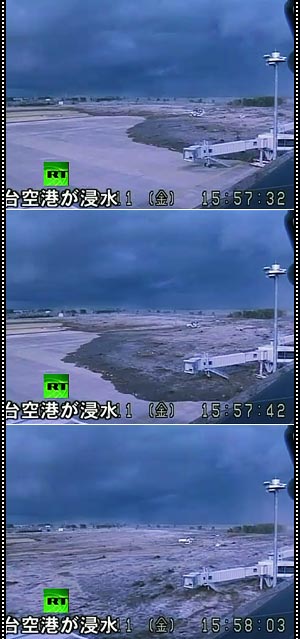
Aerial footage showed buildings, trains and even light aircraft strewn like children's toys after powerful walls of seawater swamped areas around Sendai.
In Iwanuma, not far from Sendai, nurses and doctors were rescued on Saturday after spelling S.O.S. on the rooftop of a partially submerged hospital, one of many desperate scenes. In cities and towns, worried relatives checked information boards on survivors at evacuation centres.
Dazed residents hoarded water and huddled in makeshift shelters in near-freezing temperatures.
"All the shops are closed, this is one of the few still open. I came to buy and stock up on diapers, drinking water and food," Kunio Iwatsuki, 68, told Reuters in Mito city, where residents queued outside a damaged supermarket for supplies.
 Japan's
Kyodo
news agency said about 300,000 people were evacuated nationwide, many seeking refuge in shelters, wrapped in blankets, some clutching each other sobbing.
Japan's
Kyodo
news agency said about 300,000 people were evacuated nationwide, many seeking refuge in shelters, wrapped in blankets, some clutching each other sobbing.
It said 5.5 million people were without power, while 3,400 buildings had been destroyed or damaged. Four trains were unaccounted for after the tsunami.
In Tokyo, the usually bustling central districts were deserted on Saturday night, and the few in bars and restaurants were glued to television coverage of the disaster.
"Even in the bar we kept staring at the news," said Kasumi, a 26-year-old woman meeting a friend for a drink in the central district of Akasaka. "I looked at the tsunami swallowing houses and it seemed like a film."
In the small port town of Minamisanriku alone, some 10,000 people were unaccounted for- more than half the population of the town, which was practically erased, NHK reported.
No repeat of Chernobyl, say experts
The blast at the nuclear plant raised fears of a meltdown at the power facility.
Experts had earlier said Japan should not expect a repeat of Chernobyl. They said pictures of mist above the plant suggested only small amounts of radiation had been expelled as part of
measures to ensure its stability, far from the radioactive clouds Chernobyl spewed out 25 years ago.
Plant operator Tepco has had a rocky past in an industry plagued by scandal. In 2002, the president of the country's largest power utility was forced to resign along with four other senior executives, taking responsibility for suspected falsification of nuclear plant safety records.
 Many Japanese flooded social networking sites with worries about the plant.
"I can't trust Tepco," said a person with the handlename Tanuki Atsushi on mixi, the Japanese social networking site.
Japan's biggest crisis since WW2
The earthquake and tsunami, and now the radiation leak, present Japan's government with its biggest challenge in a generation.
Prime Minister Naoto Kan said today he was confident that the nation could overcome the crisis caused by a massive earthquake and tsunami disaster, which he termed the biggest crisis Japan has faced since the end of World War Two.
The disaster struck as the world's third-largest economy had been showing signs of reviving from an economic contraction in the final quarter of last year. It raised the prospect of major disruptions for many key businesses and a massive repair bill running into tens of billions of dollars.
Foreign countries have started to send disaster relief teams to help Japan, with the United Nations sending a group to help coordinate work.
The earthquake was the fifth most powerful to hit the world in the past century. It surpassed the Great Kanto quake of Sept 1, 1923, which had a magnitude of 7.9 and killed more than
140,000 people in the Tokyo area.
State of emergency at Onagawa
Meanwhile Reuters reported this evening that the Japanese authorities have told the UN nuclear watchdog that the lowest state of emergency has been reported by the operator at the Onagawa nuclear power plant.
"The alert was declared as a consequence of radioactivity readings exceeding allowed levels in the area surrounding the plant.
"Japanese authorities are investigating the source of radiation," the International Atomic Energy Agency (IAEA) said in a statement.
Cooling pump stops at Kyodo plant
The cooling system pump has stopped at the Tokai No.2 nuclear power plant in Japan's Ibaraki prefecture, Kyodo news reported, in the wake of the massive earthquake that has crippled other reactors in the country.
The plant, located about 120 km north of Tokyo, had suffered a nuclear accident in 1999.
- Agencies


Are you sure you want to delete this comment?
This action cannot be undone.