




Activist urges Sabah to return all 'lost' NCR land
A leading land rights activist in Sabah, invoking a Federal Court ruling on Tuesday, has urged that the state government speedily return all native customary rights (NCR) land seized from their lawful owners “under one pretext or another”.
A leading land rights activist in Sabah, invoking a Federal Court ruling on Tuesday, has urged that the state government speedily return all native customary rights (NCR) land seized from their lawful owners “under one pretext or another”.
The “return”, he postulates, could also be in the form of equivalent state land or monetary compensation “if the rightful land owners agree”.
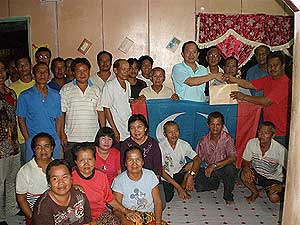 “The courts are now clear on the
status of NCR land
as decided by the Federal Court on Tuesday,” said senior lawyer Kong Hong Ming (
in light blue shirt, centre in picture
) who works
pro bono
on NCR cases. “The state government can also refer to the other landmark judgments on NCR cases in Sabah and Sarawak.”
“The courts are now clear on the
status of NCR land
as decided by the Federal Court on Tuesday,” said senior lawyer Kong Hong Ming (
in light blue shirt, centre in picture
) who works
pro bono
on NCR cases. “The state government can also refer to the other landmark judgments on NCR cases in Sabah and Sarawak.”
He was commenting on Wednesday night on the Federal Court decision on Tuesday to deny application for leave to a businessman, Ruddy Awah, to appeal against lower court decisions favouring Rambilin Ambit, 54, over the ownership of a 15-acre piece of land in Pitas, northern Sabah.
Chief Justice Zaki Azmi, the Chief Judge of Sabah and Sarawak Richard Malanjum and Federal Court Judge Mohd Raus Sharif unanimously dismissed the application for leave by Ruddy Awah to contest the judgments of the Court of Appeal and the High Court.
Kong, who also heads the Land Development and Management Committee in the Sabah PKR presidential council, pleaded that “the natives not be dragged to court any longer on a case by case basis”. In reality, Kong noted, very few natives can be like Rambilin who sustained an unprecedented legal battle all the way from the Pitas Land Office to the Federal Court for over 15 years from 1996 to 2011.
‘No longer any justification to delay’
There’s no longer any justification to delay redressing the grievances of those who have lost their NCR to the state government, state agencies, GLCs, private companies and individuals, he added. “Almost all the lands lost have been for private gain and not public purposes.”
He attributes the loss of NCR land as due to land grabs and either inaction or the lack of knowledge on NCR issues at the administrative level in the Land and Surveys Department (LSD).
Rambilin in deciding on the finality of issues, according to Kong, among others upheld three principles in the recognition of NCR land “and this should be good enough for the state government”.
First, that NCR, being a pre-existing right before any land legislation, exists until today; second, that Rambilin, being a native of Sabah, is not required to seek the permission of the authorities before entering state land to establish NCR claims; and third, NCR prevails in common law as the state’s interest or rights in land is subject to any native rights over land.
“The Rambilin case renews focus on the predicament of the natives who have been and continue to be deprived of their customary rights in land,” said Kong. “It remains to be seen whether the state government will settle all land cases which can use Rambilin as a binding precedent.”
One critical issue seen by Kong is whether the land administrators at the LSD, and others holding public office, “truly understand and are competent enough to determine NCR land held by natives”. Hence, this means that the LSD should have a proper mechanism to give effect to such rights without causing further deprivation and injustice when it comes to property rights.
If so, he continued, the natives would not be forced to resort to the courts to seek relief.
He suggested that the state government carry out a full settlement exercise, as evident in the Rambilin judgment, to determine and return all NCR land to the native communities. The settlement exercise, he said, was also in line with the status of the state government as the custodian and trustee having the fiduciary duty in the well-being of the natives of Sabah.
However, he does not see the return of lost lands as automatically happening “unless the natives bring pressure to bear on their legislators”. He fears that Barisan Nasional component parties in Sabah may have been rendered irrelevant by the presence Umno in the state government.
Kong suspects that some legislators may also have been in cahoots with the land grabbers to deprive the natives of their NCR claims. He surmises this from the inaction and indifference of these legislators in the face of rampant land grabs which “creates deprivation, insecurity and uncertainty among the natives and denies them justice”.
‘Paying lip service would no longer do’
The Sabah PKR activist warns that any state government efforts towards alleviating poverty among the natives will be an exercise in futility if fundamental basic property rights issues are not resolved and the right to life issue respected.
“Paying lip service would no longer do,” said Kong. “Actions speak louder than words.”
Justice Ian Chin, in allowing Rambilin’s suit on July 9, 2007 declared that she was entitled to possession of the land in Kampung Gailun Salimpodon, Pitas and ordered Ruddy or his servants or agents to vacate the land and deliver it to her.
He also ordered Ruddy to pay Rambilin mense profit at the rate of RM500 per month from Dec 1, 1996 until possession of the land is delivered to Rambilin as well as pay her special damages of RM66, 500 and statutory interest at 8 percent per annum from Dec 31, 1996 until the date of judgment.
Apart from that, Justice Chin also ordered Ruddy to pay mense profit of RM10,000 being exemplary and aggravated damages, saying this was justified by the fraudulent scheme, with costs to Rambilin.
Rambilin, according to her affidavit-in-support, claimed that bought the two pieces of land totaling 15 acres in the said village in 1982 from one Sharif Osman Sharif Murah and Sharif Endun Sharif Ading. She and her husband cleared the land and built a house as well as planted coconut trees and fruit trees.
Rambilin did not stay continuously on the land as she had to follow her husband who was a government servant on his postings.
During her absence, Ruddy entered and took possession of the said land.
Related Stories
Sabah's NCR guidelines 'illegal', warns activist
Sabah BN 'neglecting' NCR issues


Are you sure you want to delete this comment?
This action cannot be undone.