




'Best solution to NCR issue is gov't change'
Sarawak natives may have won a landmark case in 2009 at the Federal Court to protect their natives customary land rights (NCR), but activist lawyer-turned politician Baru Bian concluded that the fastest way to resolve the long simmering issue is a complete change of government.
Sarawak natives may have won a landmark case in 2009 at the Federal Court to protect their natives customary land rights (NCR), but activist lawyer-turned politician Baru Bian concluded that the fastest way to resolve the long simmering issue is a complete change of government.
Currently handling over 100 cases of NCR land disputes, the Sarawak PKR chief believed that the core problem lay with the Sarawak government that has consistently defied court rulings and continued to grant land concessions to private companies that encroached into NCR lands.
 "We can take the case to court but it takes years to reach a final decision. By that time the land would have been harvested and money pocketed," Baru told some 40 people who turned up for the 'The Tarik Session with Baru Bian' organised by news portal
Malaysia Digest
in Kuala Lumpur yesterday.
"We can take the case to court but it takes years to reach a final decision. By that time the land would have been harvested and money pocketed," Baru told some 40 people who turned up for the 'The Tarik Session with Baru Bian' organised by news portal
Malaysia Digest
in Kuala Lumpur yesterday.
Thus the fastest way to put a stop to it is to change the state or federal government through the ballot box, he said.
"Although we failed at the state election but we still can win the federal government in the next general election," said the newly elected Ba'Kelalan state assemblyperson.
The landmark case of Nor ak Nyawai vs Borneo Pulp Plantation Sdn Bhd in which the High Court recognised NCR land, had started as early as 1999 but it was only in 2009 that the nation's highest court reaffirmed the decision.
Baru reiterated the Pakatan Rakyat election manifesto that an independent land commission would be formed to study and find a solution for NCR land disputes should the opposition coalition take office.
Gov’t fanning fire with policy
He warned that more violent clashes over NCR land disputes will occur because the state government had shown no sign of stopping its trouble instigating practice.
"This is dangerous for Sarawak's future if nothing is done."
Discussing the outcome of the recently concluded Sarawak state election, Baru said the party had learnt its lesson that early preparation is crucial to win in polls, especially the early selection of candidate.
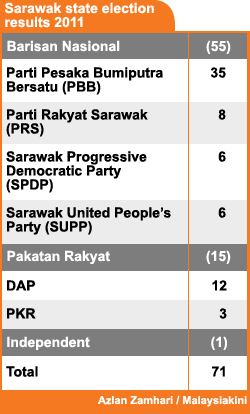 PKR managed to grab three out of the 71 seats in the election, including two native-majority seats of Ba'kelalan and Krian, which were formerly BN bastions. Political observers had attributed the victory to early preparation and pre-selection of candidates.
Baru conceded that the groundwork in other constituencies started late, delayed by the party’s internal problems and the existence of more than one potential candidate in those areas.
Hence, he said, the party will try to replicate Ba'kelalan and Krian’s success formula in the next general election, through early selection of candidates who will immediately be put to work on the ground.
"The fear of announcing the candidates early is that they could be bought over (by the rival) but we can identify the candidates first without announcing them," he told Malaysiakini after the event.
Setback blessing in disguise
Baru added that the state election had eased the parliamentary candidate selection process.
"We can gauge their performance and experience in the last state election, whether we can trust them or not."
On DAP parliamentary leader Lim Kit Siang’s proposal to merge Sarawak DAP with Snap on the grounds that it could strengthen Sarawak Pakatan, Baru remained doubtful, pointing out that the polls result showed that Sarawakians had turned their backs on Snap.
All 26 Snap candidates, except one, had lost their deposit in the election, failing to obtain one eighth of the total votes cast.
 However, Baru said that the proposal is understandable as DAP wants to widen its perspective after being tagged a Chinese chauvinist party when it snared almost all the Chinese-majority seats during the polls.
"DAP only worked in Chinese constituencies and only focused on Supp in the past 40 years. So now it is restricted to Chinese seats. Although it had tried to expand to non-Chinese areas like Bukit Kota, it failed," he added.
Hence he repeated the *party's invitation* for DAP to help PKR to cover more non-Chinese areas in the coming general election.
"We were not greedy (to contest 49 out of 71 seats) but we wanted to make sure no seat would be won uncontested by the BN."
Earlier, PKR strategy director Rafizi Ramli had called on Pakatan partners to share the 'burden' of contesting in Sarawak’s ‘black' constituencies, but none were willing to fight for in the last state election.
This had overstretched the PKR’s resources during the campaign period, he said.


Are you sure you want to delete this comment?
This action cannot be undone.