




Reclaim mainstream media, CIJ urges M'sians
The Centre for Independent Journalism has urged all Malaysians to speak up and “reclaim the mainstream media”.
The Centre for Independent Journalism has urged all Malaysians to speak up and “reclaim the mainstream media”.
“The Sarawak elections saw the opposition gaining 45 percent of the popular vote. This should empower Malaysians to make their demands heard especially since a snap general election is expected this year,” it said in a statement to mark World Press Freedom Day.
Executive officer Masjaliza Hamzah said the people should demand media plurality, so that they will have access to a variety of sources of information. In this way, too, they can choose the media that practises ethical reporting.
“It is time for the p
 eople to reclaim the mainstream media and help them restore the dignity and respect they once commanded, which will also ensure that journalists are able to do their job - safely, unhindered and ethically.”
She also reiterated a call for a parliamentary caucus to be created to promote freedom of expression.
This, it said, should conduct an extensive review of laws that curb press freedom and the fundamental right to freedom of expression in Malaysia.
Masjaliza said although this year's theme is ‘21st century media: New frontiers, new barriers’, the old barriers still loom large in Malaysia, especially repressive laws like the Printing Presses and Publications Act 1984 (PPPA).
 “Now (laws) are being considered for new media,” she pointed out.
“Home Minister Hishammuddin Hussein’s (left) statement that discussions are still at the early stages is hardly reassuring given the federal government's record of amending laws without public consultation with all stakeholder groups, and which usually ends with increased executive power.
Masjaliza said the PPPA is an example of this. A clause requiring serial publications to be licensed was amended to remove any prospect of judicial challenge, giving the minister the final and absolute say in related matters.
The PPPA not only chains newspapers that are already controlled by parties in power, through direct or indirect ownership, but it also controls opposition party organs, whose applications for renewal of the annual permit are constantly delayed, she said.
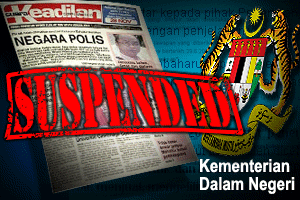 Citing
Suara Keadilan
, the monthly organ of Parti Keadilan Rakyat as an example, she pointed out that it has not received its permit since this expired on June 30, 2010. As such, it has had to resort to creatively changing its name every month, so as not to violate the law.
Citing
Suara Keadilan
, the monthly organ of Parti Keadilan Rakyat as an example, she pointed out that it has not received its permit since this expired on June 30, 2010. As such, it has had to resort to creatively changing its name every month, so as not to violate the law.
“The consequences of the PPPA over the years have been dire. Mainstream press editors who have been held 'hostage' by the law now accept the executive-‘assigned’ position of the press as publicist - or worse, propaganda arm - of the federal government.
“The newspapers report as a matter of fact the executive's intentions and initiatives, such as the Government Transformation Programme updates and first year report, as well as the New Key Results Area...
“What’s more, top editors can be held 'responsible' for coverage of a crucial issue resulting in an unfavourable outcome to the authorities, as The Star faced (over) the Al Kitab coverage.”
Hostile environment
Masjaliza said this creates a hostile environment for press freedom, as it makes it difficult for conscientious journalists to practise ethics in their daily work.
It increases the prevalence of self-censorship, resulting in important issues of public interest being suppressed and executive powers going dangerously unchecked.
Journalists, Masjaliza said can barely make an unequivocal stand for press freedom and are silenced.
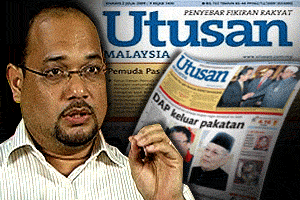 She also referred to the sacking of National Union Journalist president Mohamed Ha'ta Wahari, for daring to criticise editors of the Umno-owned
Utusan Malaysia
, where he worked.
She also referred to the sacking of National Union Journalist president Mohamed Ha'ta Wahari, for daring to criticise editors of the Umno-owned
Utusan Malaysia
, where he worked.
The Malay daily is also the subject of several defamation lawsuits by opposition members, following its divisive positions on religion and ethnicity.
“This resulted in MCA to even call for a boycott (of Utusan ),” she noted.
Another threat looms with the government proposal for a media consultative council to be set up.
“Although it seems an ideal solution to addressing unethical reporting in a free environment - and may even be welcomed after the recent lows descended to by some mainstream media in a politically motivated attempt to implicate Opposition Leader Anwar Ibrahim in yet another sex scandal - a media council would essentially act as another level of control (by the executive),” she added.
According to a Freedom House survey released today, Malaysia has slipped to 143 among 196 countries in terms of press freedom.


Are you sure you want to delete this comment?
This action cannot be undone.