




Submit views on NCR, state gov'ts told
The Human Rights Commission (Suhakam) has urged state governments to state their position on the issue of native customary rights (NCR) to land.
The Human Rights Commission (Suhakam) has urged state governments to state their position on the issue of native customary rights (NCR) to land.
Such views should be submitted when Suhakam holds its national inquiry into indigenous peoples' land rights.
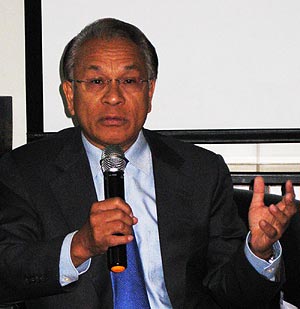 "It is important for state governments to engage us. (Otherwise), we will come out with a lopsided report,” cautioned Suhakam chairperson Hasmy Agam at a press conference in Kuala Lumpur today.
“At (very) least, they should make a submission, put (down) their position on the issue and send their representatives to respond to allegations. Like it or not, they have to be present."
Suhakam’s decision to hold the inquiry is based on complaints and memoranda submitted over the years, on alleged infringement of the rights of the indigenous peoples to their customary land.
Although state governments, especially those of Sabah and Sarawak, are often accused of turning a blind eye to encroachment by private companies - and even colluding with them - Hasmy remained optimistic that they will cooperate fully.
"None (of them) have indicated reluctance. Sometimes it is because of resources," he said in reply to a question as to whether state governments are reluctant to cooperate with the commission.
Suhakam vice-chairperson Khaw Lake Tee, who had met the Sarawak state secretary and state attorney-general recently, said they were prepared to assist the inquiry.
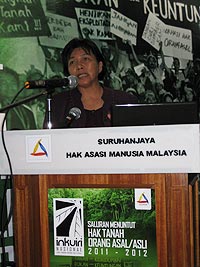 “The response was very positive and encouraging. The problem is timing,” she told
Malaysiakini
after the press conference.
“The response was very positive and encouraging. The problem is timing,” she told
Malaysiakini
after the press conference.
Among the 1,098 native land complaints received by Suhakam between 2002 to 2011, Sabah tops the list with 824 complaints followed by Sarawak (229) and the peninsula (45).
One hundred and fourteen out of the 229 complaints from Sarawak are related to encroachment.
Another commissioner, Jannie Lasimbang ( right ), commented that the complaints received were just the tip of the iceberg.
‘Review land laws and policies’
The national inquiry, comprised of both consultation and public hearing, is empowered by the Human Rights Commission of Malaysia Act 1999. It is a nationwide and time-consuming mechanism to look into systemic human rights issues with a view to solving it through effective means.
“It will examine the root causes of the problems relating to NCR land in a comprehensive manner from a human rights perspective and will recommend appropriate solutions to the problems,” said Hasmy.
The terms of reference of the national inquiry are:
- To determine the constitutional, legal, administrative and political recognition of the indigenous peoples’ right to land and their effectiveness in protecting and promoting the indigenous peoples’ right to land.
- To inquire into the land rights situation of the indigenous peoples and the impact of the recognition or non-recognition of the indigenous peoples’ right to land on their social, economic, cultural and political rights, taking into consideration relevant international and domestic laws.
- To identify the constraints which impede the enjoyment of the indigenous peoples’ right to land.
- To create and promote more awareness, knowledge and understanding of the indigenous peoples’ right to land and their way of life.
- To develop recommendations to the federal and state government, where appropriate, on the following:
a. To review land laws and policies, to make them more human rights compliant, including their implementation, taking into consideration past and present problems faced by the indigenous peoples; and
b. To formulate strategies and plan of action to facilitate the realisation of the indigenous peoples’ right to land as an integral part of human rights.
The panel of inquiry will comprise Suhakam commissioners which will be assisted by a line of independent consultants including former commissioners Simon Sipaun, Ranita Mohd Husein, Denison Jayasooria, and indigenous rights activist Colin Nicholas as well as Bar Council human rights committee chairperson Andrew Khoo.
The consultations with various stakeholders including government agencies, private companies and NGOs will begin in June and will be followed by public hearings from November this year to January 2012 in the peninsula, Sabah and Sarawak.
The final report will be published in June 2012 and the commission will follow up its recommendations in the report with relevant authorities starting from July 2012.
The commission has the power to subpoena anyone to assist in the inquiry or testify in the public hearing, which is open to members of the public and the press.
The panel also welcomed public submissions on the issue which should reach the secretariat of the national inquiry at the latest by Nov 30 this year.
Suhakam has set up a separate website for the national inquiry.


Are you sure you want to delete this comment?
This action cannot be undone.